


When a broken bone is fixed with plates and screws, surgeons expect metal hardware to hold the fracture steady while the body heals. But sometimes the same hardware becomes a hiding place for bacteria. Fracture-related infection, or FRI, is one of the most feared complications of fracture surgery, and one of the hardest to diagnose. Microbes settle onto implant surfaces and encase themselves in a slimy biofilm, a protective matrix that shields them from both the immune system and laboratory detection. A new study from University Hospital Giessen in Germany now offers a careful, numbers-driven answer to a question trauma surgeons have debated for years: is it better to culture tissue from around the implant, or to bathe the removed hardware in sound waves and culture what shakes loose? The answer, it turns out, is that neither method is enough on its own.
The research, led by Belal Abdo and Markus Rupp of the Department of Trauma, Hand and Reconstructive Surgery together with microbiologists at Justus Liebig University Giessen, was published in the Journal of Bone and Joint Infection. The team conducted a retrospective single-center study covering the years 2016 to 2023, screening 287 cases in which explanted osteosynthesis material had been analyzed by sonication. After applying strict inclusion criteria, 157 patients remained in the final analysis. Every included patient had undergone implant removal because of confirmed or suspected fracture-related infection, and every case had results from both peri-implant tissue culture and sonication fluid culture, allowing a direct, paired comparison of the two techniques in the same patients.
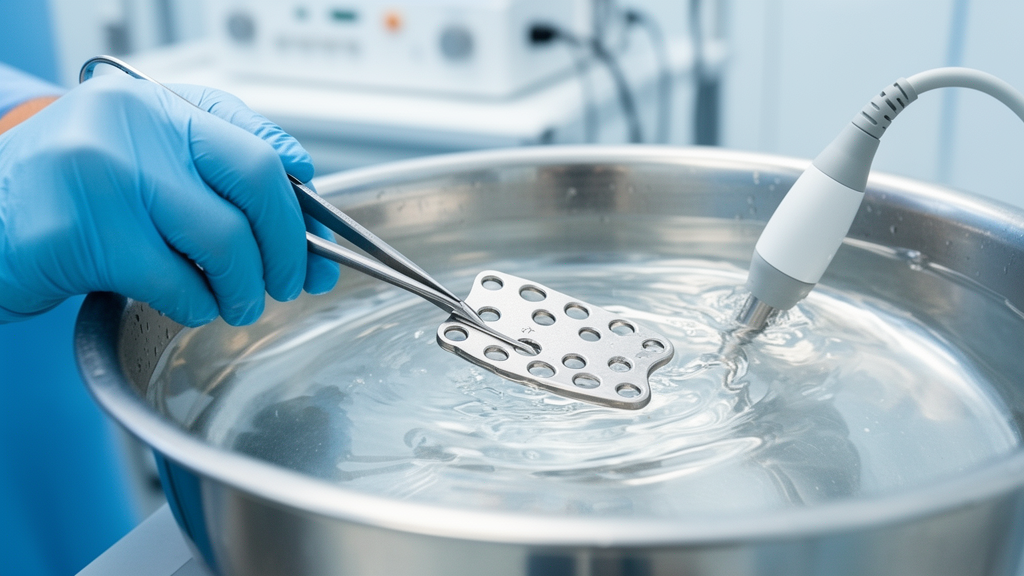
The technical logic behind the comparison is straightforward. Peri-implant tissue culture, the current standard, relies on surgeons taking small samples of tissue from immediately around the hardware during revision surgery. These samples are processed in the microbiology laboratory and incubated to see what grows. The weakness of this approach is that biofilm bacteria concentrate on the implant surface itself, not necessarily in the surrounding tissue, and prior antibiotic treatment can suppress growth in culture. False-negative microbiological results occur in up to 35 percent of cases despite clinically manifest infection, according to previous research cited by the authors. Sonication takes a different route: the removed implant is placed in a sterile container filled with 0.85 percent sodium chloride solution and exposed to ultrasound for one minute at 80 percent intensity. The sound waves dislodge biofilm organisms from the metal surface into the fluid, which is then centrifuged, concentrated, and inoculated into a panel of liquid and solid culture media, including aerobic, anaerobic, and fungal media, all incubated for up to 14 days.
The head-to-head results were strikingly balanced. Peri-implant tissue culture detected pathogens in 60.5 percent of the 157 cases, while sonication fluid culture achieved 57.3 percent. Statistically, the difference between the two methods was not significant, a finding confirmed by McNemar’s test for paired binary outcomes. Yet the overlap between the methods was far from complete. Sonication identified additional pathogens that tissue culture had missed in 17.8 percent of cases, while tissue culture uniquely detected organisms in 22.9 percent of cases. When the results of both methods were combined, the overall pathogen detection rate climbed to 70.1 percent. In other words, roughly one in ten additional infections were unmasked simply by running both tests rather than relying on either one alone.
The pathogen spectrum revealed by the two methods overlapped substantially, with methicillin-sensitive Staphylococcus aureus and coagulase-negative staphylococci predominating in both. Most positive cultures were monomicrobial, though polymicrobial growth was observed in 14.4 percent of sonication-positive cases and 21.1 percent of tissue-culture-positive cases, a numerical difference that did not reach statistical significance. Resistant organisms were rare but clinically important: methicillin-resistant Staphylococcus aureus appeared in four cases with each method, and one multidrug-resistant Enterobacterales strain was detected by each approach. The predominance of plate osteosynthesis systems, which accounted for 61.1 percent of removed implants, and screws at 18.5 percent, reflected the typical hardware profile of a trauma center population. The mean patient age was 57.4 years, and late infections occurring more than ten weeks after surgery were the most common presentation at 42.7 percent of cases.
One of the most clinically pressing questions the study addressed was whether prior antibiotic therapy undermines either diagnostic method. At the time of implant removal, 51 of the 157 patients were on ongoing antibiotic treatment or had received antibiotics within the previous 14 days, excluding routine perioperative prophylaxis. The concern is well founded: antibiotics circulating in tissue can suppress bacterial growth in culture, potentially producing misleading negative results. In this cohort, however, ongoing antibiotic therapy was not associated with a statistically significant difference in pathogen detection between the two methods. Tissue culture did show a numerically higher diagnostic yield than sonication among patients receiving antibiotics, but the authors caution that this observation should be interpreted carefully given the limited subgroup size. The finding contrasts with some earlier studies, including work by Dudareva and colleagues, who reported that both methods lost sensitivity after antibiotic exposure, and with the landmark 2007 study by Trampuz and colleagues, which found sonication particularly valuable after prior antibiotics in prosthetic joint infection.
The therapeutic consequences of the microbiological findings may be the most consequential part of the analysis. Antibiotic therapy was actually modified after revision surgery in 47.8 percent of cases. Most of these modifications, 38.9 percent of the entire cohort, were based on concordant findings from both diagnostic methods working together. Only 4.5 percent of patients had their treatment changed exclusively because of sonication results, and an identical 4.5 percent solely because of conventional culture findings. When the researchers asked a slightly different question, namely in how many cases a therapy modification would have been possible on microbiological grounds, the combined findings supported potential adjustment in 93 cases, with 8.3 percent attributable exclusively to sonication and 7.6 percent exclusively to tissue culture. The pattern is clear: the clinical value of each method lies less in replacing the other than in adding pieces to a diagnostic puzzle that neither can complete alone.
These results place fracture-related infection diagnostics in useful context. Sonication has long been an established component of the diagnostic algorithm for periprosthetic joint infection, where multiple studies have shown higher sensitivity than conventional tissue cultures, with reported sonication sensitivities ranging from roughly 52 to 100 percent depending on population and technique. For fracture-related infection, however, the evidence has been more contested. A 2018 systematic review by Onsea and colleagues concluded that sonication fluid culture may serve as a useful adjunct to tissue culture without strong evidence of superiority, and subsequent studies have split on which method performs better. The Giessen data align with the complementary view. Trenkwalder and colleagues similarly reported in 2023 that in septic and aseptic nonunion, sonication fluid culture showed lower sensitivity than tissue culture but higher sensitivity than histopathology, supporting a multimodal approach.
The study is honest about its limitations, and they matter for interpretation. Nearly half of the potentially eligible cases, 130 of 287, were excluded, mostly because they did not meet FRI criteria or because documentation was incomplete during a transition to a new hospital data system, so selection bias cannot be excluded. The retrospective design meant the exact number of intraoperative tissue samples could not always be verified, and because microbiological culture is itself part of the FRI Consensus Definition used as the reference standard, some incorporation bias is unavoidable. The single-center design also limits generalizability. Even so, the central conclusion stands on firm ground: nearly 30 percent of clinically confirmed infections remained culture negative even with both methods combined, underscoring that microbiology must be interpreted within the broader FRI diagnostic framework, which integrates clinical signs, intraoperative findings, histopathology, and culture results.
For surgeons and infectious disease specialists, the practical message is refreshingly concrete. When hardware comes out because of suspected infection, send the implant for sonication and take peri-implant tissue samples, and treat the two results as complementary rather than competing. The combined approach improved pathogen detection irrespective of prior antibiotic exposure, supported targeted antimicrobial management in nearly half of patients, and cost relatively little beyond standard laboratory processing. In an era when biofilm-embedded bacteria routinely defeat single diagnostic tests, the humble strategy of shaking the metal and swabbing the tissue, then reading both answers together, may be the most reliable tool clinicians have for turning invisible infections into treatable ones.
Subject of Research: Diagnostic comparison of implant sonication and peri-implant tissue culture for detecting fracture-related infection
Article Title: Sonication versus peri-implant tissue culture in fracture-related infection: diagnostic performance and therapeutic consequences in a single-center cohort
Article References: Abdo, B., Strack, D., Schäuffele, M., Tüngler, T. L., Imirzalioglu, C., Windhorst, A., Fritzenwanker, M., Heiss, C., & Rupp, M. (2026). Sonication versus peri-implant tissue culture in fracture-related infection: diagnostic performance and therapeutic consequences in a single-center cohort. Journal of Bone and Joint Infection, 11(4), 555-563. https://doi.org/10.5194/jbji-11-555-2026
Image Credits: AI Generated
Keywords: fracture-related infection, sonication, biofilm, peri-implant tissue culture, osteosynthesis, diagnostic sensitivity, antibiotic therapy, orthopedic surgery, implant infection, microbiology, trauma surgery, pathogen detection
Cite Scienmag News
Ophelia Keating. (October 8, 2026). Shaking Loose Hidden Bacteria: Implant Sonication Boosts Detection of Bone Infections. Scienmag. https://scienmag.com/shaking-loose-hidden-bacteria-implant-sonication-boosts-detection-of-bone-infections/
Ophelia Keating. "Shaking Loose Hidden Bacteria: Implant Sonication Boosts Detection of Bone Infections." Scienmag, 8 October 2026, https://scienmag.com/shaking-loose-hidden-bacteria-implant-sonication-boosts-detection-of-bone-infections/. Accessed 8 October 2026.
Ophelia Keating. "Shaking Loose Hidden Bacteria: Implant Sonication Boosts Detection of Bone Infections." Scienmag. October 8, 2026. https://scienmag.com/shaking-loose-hidden-bacteria-implant-sonication-boosts-detection-of-bone-infections/


