


Weeds are among the most persistent threats to global agriculture, stealing water, nutrients, and sunlight from crops while demanding enormous labor and chemical inputs to control. The stakes of getting weed management right are enormous: misidentify a weed at a critical growth stage, and a farmer may apply the wrong herbicide, miss the optimal window for mechanical control, or allow an invasive species to gain a foothold in a field. Yet identifying weeds accurately is surprisingly difficult, even for trained eyes. Many species look nearly identical to one another, and the same plant can change dramatically in appearance between seedling, vegetative, flowering, and senescent stages. A new study published in Nature Communications presents an artificial intelligence system designed to tackle exactly this challenge at a planetary scale.
The system, called WeedNet, was developed by a large interdisciplinary team led by Yanben Shen and Timilehin T. Ayanlade, with corresponding authors Soumik Sarkar and Arti Singh, bringing together researchers at Iowa State University and the University of Arizona. Their goal was ambitious: build a single AI model capable of recognizing an extensive set of weed species from around the world, and then adapt that global knowledge to the specific weed communities of individual regions. The work addresses a bottleneck that has long frustrated agricultural AI. Computer vision models need vast amounts of expert-verified training data, but curated, labeled images of weeds are scarce, expensive to produce, and highly variable in quality. Morphological similarity between species compounds the problem, causing even sophisticated deep learning systems to confuse close relatives.
Technically, WeedNet is an end-to-end identification pipeline built on a foundation model architecture, the same class of large, general-purpose neural networks that has transformed fields from language processing to medical imaging. Rather than training from scratch on limited weed photographs, the researchers employed self-supervised learning, a technique in which the model learns visual representations from unlabeled imagery by solving pretext tasks, such as predicting hidden portions of images or distinguishing between different views of the same plant. This pretraining allows the network to internalize the general statistical structure of plant imagery, capturing features like leaf venation, stem architecture, inflorescence shape, and texture, before it is ever asked to make a species-level judgment. Fine-tuning on labeled weed data then specializes these general representations for the taxonomy at hand.
The reported performance is striking. Across 1,593 weed species, WeedNet achieved 91.02 percent overall identification accuracy. Even more remarkable, 41 percent of the species in the evaluation were identified with perfect accuracy, meaning the model correctly classified every test image for those taxa. For a task where many species differ only subtly, in the hairiness of a leaf margin or the arrangement of florets, this level of performance suggests the foundation model approach captures discriminative features that earlier, smaller-scale systems missed. The team then demonstrated the second half of their global-to-local strategy by fine-tuning the model for a specific region. The resulting local Iowa WeedNet model reached 97.38 percent overall accuracy across 84 weed species relevant to Iowa agriculture, a substantial gain over the global model and a demonstration that regional adaptation is both feasible and effective.
One of the most scientifically valuable contributions of the study is its analysis of what drives performance. The researchers systematically tested the model under conditions of intra-species dissimilarity, where images of the same species look very different from one another, and inter-species similarity, where images of different species look nearly alike. These are precisely the failure modes that plague weed identification. Their findings indicate that diversity in the collected images, spanning all growth stages and the distinguishable plant characteristics that experts actually use in the field, is crucial to model performance. In other words, the model is only as good as the ecological breadth of its training data. A dataset heavy on flowering specimens will fail on seedlings; a dataset from one continent will stumble on weeds photographed under different lighting, soils, and backgrounds elsewhere.
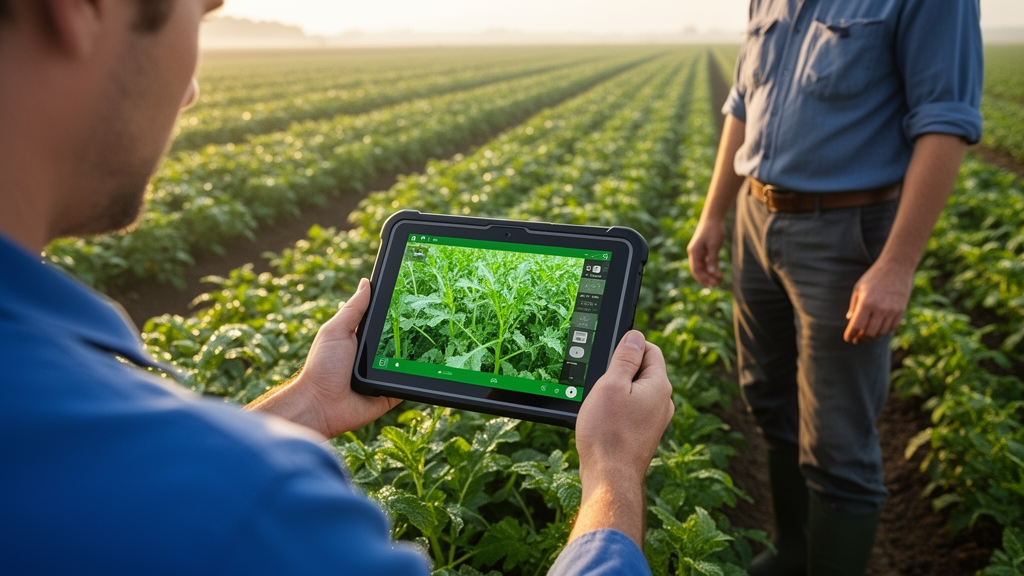
The implications for precision agriculture are considerable. Modern weed control increasingly relies on targeted interventions: spot spraying, mechanical hoeing, and laser weeding systems that act on individual plants rather than blanketing entire fields with herbicide. All of these depend on fast, reliable in-field species identification. To test whether WeedNet could serve as the perceptual brain of such machinery, the team validated the model on images captured by drones and ground rovers, platforms that introduce motion blur, unusual viewing angles, variable illumination, and occlusion by crop canopy. The successful performance on these imagery sources highlights the model’s potential for integration into robotic platforms, moving it from a laboratory benchmark toward a working component of autonomous field equipment.
Beyond robotics, the researchers explored a conversational dimension. By integrating WeedNet with artificial intelligence systems capable of natural language interaction, they created intelligent consulting tools that can serve farmers, researchers, and government agencies. A farmer could photograph an unfamiliar plant and receive not just a species name but contextual guidance relevant to that identification, while an ecological conservation agency could use the same underlying model to monitor invasive weed spread across diverse landscapes. This fusion of visual identification with conversational AI reflects a broader trend in agricultural technology, where standalone perception models are becoming front ends to richer decision-support systems that translate a classification into actionable management advice.
The global-to-local design also carries lessons for how foundation models should be deployed in domain sciences generally. A single monolithic model trained on globally averaged data will inevitably be mediocre everywhere, because weed floras differ radically between regions, and local species that dominate Midwestern cornfields may be absent from Asian rice paddies and vice versa. WeedNet’s architecture treats the global model as a shared foundation, a reservoir of general plant visual knowledge, from which targeted regional models can be efficiently derived through fine-tuning. This mirrors strategies now standard in natural language processing, where large pretrained models are adapted to specialized vocabularies and tasks, and suggests a template for other biodiversity applications, from crop disease diagnosis to pollinator monitoring, where global data exists but local expertise is the scarce resource.
The scale of the collaboration itself is noteworthy. The author team spans agronomy, mechanical engineering, computer science, plant pathology, and a data science institute, reflecting the reality that modern agricultural AI cannot be built by any single discipline. Agronomists supplied the taxonomic and phenological expertise needed to curate and verify species labels; machine learning researchers designed the self-supervised and fine-tuning pipelines; and roboticists and extension specialists grounded the work in the practical constraints of fields and farms. The project received support from the U.S. National Science Foundation and the U.S. Department of Agriculture, including the AI Institute for Resilient Agriculture, and drew on iNaturalist as a data source, underscoring how citizen-science platforms are becoming indispensable infrastructure for biodiversity AI.
Challenges remain before systems like WeedNet become ubiquitous in the world’s fields. Model accuracy, however high, is not perfect, and the consequences of a wrong identification, an unnecessary herbicide application or a missed invasive incursion, mean that trustworthiness strategies and uncertainty communication will need to accompany any deployment. The authors emphasize enhanced trustworthiness as a core component of their pipeline, an acknowledgment that agricultural users need to know when a model is confident and when it should defer to human expertise. Continued expansion of training data, particularly for underrepresented regions, growth stages, and rare species, will further improve robustness. Still, the trajectory is clear. A model that can identify more than 1,500 weed species with over 91 percent accuracy, adapt to local floras with near-perfect regional performance, and run on drones and rovers represents a genuine step change in how the oldest of agricultural chores, knowing your enemy, can be automated for the sustainable farms of the coming decade.
Subject of Research: AI-based global weed species identification and classification using foundation models
Article Title: WeedNet: a foundation model-based global-to-local AI approach for weed species identification and classification
Article References: Shen, Y., Ayanlade, T. T., Boddepalli, V. N., Saadati, M., Rairdin, A., Deng, Z. K., Arshad, M. A., Chiranjeevi, S., Balu, A., Mueller, D., Singh, A. K., Everman, W., Merchant, N., Ganapathysubramanian, B., Anderson, M., Sarkar, S., & Singh, A. (2026). WeedNet: a foundation model-based global-to-local AI approach for weed species identification and classification. Nature Communications. https://doi.org/10.1038/s41467-026-78044-4
Image Credits: AI Generated
DOI: 10.1038/s41467-026-78044-4
Keywords: WeedNet, weed identification, foundation model, self-supervised learning, precision agriculture, computer vision, fine-tuning, Iowa State University, agricultural robotics, invasive species, Nature Communications, machine learning
Cite Scienmag News
Blake Davidson. (October 8, 2026). Global AI Model WeedNet Identifies 1,593 Weed Species With Record Accuracy. Scienmag. https://scienmag.com/global-ai-model-weednet-identifies-1593-weed-species-with-record-accuracy/
Blake Davidson. "Global AI Model WeedNet Identifies 1,593 Weed Species With Record Accuracy." Scienmag, 8 October 2026, https://scienmag.com/global-ai-model-weednet-identifies-1593-weed-species-with-record-accuracy/. Accessed 8 October 2026.
Blake Davidson. "Global AI Model WeedNet Identifies 1,593 Weed Species With Record Accuracy." Scienmag. October 8, 2026. https://scienmag.com/global-ai-model-weednet-identifies-1593-weed-species-with-record-accuracy/


