


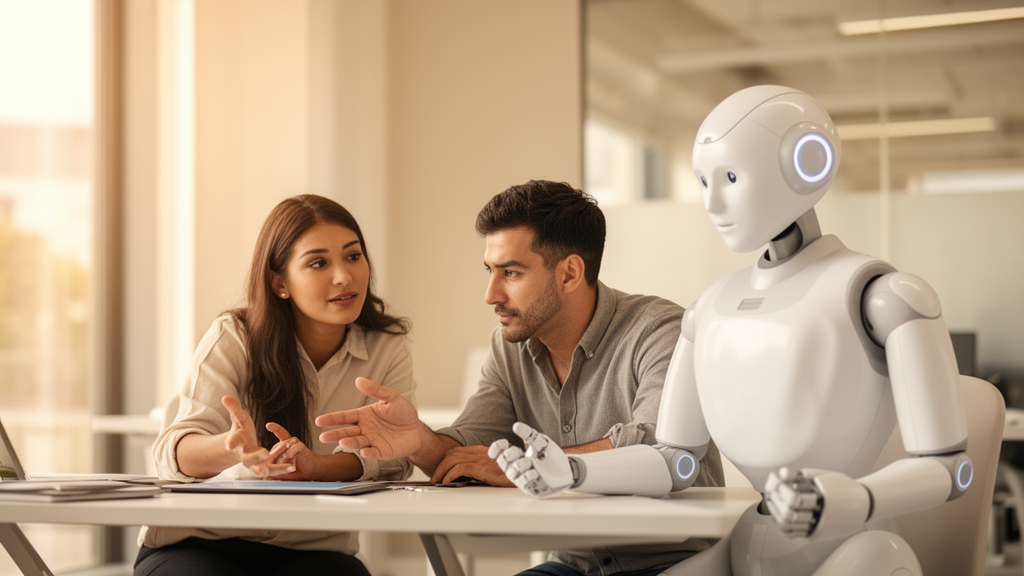
For years, companies have been told that artificial intelligence will transform productivity, yet the results of deploying AI in the workplace have been strikingly uneven. Some workers report dramatic gains, while others find the same tools frustrating or even counterproductive. A new study published in the Proceedings of the National Academy of Sciences offers the first large-scale, randomized controlled evidence for why that might be: the personality of an AI agent, and how it matches the personality of the human working with it, can measurably shape the quality of collaborative work. The research, conducted by Sinan Aral of the MIT Sloan School of Management and Harang Ju of the Johns Hopkins University Carey Business School, suggests that personalizing AI to fit the individual may be one of the most consequential design decisions a business can make.
The paper, titled Personality Pairing Improves Human-AI Collaboration, is the first of its kind to test systematically how AI personalities interact with human personalities in a controlled experimental setting. Most previous research on AI’s benefits gave every participant an identical AI tool, which made it impossible to determine whether differences in performance stemmed from the technology itself or from the fit between the tool and its user. Developers can now shape the personalities of AI agents through prompting, raising the question of whether tailoring those personalities to individual users could unlock real performance gains. Aral and Ju set out to answer that question with a rigor that the field had not yet seen.
To do so, the researchers built a platform called Pairit, designed specifically to randomize human-AI collaborations at scale. More than 1,200 participants from the United States were recruited for the experiment. Each human participant was randomly paired with an AI agent that had been prompted to independently exhibit either high or low levels of the Big Five personality traits, the dominant framework in personality psychology: openness, conscientiousness, extraversion, agreeableness, and neuroticism. This design allowed the team to isolate the causal effect of personality pairings, rather than merely observing correlations, because neither the humans nor the AI configurations were self-selected.
The task itself was deliberately realistic. Each human-AI team was asked to create display advertisements marketing a year-end report from a real think tank, working within a 40-minute session. The collaboration took place through real-time chat alongside synchronized text- and image-editing tools, meaning that the human and the AI had to coordinate genuinely, exchanging ideas and refining materials together rather than the human simply issuing one-off prompts. The researchers first measured the quantity of ads each team produced within the time limit, but quantity alone would say little about whether personality pairing actually improved the work.
To assess quality, a separate group of approximately 1,100 people rated the ads on the quality of their images and text. The ratings revealed that some types of AI personalization yielded markedly better outcomes than others. The most highly rated text and images emerged from three pairings: extraverted humans working with extraverted AI, conscientious humans working with conscientious AI, and open humans working with conscientious AI. In other words, similarity helped in two of the three winning combinations, while a pairing of imaginative, open humans with disciplined, conscientious AI also produced standout creative work.
Just as striking were the combinations that significantly reduced ad quality. Extraverted humans paired with conscientious AI, conscientious humans paired with agreeable AI, and neurotic humans paired with conscientious AI all produced worse results than other configurations. The findings suggest that mismatches between human and machine temperament are not merely neutral; they can actively undermine the collaborative output. When it comes to working with AI, Ju noted, very specific pairings can make a significant difference in terms of performance, a conclusion that challenges the one-size-fits-all approach embedded in most commercial AI tools today.
A crucial strength of the study is that it did not stop at subjective quality ratings. To determine whether the rated quality of the ads translated into real-world value, the researchers ran the ads on the social media platform X for a two-week period, during which the advertisements received approximately five million impressions. They measured both the click-through rate and the cost per click, two of the most closely watched metrics in digital marketing. The results confirmed that the quality ratings predicted actual market performance: better-made ads genuinely performed better in the wild, not just in the eyes of the raters.
The economic implications of that real-world test were substantial. The researchers found that higher text quality increased the click-through rate by about 7 percent and decreased the cost per click by roughly 30 cents. In an industry where advertising budgets run into the billions and marginal improvements in click efficiency compound across millions of impressions, those figures point to a significant opportunity. Aral observed that participants had reported the better-performing ads were higher quality overall, with stronger images and text, and that the team was then able to see that play out in the real world when the ads performed better in the advertising market. The implication is that training AI to produce better text and images, calibrated to the right human collaborators, can yield substantial marketing results.
The study also carries a broader conceptual message. Research on human teams has consistently shown the advantages of bringing certain complementary personalities and abilities together, and Aral argues that personalized AI can be implemented in much the same way: by matching the right type of personalization of the AI agent to the individual, performance on the task can be maximized. This reframes AI personalization not as a cosmetic feature, such as a chatbot adopting a friendly tone, but as a structural lever on team composition. Just as a manager would not staff a project team at random, the findings suggest that organizations should think deliberately about which AI temperament to assign to which employee, and that the wrong assignment may be worse than no assignment at all.
The authors caution that their results motivate further research into the complex implications of AI personalization for collaboration, teamwork, and performance, and they are already planning follow-up studies in other settings and industries, including sales, engineering, and healthcare. Ju expressed confidence that everyone can benefit from a high level of personalization in their own agent use by understanding the types of personality pairings that work best across settings and industries. If the pattern holds beyond advertising, the era of identical AI assistants for every user may be drawing to a close, replaced by systems that are matched to the people they work with as carefully as any human colleague would be. Aral and Ju are co-founders of Pairium AI, a technology company developing AI personalization tools to optimize human-AI collaboration, meaning the science and the commercial application of these findings are advancing in parallel.
Subject of Research: The effect of matching human and AI personality traits on human-AI collaboration and performance
Article Title: Personality pairing improves human-AI collaboration
Article References: Personality pairing improves human-AI collaboration. (n.d.). Original publication
Image Credits: AI Generated
DOI: Not provided
Keywords: human-AI collaboration, AI personalization, Big Five personality traits, randomized controlled trial, MIT Sloan, Sinan Aral, Harang Ju, PNAS, advertising performance, click-through rate, AI agents, team performance
Cite Scienmag News
Courtney Benton. (October 8, 2026). Matching Personalities Between Humans and AI Boosts Team Performance, Study Finds. Scienmag. https://scienmag.com/matching-personalities-between-humans-and-ai-boosts-team-performance-study-finds/
Courtney Benton. "Matching Personalities Between Humans and AI Boosts Team Performance, Study Finds." Scienmag, 8 October 2026, https://scienmag.com/matching-personalities-between-humans-and-ai-boosts-team-performance-study-finds/. Accessed 8 October 2026.
Courtney Benton. "Matching Personalities Between Humans and AI Boosts Team Performance, Study Finds." Scienmag. October 8, 2026. https://scienmag.com/matching-personalities-between-humans-and-ai-boosts-team-performance-study-finds/


