


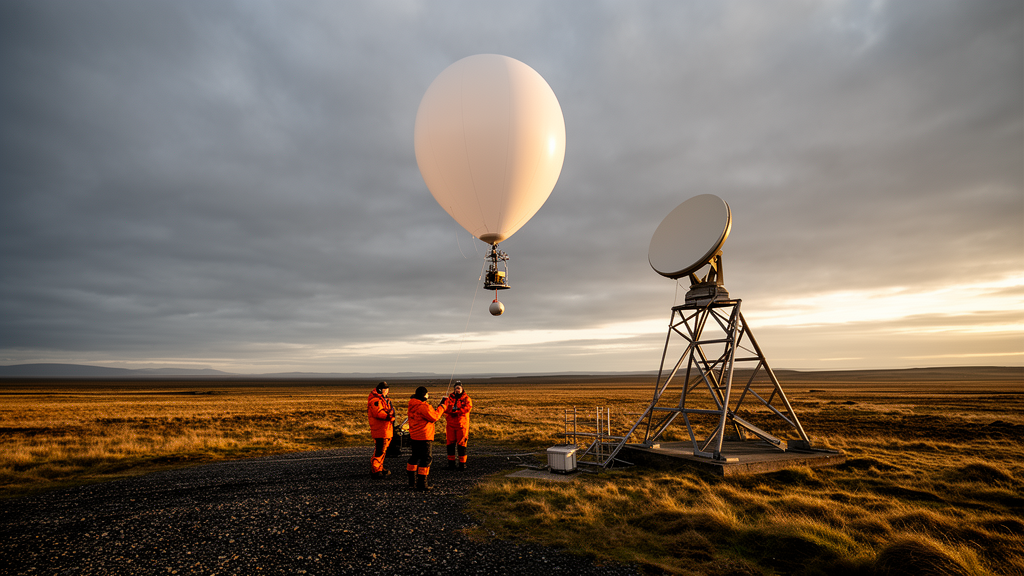
Some of the most important instruments in atmospheric science are quietly pointing in slightly the wrong direction. Vertically pointing cloud radars, the workhorses used to measure air motion inside clouds and falling snow and ice, are supposed to stare straight up at the zenith. But a team of researchers at the U.S. Department of Energy’s Atmospheric Radiation Measurement (ARM) user facility has shown that even a tilt of half a degree, an angle far too small to see with the naked eye, can contaminate the very measurements these radars were built to make. Their solution, published in the journal Atmospheric Measurement Techniques, is elegantly simple: use routine weather balloon launches to catch the error.
The problem boils down to geometry. When a cloud radar’s beam is perfectly vertical, the Doppler velocity it measures is the sum of just two things: the speed at which hydrometeors such as ice crystals and raindrops fall, and the vertical motion of the air itself. Separating those two contributions is already one of the fundamental challenges in cloud radar analysis, and decades of techniques have been built around Doppler spectra and their moments to tease them apart. But if the beam tilts even slightly away from zenith, a third term sneaks in: the horizontal wind, projected onto the tilted beam. A radar that thinks it is measuring falling snow may actually be measuring a slice of the jet stream.
The size of this contamination is startling given how small the tilts are. The researchers’ simulations show that a pointing offset of just 0.5 degrees, with a horizontal wind of 10 meters per second, injects a Doppler velocity signal of roughly 0.1 meters per second, comparable to the fall speeds of the smallest ice crystals. Crank the wind up to 40 meters per second, typical of upper-level jet conditions, and the bias grows to about 0.3 meters per second. Doubling the tilt to one degree roughly doubles the amplitude of the spurious signal, and a two-degree offset quadruples it. For radars designed to detect the feeble velocity perturbations of boundary-layer turbulence, these are not rounding errors; they are systematic biases that can propagate into retrievals of vertical air motion, turbulence, and cloud microphysics.
Min Deng of Brookhaven National Laboratory and her colleagues developed a technique they call the U-normalized velocity-direction display, or UN-VDD, which turns this contamination into a diagnostic. The key insight is that the wind-induced Doppler velocity does not vary randomly. It follows a cosine dependence on wind direction, peaking when the wind blows along the radar’s tilt azimuth and reversing when it blows the opposite way. This is the same geometric principle that underpins the velocity-azimuth display method used since 1968 to retrieve winds from scanning Doppler radars, but run in reverse: instead of assuming a vertical beam to find the wind, the team assumes a known wind to find the beam.
Normalizing is what makes the method work in practice. Because horizontal wind speed changes with height and time, raw Doppler velocities mix the geometric signal with variations in wind magnitude. Dividing the measured Doppler velocity by the radiosonde-measured wind speed strips that dependence away, leaving a quantity dominated by the beam-pointing geometry itself. Particle fall velocities and vertical air motions do not vary systematically with wind direction, so they appear as scatter and a roughly constant offset rather than a coherent cosine wave. The amplitude of the fitted cosine then yields the off-vertical tilt angle, and its phase gives the azimuth of the tilt. In upper-level ice clouds, where fall speeds are weak compared with synoptic-scale winds, the approximation is particularly clean.
The team put the method through its paces during the Cloud and Precipitation Experiment at kennaook (CAPE-k) in Tasmania, where a Ka-band ARM Zenith Radar (KAZR) and a Marine W-band ARM Cloud Radar (MWACR) operated within 100 meters of each other. A telling case from September 2024 showed the two radars observing the same ice cloud layer between 5 and 8 kilometers altitude, yet reporting systematically different Doppler velocities: the KAZR registered apparent upward velocities approaching 2 meters per second near cloud top, physically implausible as sustained air motion, while the MWACR showed weak downward values consistent with small ice crystals. Applying UN-VDD to the full campaign revealed why. The KAZR beam was tilted about 2.5 degrees from vertical, toward an azimuth near 140 degrees, while the MWACR was nearly true at about 0.6 degrees off zenith.
The most convincing validation came from subtracting one radar’s velocities from the other. Because the two instruments observe nearly the same atmospheric volume, the contributions of particle fall speed and vertical air motion largely cancel in the difference, leaving a signal dominated by their relative pointing error. The normalized velocity difference showed a strikingly clear cosine dependence with a near-zero offset, yielding a relative tilt of about 1.5 degrees at an azimuth of roughly 140 degrees, consistent with the individual radar fits. It is a neat piece of self-consistency: two independent radars, one analysis, one answer.
The method proved robust well beyond Tasmania. Applied to the Bankhead National Forest campaign in the southeastern United States, it retrieved a smaller offset of about 0.5 degrees, and sensitivity tests showed the retrieved angle varied by less than 0.3 degrees across different radar averaging windows and by less than 0.25 degrees across different reflectivity thresholds used to select ice-cloud samples. The overall uncertainty is estimated at roughly 0.5 degrees. Across recent ARM campaigns including SAIL, TRACER, EPCAPE, and CoURAGE, most deployments showed tilts within about half a degree, with CoURAGE showing a moderate 1.2-degree offset and CAPE-k the largest at 2.5 degrees for the KAZR. Notably, the method even caught history: at the Eastern North Atlantic fixed site, the analysis detected a growing pointing deviation during 2017 and 2018 that matched a documented data quality issue, and after a radar levelling procedure in January 2019, the retrieved offset dropped to about 0.1 degrees.
What makes the technique genuinely powerful is that it requires no new hardware and no special campaigns. Radiosondes are launched routinely at ARM sites and at weather stations worldwide, providing high-resolution wind profiles that are independent of radar calibration. The main caveat is balloon drift: a radiosonde can travel 5 to 30 kilometers horizontally by the time it reaches 10 kilometers altitude, introducing representativeness uncertainty in sheared environments. But because the wind-direction signature is geometric rather than local, aggregating many launches across a campaign builds up enough directional coverage to constrain the fit reliably.
The researchers also lay out how the retrieved angles could be used to correct archived data. For a small tilt, the maximum wind contamination is approximately the wind speed times the tilt angle in radians, so a 0.5-degree offset can bias velocities by up to 0.17 meters per second in 20-meter-per-second winds and 0.35 meters per second in jet-level winds. A correction formula removes the projected wind component, though the authors caution that corrections should only be applied when the tilt is statistically distinguishable from zero and the projected bias exceeds what the intended product can tolerate. For a global network of cloud radars feeding climate models and process studies, a quality-control tool that costs nothing but arithmetic on data already being collected may prove one of the quiet upgrades with the loudest consequences.
Subject of Research: Estimating beam pointing errors of vertically pointing cloud radars using radiosonde wind measurements
Article Title: Estimating beam pointing of vertically pointing cloud radars using radiosonde measurements
Article References: Deng, M., Giangrande, S. E., Theisen, A. K., Johnson, K. L., Lindenmaier, I. A., Wendler, T. G., Comstock, J., Rocque, M., Zhu, Z., & Matthews, A. (2026). Estimating beam pointing of vertically pointing cloud radars using radiosonde measurements. Atmospheric Measurement Techniques, 19(19), 6327-6339. https://doi.org/10.5194/amt-19-6327-2026
Image Credits: AI Generated
Keywords: cloud radar, radiosonde, beam pointing, Doppler velocity, ARM, KAZR, MWACR, vertical air motion, atmospheric measurement, CAPE-k, radar calibration, wind projection
Cite Scienmag News
Russell Cooper. (October 8, 2026). Weather Balloons Reveal Hidden Tilts in Cloud Radars That Skew Climate Data. Scienmag. https://scienmag.com/weather-balloons-reveal-hidden-tilts-in-cloud-radars-that-skew-climate-data/
Russell Cooper. "Weather Balloons Reveal Hidden Tilts in Cloud Radars That Skew Climate Data." Scienmag, 8 October 2026, https://scienmag.com/weather-balloons-reveal-hidden-tilts-in-cloud-radars-that-skew-climate-data/. Accessed 8 October 2026.
Russell Cooper. "Weather Balloons Reveal Hidden Tilts in Cloud Radars That Skew Climate Data." Scienmag. October 8, 2026. https://scienmag.com/weather-balloons-reveal-hidden-tilts-in-cloud-radars-that-skew-climate-data/


