


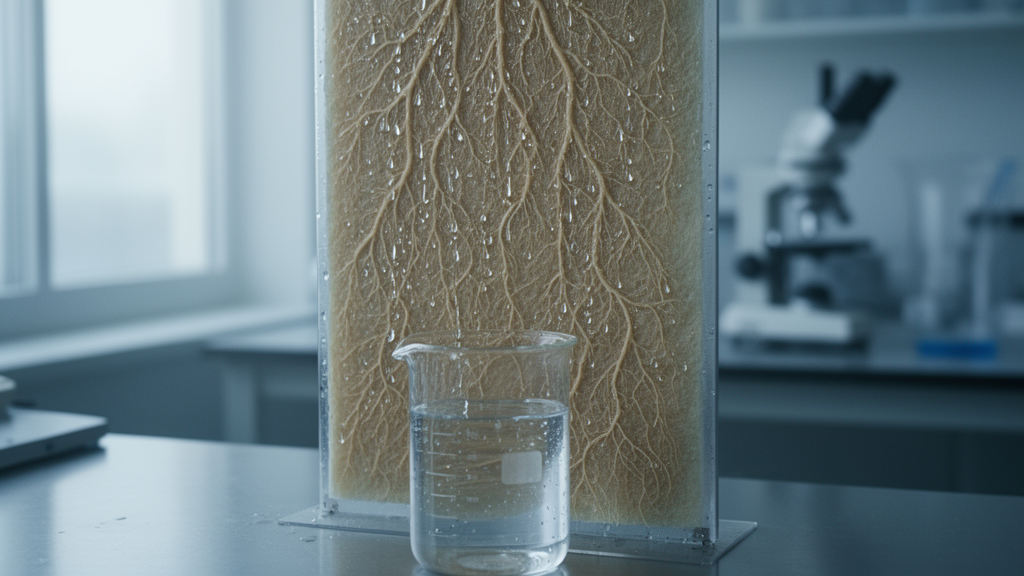
Freshwater scarcity is one of the defining challenges of a warming, crowded century, and one of the most tantalizing answers has been hanging in the air all along. The atmosphere holds vast quantities of water vapor, even in arid regions, and devices that can capture and release that moisture on demand promise decentralized drinking water without desalination plants, pipelines, or aquifers. Now, a team of researchers reporting in Advanced Science has unveiled a biomimetic membrane that borrows a trick from mangrove trees and, in doing so, appears to dissolve one of the most stubborn trade-offs in the field: the choice between how much water a material can hold and how fast it can grab it.
The technology belongs to a family known as sorption-based atmospheric water harvesting, or SAWH. Unlike condensation systems, which chill air below its dew point and demand substantial electrical power, sorption-based systems use hygroscopic materials that soak up vapor at ambient temperature and then release it when gently heated, often by nothing more than sunlight. That makes them attractive for off-grid communities, remote islands, and agricultural settings. But the leading materials, salt-composite hydrogels, have long suffered from a kinetic bottleneck. Loading more hygroscopic salt raises the total water capacity, yet it also thickens the internal diffusion barrier, so the material takes longer to reach its capacity. A sorbent that needs hours to saturate simply cannot cycle often enough to be productive.
The new work traces that bottleneck to a transport problem with two coupled stages. Water vapor must first find and bind to hygroscopic sites, and the resulting salt solution must then redistribute through the polymer network. Previous analyses have suggested that, under representative conditions, liquid diffusion inside the hydrogel is often the dominant resistance, not the arrival of vapor from the surrounding air. Earlier attempts to speed things up focused on porous architecture: ice-templating, foaming, and directional freeze-drying all shorten diffusion distances. But those approaches are energy-intensive, add processing complexity, and never fully solve the deeper issue that much of the salt remains buried inside the polymer matrix, out of direct contact with the air it is supposed to be drinking from.
The inspiration for a different solution came from the grey mangrove, Avicennia marina, a plant that thrives while rooted in seawater. The mangrove transports salt ions from its internal tissues to specialized glands on its leaf surface, where the salt accumulates in microstructured regions. Under humid conditions, that surface salt deliquesces and pulls moisture straight out of the atmosphere. The research team realized that the most valuable feature was not the plant’s physiology but its geometry: a spatial separation between internal salt transport and storage on one hand, and surface-exposed, air-accessible hygroscopic sites on the other. A synthetic material built on that principle could let vapor meet salt immediately, without waiting for moisture to fight its way through a dense gel.
Translating that idea into hardware, the researchers fabricated what they call a multi-layer heterogeneous hygroscopic membrane, or MHH membrane. It is a sandwich structure made by alternating electrospinning and spraying. First, a porous mat of polyacrylonitrile nanofibers is electrospun onto a collector. Then, pre-formed brush-like hydrogel microspheres, roughly 100 micrometers across, are sprayed onto the fiber scaffold. A second round of electrospinning encapsulates the hydrogel, producing a nanofiber-hydrogel-nanofiber stack. The outer nanofiber layer is coated with polypyrrole, a black polymer that absorbs sunlight efficiently, and the whole membrane is loaded with lithium chloride, one of the most powerful hygroscopic salts known. The final membrane carries about 170 grams of salt per square meter.
The clever part is what happens during drying. When the saturated membrane is regenerated, salt solution is driven out of the hydrogel and crystallizes in the voids of the outer nanofiber layer, right at the air interface. On the next adsorption cycle, that surface-enriched salt meets humid air directly and deliquesces almost immediately, and the resulting solution is then drawn into the hydrogel reservoir below. Energy-dispersive X-ray spectroscopy confirmed the effect: the membrane surface showed a chlorine-to-carbon atomic ratio of 10.80, compared with just 1.27 on the surface of conventional hydrogel microspheres loaded with the same amount of salt. Cross-sectional imaging found substantial salt deposits occupying the inter-fiber voids of the outer layer, consistent with the redistribution mechanism.
The kinetic payoff is striking. At 25 degrees Celsius and 70 percent relative humidity, both the MHH membrane and the hydrogel microsphere control reach a similar equilibrium uptake of about 2.4 grams of water per gram of material, proving that the layered design sacrifices no storage capacity. But the membrane absorbs roughly 1.4 grams per gram within the first 30 minutes, nearly double the control, and hits 85 percent of equilibrium within 90 minutes. The microspheres need about 300 minutes to reach the same fraction. Fitting the curves with a unified adsorption model yields a characteristic time constant of 40.12 minutes for the membrane versus 110.72 minutes for the microspheres, and an initial sorption rate about 2.1 times higher. Independent measurements of the elementary steps showed why: the hydrogel takes up saline solution faster than the nanofiber layer can generate it by vapor-driven deliquescence, so the interface never floods and vapor capture can continue.
That rapid liquid uptake is itself engineered at the molecular scale. The hydrogel microspheres are not ordinary polyacrylamide; they contain polyethylene glycol side chains grafted onto the network, forming a brush-like architecture. Flexible PEG segments increase chain mobility and accessible free volume, easing the passage of water molecules. In cross-flow vapor permeation experiments, a PAM-co-PEGMA film 0.46 millimeters thick showed a permeation lag time of only about 2 minutes, whereas a plain polyacrylamide film of just 0.14 millimeters lagged roughly 13 minutes. Normalized to a common thickness, the time-lag-derived effective diffusion coefficient of the brush-like hydrogel came out approximately 70 times that of conventional PAM. Swelling tests reinforced the picture: in 10 percent lithium chloride solution, the brush-like hydrogel swelled to about 1000 percent after 240 minutes, versus roughly 600 percent for PAM, with kinetics consistent with Fickian transport rather than sluggish polymer relaxation.
The membrane also regenerates efficiently under sunlight. Coated with polypyrrole on its outer surface, it releases about 70 percent of its stored water within 90 minutes under one-sun illumination, compared with about 60 percent for the microspheres, and its surface temperature exceeds 70 degrees Celsius within 20 minutes, roughly 10 degrees hotter than the control. Because the photothermal layer sits at the evaporation interface rather than dispersed through a hydrated gel, heat is generated exactly where water leaves. Durability held up too: after 20 adsorption-desorption cycles, the membrane retained about 2.5 grams per gram of uptake with overlapping kinetic curves, and salt remained visible in the nanofiber interstices. One honest caveat emerged from a 48-hour exposure to 100 percent humidity, which caused slight saline leakage; the design does not fully confine salt solution under prolonged saturation, though performance recovered after drying.
Crucially, the material-level speed translated into device-level output. The team built a semi-continuous, three-bed harvester in which one bed desorbs under a solar lamp while the others adsorb, cycling every 2 hours of capture and 1 hour of release. In the laboratory at 25 degrees Celsius and 90 percent relative humidity, the device produced 3.47 liters per square meter over 8 hours, an average of 0.43 liters per square meter per hour. Outdoors in Xiamen, under 60 to 65 percent humidity and peak solar irradiance near 830 watts per square meter, the same prototype yielded about 1.62 liters per square meter in a day, and a second field test under cloudier, hotter conditions reached about 1.96 liters per square meter per day. Condensate analysis by ICP-OES found low inorganic contamination, though the authors caution that microbiological safety requires separate system-level measures. The broader lesson may outlast the specific membrane: by engineering interfacial accessibility and internal transport together, across scales from nanofibers to polymer side chains, sorbent designers can finally stop choosing between capacity and speed.
Subject of Research: Biomimetic multi-layer hygroscopic membranes for rapid sorption-based atmospheric water harvesting
Article Title: Interfacial Salt Redistribution Enables Rapid Atmospheric Water Harvesting in a Biomimetic Multi‐Layer Hygroscopic Membrane
Article References: Zhong, F.-Y., Guo, C.-Y., Shao, Z.-D., Zhong, L.-B., Chen, G. Z., Zheng, Y., Zhou, J. L., Zheng, Y.-M., & He, J. (2026). Interfacial Salt Redistribution Enables Rapid Atmospheric Water Harvesting in a Biomimetic Multi‐Layer Hygroscopic Membrane. Advanced Science, Article e78196. https://doi.org/10.1002/advs.78196
Image Credits: AI Generated
DOI: 10.1002/advs.78196
Keywords: atmospheric water harvesting, hygroscopic membrane, mangrove biomimicry, lithium chloride, hydrogel, electrospinning, solar desorption, water scarcity, sorption kinetics, polyethylene glycol, nanofibers, photothermal materials
Cite Scienmag News
Denise Maddox. (October 8, 2026). Mangrove-Inspired Membrane Pulls Drinking Water From Air at Record Speed. Scienmag. https://scienmag.com/mangrove-inspired-membrane-pulls-drinking-water-from-air-at-record-speed/
Denise Maddox. "Mangrove-Inspired Membrane Pulls Drinking Water From Air at Record Speed." Scienmag, 8 October 2026, https://scienmag.com/mangrove-inspired-membrane-pulls-drinking-water-from-air-at-record-speed/. Accessed 8 October 2026.
Denise Maddox. "Mangrove-Inspired Membrane Pulls Drinking Water From Air at Record Speed." Scienmag. October 8, 2026. https://scienmag.com/mangrove-inspired-membrane-pulls-drinking-water-from-air-at-record-speed/


