


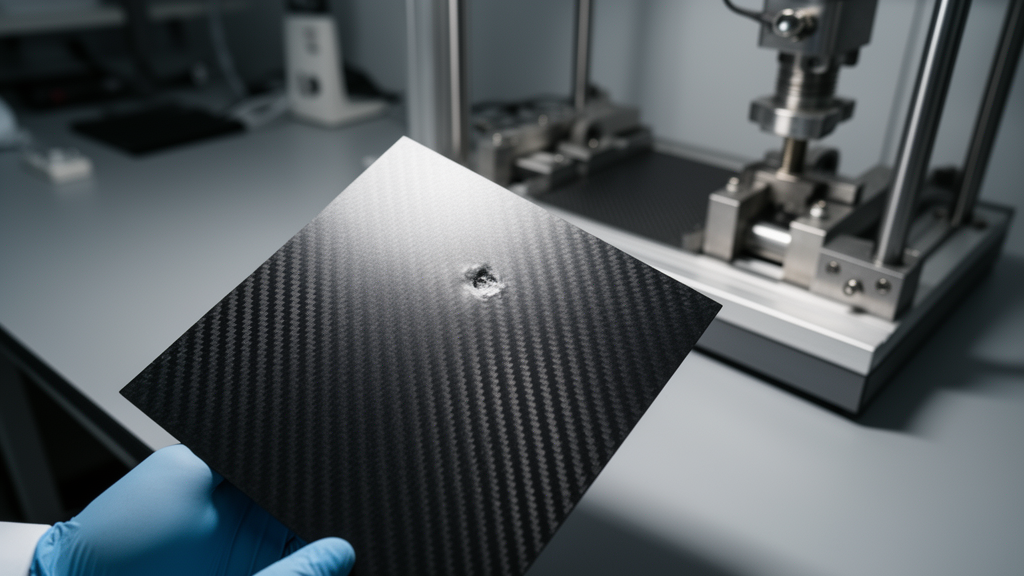
When a composite aircraft part takes a knock on the tarmac, the most dangerous consequences are often invisible. A dropped tool, a hailstone, or a runway debris strike can leave the glossy outer surface of a carbon-fiber laminate looking untouched while the layers beneath quietly separate. These internal delaminations are the nightmare scenario for aerospace engineers, because they can grow under the relentless rhythm of repeated compression loads in service, eventually eroding the margin between safe operation and structural failure. A new study published in the journal Aerospace Systems by researchers at the Moscow Aviation Institute and the composite manufacturer UMATEX has now put that growth process under a combined computational and experimental microscope, showing that the spread of post-impact damage under cyclic compression can be both measured and predicted with enough fidelity to support damage tolerance assessment.
The research team, led by Nikolay V. Turbin, set out to answer a question that has lingered in the composite fatigue literature for decades: once an impact has seeded a delamination inside a laminate, how does that defect evolve when the structure is compressed over and over again? The question matters because modern airworthiness regulations, including the European Union Aviation Safety Agency’s CS 25.571 damage tolerance requirements and the Federal Aviation Administration’s Advisory Circular 20-107B on composite aircraft structure, demand that manufacturers demonstrate that damaged structure can sustain load until the damage is detected. For metals, fracture mechanics offers mature tools for predicting crack growth under fatigue. For composites, the picture has remained stubbornly incomplete, and the field has been searching for reliable slow-growth approaches for post-impact fatigue for years.
The experimental core of the study involved two test specimens fabricated from carbon-fiber reinforced laminate, a material class that dominates modern primary aircraft structures. Each specimen was first subjected to impact, creating the characteristic internal damage zone of delaminations at multiple depths through the thickness. The researchers then mapped the dimensions and depth of these internal delaminations before and after cyclic compression testing, using non-destructive inspection to build a before-and-after picture of the hidden damage architecture. This baseline-and-post-test comparison is what allowed the team to quantify how much the delaminations grew, in which directions, and at which interfaces between plies, rather than simply recording whether the specimen eventually failed.
Under cyclic compression, an impacted composite panel does not behave like a pristine one. The delaminated region behaves as a local zone of separated plies that can buckle outward or inward under compressive stress, and this local instability drives the interlaminar crack faces apart, pumping energy into the delamination front with every load cycle. The result is a distinctive damage evolution pattern: the delamination front advances through the laminate, the buckling zone enlarges, and the residual compressive capacity of the element declines. Previous studies by groups including Butler and Almond, Melin and Schön, and Uda and colleagues have documented aspects of this behavior, but the field still lacks a validated, practical framework that connects measured damage growth to a computational prediction that engineers could use in certification-oriented analysis.
The Moscow Aviation Institute team approached the problem with a two-pronged strategy. On the theoretical side, they developed a framework for describing specific damage growth in the impacted laminate, drawing on the classical foundations of fracture mechanics established by Griffith in 1921 and the crack propagation laws formalized by Paris and Erdogan in 1963, adapted to the particular geometry and mechanics of a delamination embedded in a compressed anisotropic plate. On the computational side, they built numerical simulations of the approximated damage growth, using finite element tools of the kind employed in commercial platforms such as Siemens Simcenter 3D, to reproduce the stress state around the delamination and the progression of the interlaminar crack. The theoretical predictions and the numerical model were then tested against the experimental observations from the cyclic compression tests.
One of the most striking findings from the cyclic testing was the appearance of a stage of unstable delamination growth followed by arrest. Rather than advancing smoothly and continuously with every cycle, the delamination in the tested specimens went through a period of rapid, unstable extension and then stopped growing, remaining arrested until the prescribed number of cycles expired. This behavior has important implications for how engineers think about post-impact fatigue life. It suggests that damage growth in these laminates is not a monotonically accelerating march toward failure but a more nuanced process in which the local mechanics of the buckled delamination zone, the changing geometry of the crack front, and the laminate’s resistance to interlaminar fracture interact to produce periods of dormancy as well as bursts of growth.
The study’s central claim is that this damage initiation and growth can be predicted. The researchers report that both their theoretical analysis and their numerical modeling captured the detected damage initiation and the subsequent growth observed in the experiments. In other words, the computational tools did not merely describe the damage after the fact; they anticipated where and when the delaminations would begin to extend and how far they would travel under the cyclic compression loading. The authors conclude that the possibility of a computational estimate of the damage tolerance of a composite element under cyclic loads is confirmed, which is precisely the kind of validated predictive capability that the slow-growth damage tolerance philosophy requires.
The significance of this confirmation reaches well beyond a single laboratory experiment. Certification practice for composite aircraft structures has traditionally leaned on conservative assumptions, treating barely visible impact damage as a strength knockdown rather than tracking its growth over time, because reliable slow-growth prediction has been elusive. As Pascoe and co-workers argued in a widely cited 2021 review, current research approaches had not yet delivered a workable slow-growth damage tolerance method for fatigue after impact in fiber-reinforced polymers. If computational frameworks of the kind demonstrated in this study can be refined and generalized, they could allow designers to quantify how a specific impact scar will behave under a specific service load spectrum, potentially reducing conservatism while maintaining or improving safety margins.
The work also illustrates a broader trend in composite structural mechanics: the convergence of high-fidelity simulation, fracture-mechanics theory, and advanced non-destructive inspection. Phased array ultrasonic scanning of impact damage in carbon-fiber composites, as documented in the inspection literature, provides the detailed three-dimensional damage maps that models need as input and validation data. Finite element analysis of composite materials, supported by dedicated modeling techniques for delamination and progressive damage, provides the predictive engine. And carefully designed cyclic compression-after-impact tests, following standards such as ASTM D7137 for compressive residual strength of damaged laminates and ASTM D7136 for damage resistance to drop-weight impact, provide the ground truth. The new study weaves all three strands together in a single, self-consistent methodology.
There remain, of course, limits to what two specimens can establish. The authors are explicit that the aim of the work is to enhance the understanding of post-impact damage growth in order to refine the model used for composite material damage tolerance estimation, not to deliver a finished certification tool. Extending the approach across a wider range of layups, impact energies, load levels, and environmental conditions will be the necessary next step, and the statistical variability inherent in both impact damage and fatigue behavior will demand larger datasets. The study was carried out under a grant from the Russian Ministry of Science and Higher Education for large scientific projects in priority areas of scientific and technological development, reflecting the strategic weight that aviation nations place on composite damage tolerance. But the core message is clear and consequential: the hidden damage left by an impact need not remain an unquantified unknown. With the right combination of theory, simulation, and experiment, the life story of a delamination under cyclic compression can be read in advance, and that ability may reshape how the next generation of composite aircraft structures is designed, inspected, and certified.
Subject of Research: Post-impact delamination growth in carbon-fiber composite laminates under cyclic compression loading
Article Title: Computational and experimental analysis of the post-impact delamination growth in a composite structural element subjected to cyclic compression
Article References: Computational and experimental analysis of the post-impact delamination growth in a composite structural element subjected to cyclic compression. (n.d.). https://doi.org/10.1007/s42401-026-00547-1
Image Credits: AI Generated
DOI: 10.1007/s42401-026-00547-1
Keywords: composite structures, damage tolerance, delamination, compression fatigue after impact, carbon-fiber reinforced laminate, cyclic loading, fracture mechanics, finite element analysis, non-destructive inspection, aerospace structures, impact damage, fatigue life prediction
Cite Scienmag News
Denise Maddox. (October 8, 2026). Hidden Impact Damage in Carbon-Fiber Composites Tracked Cycle by Cycle in New Study. Scienmag. https://scienmag.com/hidden-impact-damage-in-carbon-fiber-composites-tracked-cycle-by-cycle-in-new-study/
Denise Maddox. "Hidden Impact Damage in Carbon-Fiber Composites Tracked Cycle by Cycle in New Study." Scienmag, 8 October 2026, https://scienmag.com/hidden-impact-damage-in-carbon-fiber-composites-tracked-cycle-by-cycle-in-new-study/. Accessed 8 October 2026.
Denise Maddox. "Hidden Impact Damage in Carbon-Fiber Composites Tracked Cycle by Cycle in New Study." Scienmag. October 8, 2026. https://scienmag.com/hidden-impact-damage-in-carbon-fiber-composites-tracked-cycle-by-cycle-in-new-study/


