


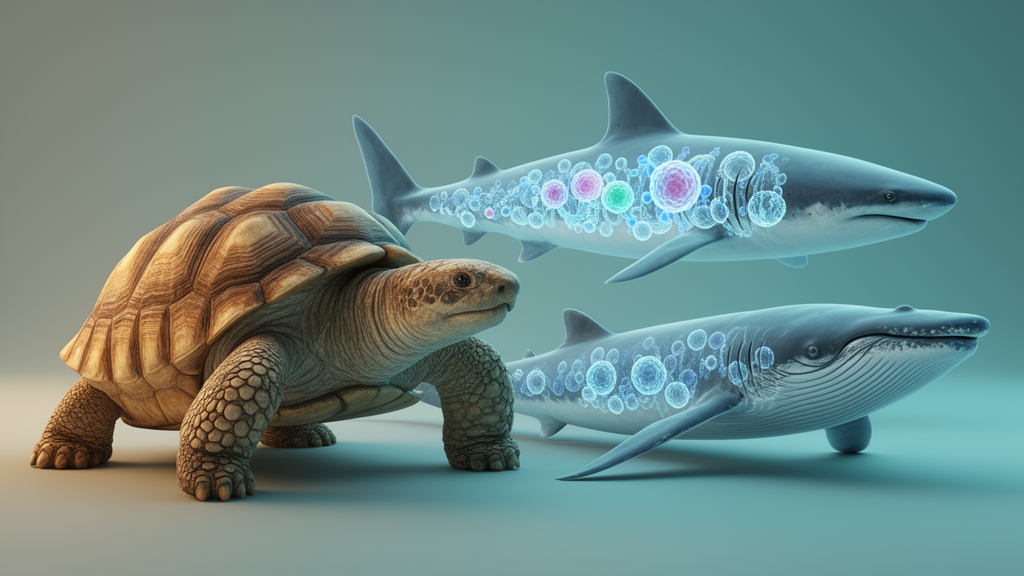
Some organisms on Earth barely seem to acknowledge the passage of time. Bristlecone pines have stood on mountain ridges for nearly five thousand years. Glass sponges anchored in Antarctic waters may have been growing since long before human civilizations existed. A jellyfish can, in principle, rewind its own development and start again. For biologists, these extreme cases are not curiosities but natural experiments: if life can persist for centuries or millennia, then aging is not an unavoidable property of being alive, and the molecular strategies that delay it must, in principle, be discoverable. A new review published in the journal Aging by Stefania E. Kapsetaki and Nektarios Tavernarakis of the Institute of Molecular Biology and Biotechnology at the Foundation for Research and Technology-Hellas, in Heraklion, Crete, takes on exactly this challenge, assembling what is known about the cellular and molecular biology of the longest-lived multicellular organisms on the planet.
The scope of the analysis is unusually broad. The authors surveyed molecular and cellular evidence from 101 multicellular species whose maximum lifespans reach at least 250 years, drawing on the AnAge database and a wide range of primary studies to compile lifespan records. Ninety of these species are plants, from oaks and pines to the ancient seagrass Posidonia oceanica and the creosote bush of the American desert, while eleven are animals, including hydras, sponges, tubeworms and the freshwater planarian Schmidtea mediterranea. Some of these organisms only modestly exceed the 250-year threshold, but others may persist for thousands or even tens of thousands of years. At the far edge of the spectrum, the planarian and the jellyfish Turritopsis dohrnii are considered potentially immortal, meaning that no intrinsic limit to their lifespan has been demonstrated under suitable conditions.
What makes the review methodologically interesting is the way it frames the comparison. Rather than asking only why some species live longer than others, the authors examined two distinct dimensions of longevity: variation between exceptionally long-lived species and shorter-lived ones, and variation among individuals within a single long-lived species. This distinction matters because the mechanisms that make one species outlast another across evolutionary time need not be the same mechanisms that determine why one 500-year-old pine survives its neighbor. The evidence base they assembled spans genetics, genomics, transcriptomics, proteomics and metabolomics, alongside studies of telomere maintenance, stress resistance, regeneration and tumor formation, giving a genuinely multi-layered picture of what extreme longevity looks like at the level of cells and molecules.
Several recurring themes emerged from this cross-species survey. Compared with shorter-lived relatives, extremely long-lived organisms tend to show better DNA maintenance and repair, greater resistance to both cellular and environmental stress, pronounced regenerative capacity, better preservation of stem-cell populations, and mechanisms that appear to suppress cancer development. Comparative genomic studies have additionally identified longevity-associated pathways involved in programmed cell death, protein homeostasis, resistance to oxidative stress and responses to environmental damage. None of these features is exotic in itself; each is a familiar component of cellular housekeeping. What is striking is that they recur together, in organisms as different as a conifer and a cnidarian, suggesting that evolution has converged on a similar toolkit whenever lifespan is pushed to extremes.
Regeneration stands out as particularly important in some of the most remarkable cases. Hydra can continuously replace the cells of its body, effectively renewing itself throughout life. Turritopsis dohrnii can reverse from a mature medusa back to an earlier developmental stage, restarting its life cycle and earning its popular name as the immortal jellyfish. Planarians carry a population of adult stem cells called neoblasts, which can generate many different cell types and support the regeneration of entire body parts, an ability that underlies their apparent exemption from aging. Long-lived plants show an analogous pattern in a botanical register: species such as Scots pine and Ginkgo biloba appear to preserve the pluripotency of their cells during aging better than shorter-lived plants do, maintaining the developmental flexibility needed to keep growing and replacing tissues across centuries.
Equally instructive is what the review does not find. The idea that a single familiar aging mechanism can explain exceptional longevity does not survive the evidence. Telomere length, telomerase activity, metabolic rate and antioxidant activity do not consistently account for lifespan differences among individuals within exceptionally long-lived species. Telomere characteristics vary not only between species but even between tissues within the same organism, which complicates any attempt to read lifespan directly from telomere biology. The authors conclude that extreme longevity arises from multiple interacting biological strategies rather than from a universal molecular switch, a conclusion that cautions against the popular habit of reducing aging to any one measurable marker.
Cancer resistance may be another essential component of the picture. Long lifespans combined with extensive cell renewal should, in principle, multiply the opportunities for malignant transformation, yet tumors appear relatively uncommon in several exceptionally long-lived species. Planarians offer a vivid example: they combine extraordinary regenerative output with robust DNA-repair mechanisms and conserved regulators of cell division, apparently keeping proliferation under control even as tissues are continuously rebuilt. The authors suggest that the anticancer adaptations of long-lived organisms deserve systematic investigation, while being careful to note that the available evidence remains incomplete. Large animals such as elephants and whales have famously evolved extra copies of tumor-suppressor genes, and the new review extends that logic to the plant and invertebrate champions of longevity, where the relevant mechanisms are far less well characterized.
Perhaps the most conceptually significant finding is the convergence between the two dimensions of longevity the authors set out to compare. Mechanisms associated with lifespan variation within species overlap with those that distinguish longer-lived species from shorter-lived ones, and both categories point toward DNA maintenance, stemness and stress-resistance pathways. Notably, these are also the hallmark features of early developmental stages and of germ cells, the two contexts in which biology most conspicuously refuses to age. The authors compress this pattern into a memorable formulation: living young appears to be a strategy of living long. In other words, the longest-lived organisms seem to maintain, into adulthood and old age, a molecular state that most cells abandon during differentiation, keeping their tissues in something closer to an embryonic or germline configuration.
The review also insists that longevity cannot be understood apart from the environment. Temperature, ecological pressures and other external conditions interact with molecular pathways over evolutionary timescales, and these relationships differ substantially among species. A cold, stable deep-sea environment slows metabolism and damage accumulation for an Antarctic sponge, while a desert shrub survives through drought tolerance and clonal growth, so no single environmental condition can be generalized as longevity-promoting. This ecological framing matters for interpretation as well: laboratory conditions rarely reproduce the circumstances under which extreme lifespans evolved, and measurements taken in cultivation or captivity may not reflect what happens in the wild.
For readers hoping that ancient trees and immortal jellyfish will yield a prescription for human life extension, the authors are appropriately restrained. The review does not establish that the longevity mechanisms of these species can be directly transferred to humans. What these organisms provide instead is a set of comparative biological models for identifying pathways that warrant further mechanistic and translational investigation, particularly those linking genome maintenance, stem-cell preservation and stress resistance to healthy aging. Major knowledge gaps remain, and the authors are candid about them: many exceptionally long-lived species have received little molecular study, existing investigations use different methods and tissues, and the field lacks comprehensive cross-species healthspan data comparable to existing lifespan databases. Larger studies using standardized methods and incorporating environmental information will be needed to separate causal longevity mechanisms from mere correlations. Even so, the central message is clear and quietly provocative. Living for centuries does not depend on a single gene or pathway, but on overlapping strategies for keeping DNA intact, preserving regenerative capacity and stemness, resisting stress and limiting cancer. Understanding how those strategies operate across the tree of life may not make humans immortal, but it could redefine what healthy aging means for a species that currently measures its ambitions in decades rather than millennia.
Subject of Research: Comparative biology of exceptional longevity across long-lived plant and animal species
Article Title: Exceptional longevity across species linked to DNA maintenance, stemness and stress resistance
Article References: Exceptional longevity across species linked to DNA maintenance, stemness and stress resistance. (n.d.). Original publication
Image Credits: AI Generated
DOI: Not provided
Keywords: longevity, aging, DNA repair, stem cells, stress resistance, regeneration, telomeres, cancer resistance, comparative genomics, planarians, Hydra, healthspan
Cite Scienmag News
Beatrice Stafford. (October 8, 2026). Living Young to Live Long: The Shared Biology of Centuries-Old Species. Scienmag. https://scienmag.com/living-young-to-live-long-the-shared-biology-of-centuries-old-species/
Beatrice Stafford. "Living Young to Live Long: The Shared Biology of Centuries-Old Species." Scienmag, 8 October 2026, https://scienmag.com/living-young-to-live-long-the-shared-biology-of-centuries-old-species/. Accessed 8 October 2026.
Beatrice Stafford. "Living Young to Live Long: The Shared Biology of Centuries-Old Species." Scienmag. October 8, 2026. https://scienmag.com/living-young-to-live-long-the-shared-biology-of-centuries-old-species/


