


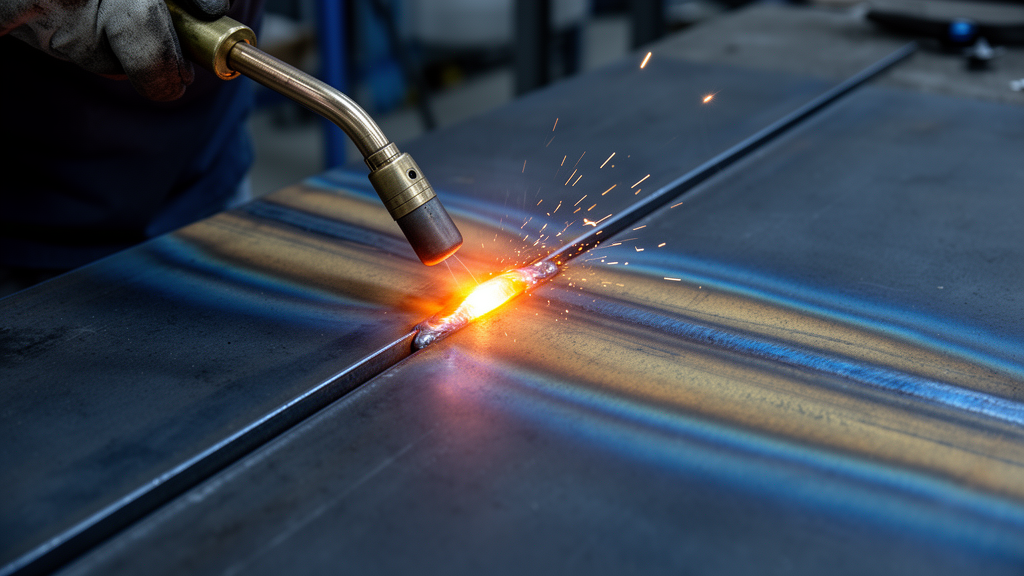
Every welded bridge girder, offshore wind turbine jacket, and steel tower carries a hidden burden that no blueprint ever shows. When an electric arc melts steel and the joint cools, the metal contracts unevenly, locking in residual stresses that can rival the material’s own yield strength. For S355, one of the most widely used structural steels in bridge and offshore fabrication, these stresses are more than an engineering nuisance: they can quietly erode fatigue life and open the door to crack propagation in components subjected to severe cyclic loading. A new study published in Results in Engineering by Issa Niangaly and colleagues now offers one of the most detailed dissections yet of where these stresses come from and, crucially, which physical mechanism relaxes them.
The research team, working across French institutions, built a coupled thermo-metallurgical-mechanical finite element model of tungsten inert gas (TIG) welding on S355J2N steel plates. What sets the work apart is its systematic decomposition of transformation-induced plasticity, or TRIP, the extra plastic strain that arises when steel changes its crystal structure while under stress. Previous simulations often ignored phase transformations entirely or included them only partially, treating the associated volumetric strains while neglecting TRIP altogether. The new study shows that this omission can inflate predicted residual stresses dramatically, potentially leading designers to underestimate the fatigue performance of real welded assemblies.
The experimental foundation of the study was meticulous. Six identical S355J2N specimens, each consisting of two plates measuring 100 by 50 by 15 millimeters joined in a butt configuration, were welded under identical conditions: 200 amperes of current, 14 volts of arc voltage, a travel speed of 2 millimeters per second, pure argon shielding, and no filler metal. Type-K thermocouples recorded the thermal cycles at 50 hertz, while optical microscopy and scanning electron microscopy mapped the microstructures of the fusion zone and the heat-affected zone. Three specimens had to be excluded from the thermal analysis because their thermocouples shifted during welding, a candid limitation the authors acknowledge, but the three retained welds showed cooling-time repeatability within one second.
On the modeling side, the arc’s heat input was represented by the Goldak double-ellipsoid model, whose parameters were calibrated from the measured fusion zone geometry: a half-width of 6 millimeters and a half-depth of 3 millimeters. Diffusive transformations among austenite, ferrite, pearlite, and bainite were described with the V. I. Machnienko model, while the diffusionless martensitic transformation followed the Koistinen-Marburger relation. The mechanical response used a temperature-dependent elastic-plastic von Mises formulation with isotropic hardening, implemented in Abaqus through custom subroutines handling the moving heat source, phase evolution, and stress integration. The mesh contained 67,650 elements, refined down to half a millimeter near the weld.
The thermal validation was convincing. Predicted peak temperatures matched the six thermocouple measurements with errors below 7 percent, and the cooling stage was reproduced with good accuracy, although the cooling time between 800 and 500 degrees Celsius was overestimated by roughly 12 to 14 percent at the two hottest measurement points. The metallurgical predictions fared well too: the model identified bainite as the dominant phase in both the fusion zone, at about 44 percent, and the heat-affected zone, at about 32 percent, exactly as the electron microscope images confirmed. Martensite remained a minor constituent, and the predicted hardness of roughly 240 Vickers in the heat-affected zone sits comfortably below the 380 HV10 limit recommended by the relevant ISO standard.
The heart of the paper lies in its comparison of seven mechanical modeling configurations. Approach A2, which neglects transformation strains entirely, predicted peak longitudinal residual stresses of 632 megapascals on the surface and 760 megapascals through the thickness, values approaching the steel’s yield strength. Adding only the volumetric strain of phase transformations, approach A1, trimmed those peaks by 21 to 35 percent. But the complete model, A4, which adds TRIP, cut the through-thickness peak to 473 megapascals and the region-averaged longitudinal stress from 641 to 280 megapascals, a reduction of more than half. Volumetric strain alone, in other words, tells only a fraction of the story.
Even more striking was the decomposition of TRIP itself into three distinct contributions: classical plasticity driven by stress variations, plasticity driven by temperature variations, and plasticity driven by the rate of change of phase fractions. When each term was isolated, the phase-fraction term emerged as the overwhelming driver of stress relaxation. On the surface path, it reduced the mean longitudinal stress by 51 percent, nearly matching the 53 percent achieved by the complete model, while the stress-only term managed just 9 percent. This finding is qualitatively consistent with the theoretical estimate of Leblond and colleagues, who calculated that plasticity from phase fraction variations could be roughly 25 times greater than that from temperature variations during martensitic transformation.
The study also quantified a subtler effect: the evolution of the effective yield stress during cooling, computed as a phase-weighted average of the individual phase yield stresses. Keeping the yield stress identical during heating and cooling, as many earlier simulations did, raised the predicted peak stress by about 8 to 24 percent compared with accounting for its evolution. Sensitivity analyses reinforced the robustness of the conclusions: plausible variations in high-temperature thermal properties, mesh refinement, and high-temperature mechanical assumptions shifted the mean longitudinal stress by at most a few percent, whereas the TRIP activation threshold proved to be the single most influential parameter, changing predicted stresses by up to 32 percent.
Transverse residual stresses, by contrast, remained much lower than the longitudinal ones, peaking at 178 megapascals on the surface and 384 megapascals through the thickness for the complete model. The authors attribute this asymmetry to the greater plastic deformation the plate undergoes in the transverse direction and to the narrow width of the weld bead relative to its length. The longitudinal dominance aligns with trends reported in earlier studies of arc-welded joints, including work showing that tensile residual stresses in tubular K-joints can drive fatigue cracks to half the chord thickness even under nominally compressive loading.
The practical implications are significant for anyone designing or fabricating welded steel structures. Models that ignore TRIP may substantially overestimate residual stresses and thereby underestimate fatigue performance, potentially triggering unnecessary post-weld treatments or overly conservative designs. Conversely, the finding that the phase-fraction term governs relaxation gives modelers a clear target: capturing transformation kinetics accurately matters more than refining thermal parameters. The authors caution that direct experimental validation of the residual stresses is still pending, with X-ray diffraction measurements on reserved specimens planned for a forthcoming study, along with Vickers microhardness validation and a dedicated investigation of the contact conductance between plate and welding table. Until those results arrive, this work stands as a compelling demonstration that the invisible drama of phase transformations inside cooling steel is not a modeling nicety but the decisive factor in predicting the stresses that determine whether welded structures endure.
Subject of Research: Thermo-mechanical modeling of residual stresses and transformation-induced plasticity in TIG-welded S355 structural steel joints
Article Title: Thermo-mechanical modeling of residual stresses in TIG-welded S355 steel joints
Article References: Niangaly, I., Abdennadher, M., Zouari, S., Leprêtre, E., & Dieng, L. (2026). Thermo-mechanical modeling of residual stresses in TIG-welded S355 steel joints. Results in Engineering, 32, Article 113233. https://doi.org/10.1016/j.rineng.2026.113233
Image Credits: AI Generated
DOI: 10.1016/j.rineng.2026.113233
Keywords: residual stress, TIG welding, S355 steel, phase transformations, transformation-induced plasticity, TRIP, finite element modeling, bainite, martensite, fatigue, heat-affected zone, structural steel
Cite Scienmag News
Denise Maddox. (October 8, 2026). Hidden Phase Changes Hold the Key to Welding’s Invisible Stresses. Scienmag. https://scienmag.com/hidden-phase-changes-hold-the-key-to-weldings-invisible-stresses/
Denise Maddox. "Hidden Phase Changes Hold the Key to Welding’s Invisible Stresses." Scienmag, 8 October 2026, https://scienmag.com/hidden-phase-changes-hold-the-key-to-weldings-invisible-stresses/. Accessed 8 October 2026.
Denise Maddox. "Hidden Phase Changes Hold the Key to Welding’s Invisible Stresses." Scienmag. October 8, 2026. https://scienmag.com/hidden-phase-changes-hold-the-key-to-weldings-invisible-stresses/


