


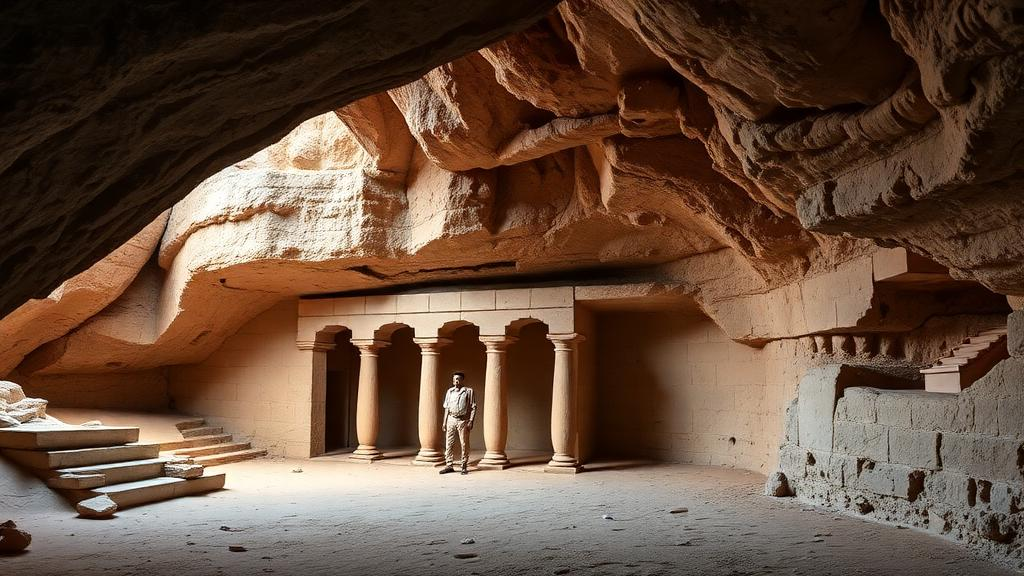
At the Longmen Grottoes in China, where more than a thousand years of Buddhist carving cover limestone cliffs along the Yi River, conservators face a deceptively simple question: when a cave temple loses its protective structure, what is the best way to shelter it again? A new study published in npj Heritage Science argues that the intuitive answer—enclose the cave as completely as possible—may be exactly wrong. By combining historical reconstruction, field monitoring, microclimate simulation, and a multi-indicator evaluation, a research team led by Ye Liu and Zengfeng Yan of Xi’an University of Architecture and Technology has developed a resilience-based framework for judging restoration schemes, and its verdict challenges decades of assumptions about protective architecture at rock-cut heritage sites.
The problem the team set out to solve is one that plagues cave temples worldwide. Many grottoes were originally carved with wooden eaves, galleries, or front halls that shielded the carved surfaces from direct sun, driving rain, and temperature swings. Over centuries, fires, wars, and decay stripped many of these structures away, exposing the fragile interiors to climatic disturbances. Restoring them seems obviously beneficial, yet the environmental consequences of different restoration designs have rarely been quantified. A shelter that blocks sunlight may also trap moisture; a structure that buffers heat may strangle airflow. Until now, conservators have lacked a rigorous, transferable method for comparing these trade-offs before committing stone, timber, and money to a particular design.
The researchers chose Cave 1280 at Longmen as their test case, a semi-open grotto whose conditions could be measured and modeled under three contrasting scenarios: no protective structure at all, a gallery-eave-type scheme that shades the cave front while leaving it largely open to the air, and a hall-type scheme that encloses the cave more completely. This scenario-based comparison is the heart of the study’s framework. Rather than asking whether a shelter helps, the method asks how each specific shelter reshapes the cave’s microclimate—temperature, relative humidity, solar radiation, and air movement—and whether those changes push the cave environment toward or away from stability.
Field monitoring first established the baseline physics of the cave. The measurements revealed pronounced seasonal vertical gradients in both temperature and relative humidity, meaning that conditions at the floor of the cave can differ substantially from conditions near the ceiling or entrance. Such stratification matters because moisture and heat do not act uniformly on carved stone; gradients drive condensation patterns, salt migration, and differential weathering that can damage one zone of a cave while leaving another untouched. Any restoration scheme, the study implies, must be judged by how it reshapes these vertical profiles, not just by average conditions at a single sensor.
The simulation results delivered a genuinely counterintuitive finding. The hall-type scheme, with its fuller enclosure, did exactly what its advocates would expect: it provided stronger thermal buffering, damping the daily and seasonal temperature swings that stress the stone, and it cut incoming solar radiation by an impressive 82 to 97 percent. On paper, those numbers look like a conservation triumph. But the same enclosure that blocks heat and light also restricts air exchange with the outside atmosphere. The hall-type scheme expanded zones of low air velocity inside the cave—pockets where the air barely moves—and this stagnation increased the cave’s sensitivity to moisture retention. In other words, the most protective-looking design created conditions under which dampness, once introduced, lingers longest against the carved surfaces.
This is where the resilience framing earns its keep. Traditional conservation assessment tends to reward structures that minimize fluctuations, treating stability as the sole goal. The resilience-based approach instead evaluates whether a cave environment can absorb and recover from climatic disturbances—rainy seasons, heat waves, visitor-driven humidity spikes—without crossing thresholds that trigger deterioration. A cave that is thermally serene but poorly ventilated may be less resilient than one that experiences wider swings but flushes moisture efficiently. The study’s multi-indicator evaluation captures this tension explicitly, weighing thermal buffering against airflow continuity, spatial openness, reversibility of the intervention, and compatibility with the surrounding landscape.
When all of these criteria were integrated, the gallery-eave-type scheme emerged as the favored option. It provides weaker thermal buffering than the hall-type design, to be sure, and it shields less of the cave from the sky. But it maintains better airflow continuity, preserving the natural ventilation that carries moisture out of the cave, and it keeps the spatial openness that matters both for the cave’s internal climate and for its visual relationship with the cliff face. The gallery-eave design is also more reversible—a crucial consideration in heritage practice, where today’s restoration may need to be revised by tomorrow’s conservators—and it sits more comfortably within the historic landscape of the grottoes.
The broader lesson, as the authors put it, is that greater enclosure does not necessarily ensure better conservation. This principle has implications far beyond a single cave in Henan Province. Semi-open grottoes—caves with large openings that are neither fully sealed chambers nor fully exposed niches—represent one of the most common and most vulnerable categories of rock-cut heritage, from the Buddhist caves of Central and East Asia to rock-hewn churches and tombs on other continents. For such sites, the study offers a transferable framework: reconstruct the historical protective architecture, monitor the actual microclimate, simulate candidate interventions under matched conditions, and evaluate the results with a multi-indicator, resilience-oriented scorecard before any physical construction begins.
The methodological machinery behind this framework deserves attention in its own right. Microclimate simulation allows conservators to test designs digitally, comparing how a gallery eave versus a full hall alters radiation loads and airflow fields across an entire annual cycle, something that would take years to measure empirically for even one design. Solar-radiation modeling quantifies the light and heat reaching carved surfaces, which matters not only for thermal stress but also for photochemical degradation and the biological growth that sunlight and dampness can jointly encourage. By anchoring these simulations in real field monitoring data, the team ensured that the modeled scenarios reflect the genuine behavior of the cave rather than idealized assumptions. The combination of measurement and modeling, evaluated through multiple indicators rather than a single metric, is what allows the framework to produce defensible, site-specific recommendations.
For the managers of Longmen—a UNESCO World Heritage site visited by millions—the findings arrive at a practical moment, offering an evidence-based path for deciding which caves receive which kind of protective architecture. For the wider heritage community, the study is a reminder that conservation is a systems problem, not a shelter problem. The carved stone at Longmen has survived fourteen centuries because of a delicate balance of shade, airflow, and moisture that the original builders understood intuitively. Modern restoration, this research suggests, succeeds best when it respects that balance rather than simply maximizing protection. Sometimes the wisest roof over an ancient Buddha’s head is the lightest one. The work was supported by the National Natural Science Foundation of China, and the team included researchers from Xi’an University of Architecture and Technology, the Leshan Giant Buddha Grottoes Research Institute, Henan University of Science and Technology, and the Longmen Research Institute, reflecting the collaboration between academic modeling and on-site stewardship that such decisions increasingly demand.
Subject of Research: Resilience-based assessment of architectural restoration schemes for the microclimate of semi-open rock-cut cave temples at the Longmen Grottoes, China
Article Title: Assessing architectural interventions in rock-cut heritage: a resilience-based restoration approach at Longmen Grottoes, China
Article References: Liu, Y., Yan, Z., Wang, C., Peng, J., Wang, J., Ma, C., Lei, F., Yue, Y., Zhang, D., & Ni, P. (2026). Assessing architectural interventions in rock-cut heritage: a resilience-based restoration approach at Longmen Grottoes, China. npj Heritage Science. https://doi.org/10.1038/s40494-026-03032-2
Image Credits: AI Generated
DOI: 10.1038/s40494-026-03032-2
Keywords: Longmen Grottoes, cave temples, rock-cut heritage, microclimate, restoration, protective architecture, thermal buffering, solar radiation, ventilation, resilience, heritage conservation, npj Heritage Science
Cite Scienmag News
Courtney Benton. (October 8, 2026). Less Shelter, Better Survival: Rethinking How We Protect Ancient Cave Temples. Scienmag. https://scienmag.com/less-shelter-better-survival-rethinking-how-we-protect-ancient-cave-temples/
Courtney Benton. "Less Shelter, Better Survival: Rethinking How We Protect Ancient Cave Temples." Scienmag, 8 October 2026, https://scienmag.com/less-shelter-better-survival-rethinking-how-we-protect-ancient-cave-temples/. Accessed 8 October 2026.
Courtney Benton. "Less Shelter, Better Survival: Rethinking How We Protect Ancient Cave Temples." Scienmag. October 8, 2026. https://scienmag.com/less-shelter-better-survival-rethinking-how-we-protect-ancient-cave-temples/


