


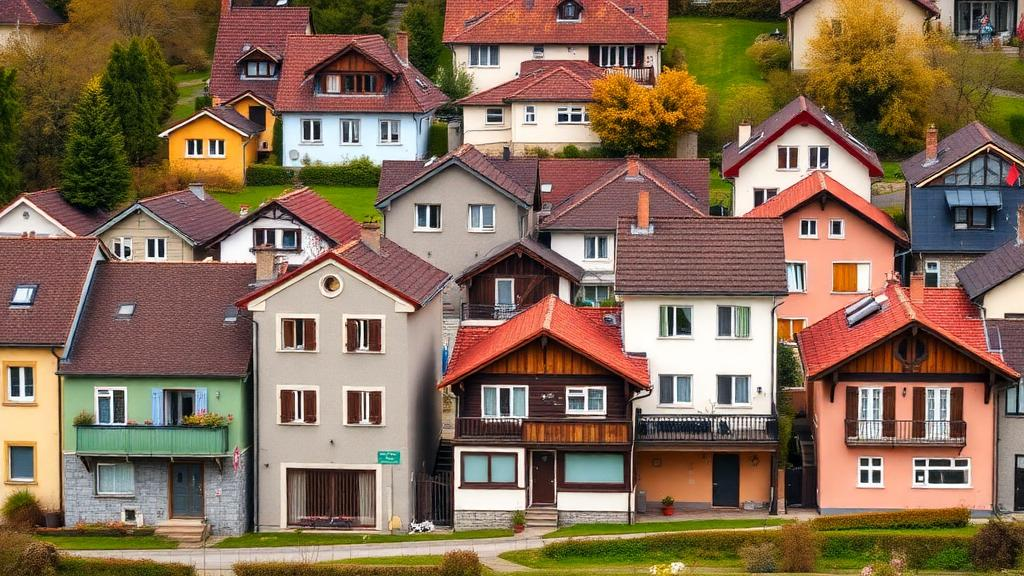
Switzerland is one of the richest countries in Europe, yet its cities are filling the streets with demonstrators demanding cheaper housing. Rents have climbed 30 percent since 2000, house prices have surged by 80 percent, and the vacancy rate has fallen to a national average of just 1.08 percent, dropping as low as 0.07 percent in Zurich. Popular initiatives, parliamentary battles, and mass protests all point to a population that feels squeezed. And yet, when researchers at ETH Zurich’s Wohnforum examined two decades of survey data, they found something surprising: the headline indicators of housing inequality in Switzerland have remained remarkably stable. Unraveling why the statistics and the public mood diverge so sharply reveals a great deal about how modern housing crises work, and why national averages can be so misleading.
Hannah Widmer and Jennifer Duyne Barenstein set out to place Switzerland’s housing situation in its broader European context, drawing on the European Union Statistics on Income and Living Conditions, known as EU-SILC. This annual survey covers roughly 8,000 Swiss households, or about 18,000 people, and captures information that register data cannot provide: total housing costs, disposable income, overcrowding, and self-reported housing quality. The team analyzed data from 2007 through 2024, comparing outcomes across tenure types, income quintiles, and degrees of urbanization. Their conceptual framework treated housing inequality as a multidimensional phenomenon, spanning affordability, accessibility, quality, and security of tenure, though the available data allowed them to examine affordability and quality most directly.
The Swiss housing system provides essential context for interpreting the numbers. With only 35.8 percent of dwellings owner-occupied, Switzerland has the lowest homeownership rate in Europe, and in Zurich a mere 8 percent of residents own their homes. The rental stock is dominated by private individuals, who own 45 percent of rental units, but corporate ownership has grown rapidly, rising from about 30 percent of rental units in 2003 to 43 percent today. Non-profit housing plays a marginal national role, with cooperatives owning just 9 percent of rental dwellings and the public sector 4 percent. Swiss housing policy has remained essentially unchanged since the 1950s, embedded in a federalist system that grants cantons and municipalities substantial autonomy and makes redistributive national housing policy difficult to enact.
Tenancy law offers only moderate protection. Landlords can raise rents when costs rise or when the reference interest rate changes, and they can pass 50 to 70 percent of value-enhancing renovation costs on to tenants. Contracts can be terminated on three months’ notice without any reason, and crucially, there are no systematic control mechanisms: it falls to tenants themselves to check the legality of rents and terminations and to contest them in court, which requires significant knowledge and financial resources. Only nine of the 26 cantons have legal frameworks supporting affordable non-profit housing construction, and federal direct subsidies were suspended in 2003, the very year the Housing Support Act was passed.
Against this backdrop, the quantitative findings paint a picture of persistent, layered inequality rather than dramatic deterioration. For mortgaged homeowners, housing costs consumed 24 percent of disposable income in 2010, falling to 18 percent by 2022, likely thanks to low interest rates. Tenants, by contrast, spend close to or above 30 percent of their disposable income on housing, with a slightly rising tendency in recent years, and those renting at market rates fare worse than those in the non-profit sector. The gradient across income quintiles is starker still: the bottom quintile devotes almost or above 50 percent of disposable income to housing in every year analyzed, nearly 20 percentage points more than the second quintile. Affordability, in other words, is overwhelmingly a problem of tenants and low-income households, concentrated in densely populated urban areas.
The European comparison adds nuance. Switzerland’s share of households facing housing cost overburden, meaning housing costs exceeding 40 percent of disposable income, is the fifth highest in Europe, and Swiss housing costs are twice the EU average. Yet rents have risen more slowly than in neighboring countries, climbing 11 percent since 2015 compared with more than 40 percent in Austria and 15 percent in Germany. House prices, however, have risen relatively strongly, and the post-2022 price decline observed elsewhere did not materialize in Switzerland. Meanwhile, overcrowding is rare by European standards: 6.1 percent of Swiss households live in overcrowded conditions in 2024, compared with an EU average of 16.8 percent, 11.4 percent in Germany, and 14.5 percent in Austria. Per capita living space has grown from 34 square meters in 1980 to 46.5 square meters in 2023, though this average conceals the fact that overcrowding is more than twice as common in densely populated areas as in thinly populated ones, and it has increased markedly among the two lowest income quintiles since 2022.
Housing quality tells a similarly two-sided story. Fewer than 1 percent of Swiss households report being unable to keep their home adequately warm, the lowest share in Europe, although the link to income appears to have strengthened following the surge in energy prices after Russia’s invasion of Ukraine in 2022. Problems with leaking roofs, damp walls, floors, or rot in window frames are considerably more common, affecting roughly 10 percent of households on average, up from 7.5 percent in 2007 to 11.2 percent in 2023, with a clear income gradient. For a country with Switzerland’s construction standards and generous tax deductibility of maintenance costs, that figure is strikingly high, and it disproportionately burdens lower-income households.
So why does the public perceive a crisis when the national indicators look stable? The researchers identify several mechanisms. First, Swiss rent regulation partially protects sitting tenants from rent increases, so the effects of a tightening market appear in the data only with a time lag. The people most exposed are those newly entering the housing market, those forced to move because of evictions or life changes, and those displaced by renovations or demolitions, a phenomenon known as renoviction. Second, the crisis is intensely local. National averages smooth over hotspots like Zurich and Geneva, where land scarcity, planning constraints, and international labor market pressure produce historically tight markets. Evidence shows that renovations with contract terminations and total reconstructions displace lower-income residents, single-parent households, and people without Swiss citizenship, dynamics that aggregate statistics do not yet fully capture.
Underlying all of this is the financialization of Swiss real estate. Institutional investors such as pension funds, banks, insurers, and asset managers have become increasingly dominant landlords, and they are expanding beyond metropolitan cores into smaller cities and tourist regions, where affluent buyers of second homes price out local residents. BlackRock, the world’s largest asset manager, multiplied its investments in Swiss real estate companies twentyfold over two decades. Because densification policies restrict buildable land, demolition and total reconstruction have become profitable strategies, allowing investors to replace sitting tenants with new ones paying market rents and thereby circumventing rent regulation on existing contracts. The authors warn that as population growth persists and financialization intensifies, these dynamics will likely make housing inequalities more pronounced in the future, even as renovations remain necessary for quality improvements and climate targets.
The study’s broader lesson extends well beyond Switzerland. A housing system can look stable in the aggregate while undergoing profound structural change beneath the surface, with the burden falling on the most mobile and most vulnerable. The researchers call for finer-grained analyses at different geographical scales and for evidence-based policy debate on how to mitigate rising inequality, noting that cantons such as Basel-Stadt, Geneva, and Vaud have already adopted stronger protections against evictions and disproportionate rent increases. Whether Switzerland’s corporatist model of regulated private provision can adapt to an era of financialized landlords and persistent population growth is now one of the central questions facing European housing policy, and the Swiss experience suggests that waiting for national averages to register a crisis may mean waiting far too long.
Subject of Research: Trends in housing inequality in Switzerland compared with other European countries
Article Title: Assessing housing inequality trends in Switzerland: where do we stand in comparison to Europe?
Article References: Assessing housing inequality trends in Switzerland: where do we stand in comparison to Europe?. (n.d.). https://doi.org/10.5194/gh-81-497-2026
Image Credits: AI Generated
Keywords: housing inequality, Switzerland, housing affordability, EU-SILC, rent regulation, tenant protection, overcrowding, housing quality, financialization, real estate investment, urban densification, European housing policy
Cite Scienmag News
Courtney Benton. (October 8, 2026). Switzerland’s Housing Crisis Hides in the Data: Why National Averages Mask Growing Inequality. Scienmag. https://scienmag.com/switzerlands-housing-crisis-hides-in-the-data-why-national-averages-mask-growing-inequality/
Courtney Benton. "Switzerland’s Housing Crisis Hides in the Data: Why National Averages Mask Growing Inequality." Scienmag, 8 October 2026, https://scienmag.com/switzerlands-housing-crisis-hides-in-the-data-why-national-averages-mask-growing-inequality/. Accessed 8 October 2026.
Courtney Benton. "Switzerland’s Housing Crisis Hides in the Data: Why National Averages Mask Growing Inequality." Scienmag. October 8, 2026. https://scienmag.com/switzerlands-housing-crisis-hides-in-the-data-why-national-averages-mask-growing-inequality/


