


Every weather forecast begins with a measurement. Before a supercomputer can simulate the atmosphere, it needs to know what the atmosphere is actually doing: how warm the air is at each height, how much water vapor it carries, and which way the wind is blowing from the ground to the edge of the weather. For more than a century, that knowledge has come largely from radiosondes, the instrument packages lofted twice a day on balloons from a sparse global network of launch sites. Between those launches, and between those sites, the lowest kilometer or two of the atmosphere, the boundary layer where most weather that affects people actually forms, remains poorly sampled. A German research campaign known as VITAL I set out to test whether a new generation of profiling instruments could close that gap, and its results, now published as a preprint under review for the journal Earth System Science Data, suggest that they largely can.
VITAL I, short for Vertical profiling of the troposphere: Innovation, optimization and application, Part I, took place in August 2024 at the Jülich Observatory for Cloud Evolution, or JOYCE, a National Facility of the ACTRIS European Research Infrastructure Consortium in western Germany. The campaign is a core activity of the Hans Ertel Centre for Weather Research, a joint initiative between German atmospheric research institutions and the German Meteorological Service, known by its German abbreviation DWD. That institutional pairing matters, because the campaign was not an academic exercise conducted in isolation from operational needs. The instruments under test are being considered for the next-generation DWD observational network, and the evaluation was carried out explicitly against the World Meteorological Organization’s Rolling Requirements Review, the international benchmark that defines how well a measurement system must perform before it is useful for short-term, high-resolution weather forecasting.
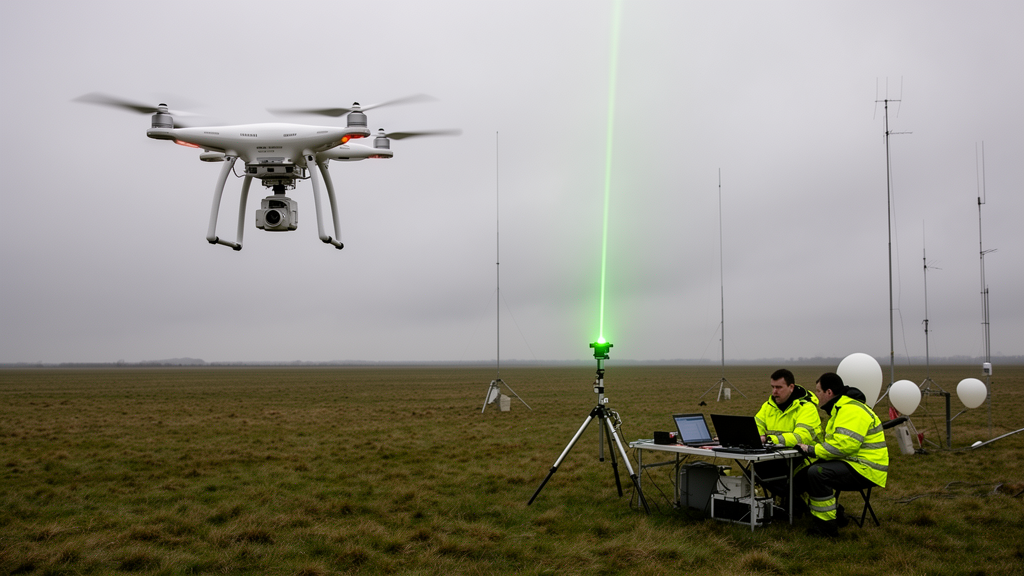
The technological lineup at the heart of the campaign reads like a catalogue of the tools many meteorologists believe will define the coming decades of atmospheric observation. On the ground, the researchers deployed Doppler lidars, which measure wind by detecting the Doppler shift of laser light scattered back from aerosol particles drifting with the air; water vapor lidars, which profile humidity by measuring the absorption and scattering of laser light by water molecules; and microwave radiometers, which infer temperature and humidity profiles from the faint microwave radiation the atmosphere emits at different frequencies. In the air, the team flew multi-copter uncrewed aerial systems, essentially instrumented drones capable of climbing through the boundary layer carrying sensors that measure temperature, humidity and wind directly along their flight paths.
What makes VITAL I scientifically valuable is that none of these instruments was evaluated in a vacuum. The two-week campaign produced vertical profiling datasets of temperature, humidity and wind that were compared against radiosondes, the established balloon-borne gold standard, and against measurements from a 120-meter meteorological tower at the site, which provides high-frequency in-situ readings at fixed heights. Comparisons were also carried out against satellite sounders, the spaceborne instruments that provide global but vertically coarse profiles of atmospheric temperature and moisture. This layered evaluation design allowed the researchers to ask a deceptively simple question with real operational consequences: when a new instrument disagrees with an old one, which one is right, and how much of the disagreement is a genuine error versus a difference in what each system can actually see?
The headline finding is encouraging for the future of ground-based profiling. Most of the tested ground-based systems were shown to fulfill the WMO breakthrough requirements, the ambitious performance thresholds the World Meteorological Organization has identified as targets that would transform forecasting capability if met. Equally important, the instruments proved capable of capturing the diurnal cycle of the atmospheric boundary layer, the full day-night evolution of the shallow, well-mixed layer of air near the surface that grows during daytime heating and collapses again after sunset. This cycle drives the formation of morning fog, the triggering of afternoon thunderstorms, and the dispersion or accumulation of pollutants, yet it unfolds largely between the twice-daily radiosonde launches, making continuous ground-based profiling a genuinely new observational capability rather than merely a cheaper substitute for balloons.
The technical challenges involved in this kind of intercomparison are considerable, and they explain why campaigns like VITAL I are needed at all. Each instrument family measures the atmosphere in a fundamentally different way. A microwave radiometer infers profiles indirectly from brightness temperatures and depends heavily on the retrieval algorithm that converts radiances into atmospheric states, with uncertainties that grow in cloudy or precipitation conditions. A Doppler lidar provides excellent wind information but needs sufficient aerosol loading to scatter light back, and its range can collapse in very clean air. Water vapor lidars offer high vertical resolution but demand careful calibration. Drones provide direct, high-accuracy in-situ measurements but sample one point in space at a time and are subject to aviation regulations and weather limits. Reconciling these different sampling geometries, resolutions and error characteristics against the tower, the radiosondes and the satellites is precisely the work that turns a collection of promising instruments into a validated observing system.
The campaign also had an educational dimension that its organizers built in from the start. Alongside the measurements, VITAL I encompassed an international summer school held simultaneously at JOYCE, designed to educate students from the bachelor to the doctoral level in modern methods of atmospheric profiling. This is more than a pleasant add-on. The transition from balloon-based to sensor- and laser-based observing networks will require a workforce fluent in radiative transfer, signal processing, data assimilation and the operational constraints of uncrewed aviation. Training the next generation of atmospheric scientists on live, cutting-edge instrumentation, while the instruments themselves are being validated, creates a pipeline of expertise that national weather services will need when these systems move from research sites into routine operations.
The data itself has been made publicly available through the research repository Zenodo, under the dataset title VITAL I: Vertical profiling of the troposphere: Innovation, optimization and application, Part I. Open release of campaign datasets of this kind has become a defining feature of modern atmospheric science, and it multiplies the value of the original effort. Model developers can use the co-located, multi-instrument observations to evaluate how well weather models represent boundary-layer structure. Retrieval scientists can test new algorithms against independent reference measurements. Instrument engineers can quantify the strengths and weaknesses of competing systems. And national meteorological services beyond Germany, all of which face the same questions about modernizing their observation networks, can draw on the evaluation results without repeating the entire campaign themselves.
The broader context is a worldwide rethink of how the lower atmosphere should be observed. Radiosonde networks provide indispensable accuracy and vertical detail, but their cost and logistics limit their temporal and spatial coverage, and the boundary layer’s rapid evolution between launches is a persistent blind spot for high-resolution forecasting. Satellites provide continuity and global reach but struggle with vertical resolution in the lowest layers, where temperature and humidity gradients are sharpest and where clouds interfere most. The emerging answer, which VITAL I was designed to stress-test, is a hybrid architecture: dense networks of continuous, ground-based active and passive remote sensors, augmented by targeted drone flights and constrained by satellite observations, all feeding data assimilation systems that can exploit high-frequency, high-resolution profiles. The finding that most of the ground-based systems tested at JOYCE meet WMO breakthrough requirements is a concrete step toward showing that such an architecture is technically feasible, not just conceptually appealing.
For the German Meteorological Service, the path from campaign to network runs through further evaluation, optimization and, ultimately, procurement decisions, and the VITAL campaign’s title promises a Part II. For forecasters and the public, the payoff would arrive in the form of better short-range forecasts of the phenomena that matter most at ground level: fog that closes airports, convective storms that flood streets, and the low-level winds that spread wildfire smoke or carry wind energy to the grid. The VITAL I dataset, gathered over two intensive weeks at a single observatory, demonstrates that the instruments to fill the boundary-layer gap already exist, that they can meet international performance standards, and that the community of scientists trained to use them is being built at the same time. What remains is the institutional work of turning a validated research dataset into an operational observing network, a transformation that, if it succeeds, will quietly reshape the accuracy of every forecast that begins with a measurement of the air above us.
Subject of Research: Evaluation of novel ground-based and uncrewed aerial profiling instruments for measuring temperature, humidity and wind in the atmospheric boundary layer
Article Title: Vertical profiling of the troposphere: Innovation, optimization and application, Part I (VITAL I)
Article References: Vertical profiling of the troposphere: Innovation, optimization and application, Part I (VITAL I). (n.d.). https://doi.org/10.5194/essd-2026-784
Image Credits: AI Generated
Keywords: atmospheric boundary layer, vertical profiling, Doppler lidar, microwave radiometer, water vapor lidar, uncrewed aerial systems, radiosonde, weather forecasting, WMO Rolling Requirements Review, JOYCE observatory, German Meteorological Service, Earth System Science Data
Cite Scienmag News
Violet Maxwell. (October 8, 2026). Drones and Lasers Put to the Test in Bid to Rebuild Weather Observation Networks. Scienmag. https://scienmag.com/drones-and-lasers-put-to-the-test-in-bid-to-rebuild-weather-observation-networks/
Violet Maxwell. "Drones and Lasers Put to the Test in Bid to Rebuild Weather Observation Networks." Scienmag, 8 October 2026, https://scienmag.com/drones-and-lasers-put-to-the-test-in-bid-to-rebuild-weather-observation-networks/. Accessed 8 October 2026.
Violet Maxwell. "Drones and Lasers Put to the Test in Bid to Rebuild Weather Observation Networks." Scienmag. October 8, 2026. https://scienmag.com/drones-and-lasers-put-to-the-test-in-bid-to-rebuild-weather-observation-networks/


