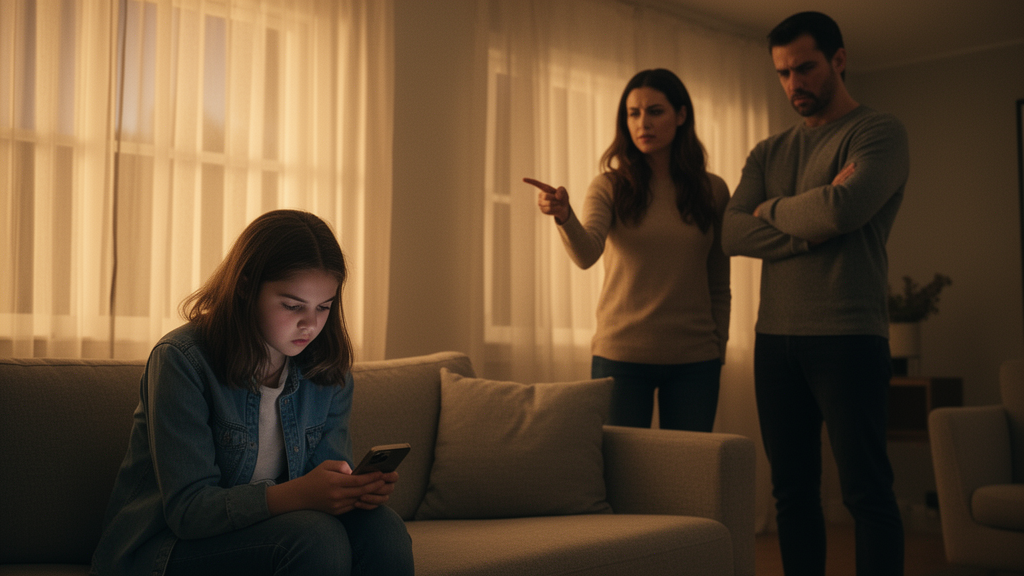
Every parent occasionally misreads their teenager’s behavior. A slammed door becomes defiance; a withdrawn silence at dinner becomes disrespect. But when those misreadings harden into a stable habit of blame—what psychologists call negative parental attribution—the consequences may ripple through an adolescent’s mental health for years. A new longitudinal study of more than 2,200 Chinese adolescents, published in Child Psychiatry & Human Development, now offers some of the strongest evidence yet that the relationship between how parents interpret their children’s behavior and how anxious those children feel in social settings is not a one-way street. It is a feedback loop, and its dynamics differ strikingly depending on whether the parent is a mother or a father, and whether the adolescent is a boy or a girl.
The research team, led by Jing Wang and colleagues at Yangzhou University, followed 2,228 adolescents across five waves of measurement spanning three years. At baseline, the participants averaged just under 13 years of age, and 46.3 percent were girls. Rather than taking a single snapshot, the investigators repeatedly assessed three constructs: parental child-oriented perfectionism, parental negative attribution, and adolescent social anxiety. Child-oriented perfectionism refers to the degree to which parents hold excessively high standards specifically for their child, scrutinizing performance and demanding flawlessness. Negative attribution, meanwhile, is the tendency to interpret a child’s ambiguous or unwanted behavior as intentionally hostile, lazy, or characterologically flawed rather than as a product of circumstance, fatigue, or developmental immaturity.
Methodologically, the study’s power comes from its use of the random intercept cross-lagged panel model, or RI-CLPM, a statistical framework that has reshaped how developmental psychologists interpret longitudinal data. Traditional cross-lagged models conflate two very different sources of association: stable differences between families (some adolescents are simply more anxious than others, and some parents are simply more critical than others) and genuine within-person dynamics (the question of whether a rise in one variable in a given individual predicts a subsequent rise in another in that same individual). By separating a stable random intercept for each person from the time-specific fluctuations around it, the RI-CLPM isolates the within-person processes that actually carry implications for intervention. A correlation that looks alarming at the between-person level may dissolve entirely once stable trait-like differences are removed; conversely, genuine reciprocal dynamics may emerge that older designs masked.
What the researchers found at the within-person level was a robust, stable, reciprocal relationship between parental negative attribution and adolescent social anxiety, and this held for both boys and girls. In practical terms, when an adolescent’s social anxiety rose above their own typical level at one wave, their parents became more likely to attribute the child’s behavior negatively at the next wave. And when parents’ negative attributions spiked, the adolescent’s social anxiety rose in turn. This bidirectional pattern is consistent with transactional models of development, which hold that children and their social environments continuously shape one another rather than one simply programming the other. An anxious teenager who avoids eye contact or refuses social invitations may be read by a frustrated parent as deliberately uncooperative; that attribution may then color parenting behavior in ways that confirm and amplify the adolescent’s fear of evaluation.
The findings on child-oriented perfectionism add a second, more intricate layer. Parental negative attribution did not operate in isolation from perfectionistic expectations; instead, the two fed into each other in patterns that were distinctly gender-specific. Fathers’ negative attributions showed reciprocal associations with their own child-oriented perfectionism and with mothers’ perfectionism when the adolescent was a daughter. For sons, however, fathers’ negative attributions only unidirectionally predicted mothers’ child-oriented perfectionism. Mothers’ negative attributions, by contrast, showed reciprocal links with fathers’ child-oriented perfectionism for daughters, and unidirectionally predicted their own perfectionism for adolescents of both genders. The adolescent’s gender, in other words, was not a peripheral demographic variable but a key moderator of the entire dynamic system.
These gender-differentiated patterns resonate with a broader literature on parenting in Chinese cultural contexts, where fathers’ involvement has historically been shaped by traditional role expectations even as contemporary shifts have increased paternal presence in childcare. They also echo theoretical models proposing that fathers may exert a distinctive influence on the development of social anxiety in children, potentially through their characteristic styles of challenge, evaluation, and humor. The new findings suggest that in Chinese families, the interpretive lens a father applies to a daughter’s behavior may become tightly coupled with the perfectionistic standards both parents hold for her, whereas the coupling works differently for sons. Why daughters’ family systems show more reciprocal interweaving of blame and perfectionism remains an open question, but it aligns with evidence that parents may socialize emotions differently in boys and girls, and that girls may be more sensitive to social evaluative feedback during adolescence.
The clinical implications are considerable. Social anxiety is among the most common and most impairing conditions of adolescence, typically emerging during the very developmental window this study captured, when sensitivity to peer evaluation peaks and the brain’s social processing circuitry is undergoing profound reorganization. If parental negative attribution and adolescent social anxiety reinforce each other within individuals over time, then interventions that target only the adolescent’s cognition may be fighting half a battle. The results argue for family-based approaches that also retrain parental attributional habits—helping parents recognize when they are defaulting to hostile or characterological explanations for developmentally normal behavior, and breaking the loop before perfectionistic standards and blame become mutually entrenching.
The gender-specific findings sharpen that prescription further. A one-size-fits-all parenting workshop may miss the mark if the pathways linking blame, perfectionism, and anxiety genuinely differ for families of daughters versus sons. The authors suggest that their results provide a foundation for developing targeted, gender-sensitive intervention strategies designed to alleviate adolescent social anxiety. Screening tools that assess parental attributions, particularly fathers’ attributions toward daughters, could identify families at elevated risk, while attribution retraining—already used in programs for parents of children with behavior problems—could be adapted to address the perfectionism-anxiety nexus identified here.
As with any study, caveats apply. The sample was drawn from Chinese schools, and attributional norms, gender role expectations, and the cultural weight of academic perfectionism vary across societies, so replication in other cultural settings will be essential before generalizing. The measures relied on adolescent reports of parental behavior and attitudes, which capture perceived parenting rather than directly observed parenting. And while the RI-CLPM is a powerful tool for establishing within-person temporal dynamics, it cannot deliver the certainty of an experiment; unmeasured third variables could still contribute to the observed cross-lagged relations. The authors note that all data supporting the findings are available from the corresponding author on reasonable request, and the study was supported by the Double Innovation Talents Program of Jiangsu Province.
Even with those limitations, the study marks a meaningful advance. It moves the conversation about parental perfectionism and adolescent anxiety beyond static correlations and into the realm of dynamic, within-person processes unfolding over years. It demonstrates that the blame an adolescent perceives and the anxiety that adolescent carries are locked in a mutually reinforcing dance, and it shows that the choreography of that dance depends on which parent is doing the interpreting and whether the child is a daughter or a son. For researchers, it offers a template for how to study family influence with the rigor the question deserves. For parents, it offers a simpler, humbling takeaway: the stories you tell yourself about why your teenager behaves the way they do may matter more than you think—and changing those stories could help change how your child feels walking into a room full of strangers.
Subject of Research: Longitudinal reciprocal associations between parental child-oriented perfectionism, parental negative attribution, and adolescent social anxiety
Article Title: Longitudinal Reciprocal Associations between Parental Child‑oriented Perfectionism, Negative Attribution, and Social Anxiety in Chinese Adolescents: A Five‑wave RI‑CLPM Study
Article References: Wang, J., Xin, Z., Jiang, Z., & Wang, M. (2026). Longitudinal Reciprocal Associations between Parental Child‑oriented Perfectionism, Negative Attribution, and Social Anxiety in Chinese Adolescents: A Five‑wave RI‑CLPM Study. Child Psychiatry & Human Development. https://doi.org/10.1007/s10578-026-02106-3
Image Credits: AI Generated
DOI: 10.1007/s10578-026-02106-3
Keywords: social anxiety, parenting, perfectionism, negative attribution, adolescence, RI-CLPM, longitudinal study, Chinese adolescents, developmental psychology, family systems, gender differences, mental health
Cite Scienmag News
Glenn Wilkins. (October 8, 2026). How Parents’ Blame and Perfectionism Feed Teen Social Anxiety, Three-Year Study Finds. Scienmag. https://scienmag.com/how-parents-blame-and-perfectionism-feed-teen-social-anxiety-three-year-study-finds/
Glenn Wilkins. "How Parents’ Blame and Perfectionism Feed Teen Social Anxiety, Three-Year Study Finds." Scienmag, 8 October 2026, https://scienmag.com/how-parents-blame-and-perfectionism-feed-teen-social-anxiety-three-year-study-finds/. Accessed 8 October 2026.
Glenn Wilkins. "How Parents’ Blame and Perfectionism Feed Teen Social Anxiety, Three-Year Study Finds." Scienmag. October 8, 2026. https://scienmag.com/how-parents-blame-and-perfectionism-feed-teen-social-anxiety-three-year-study-finds/