


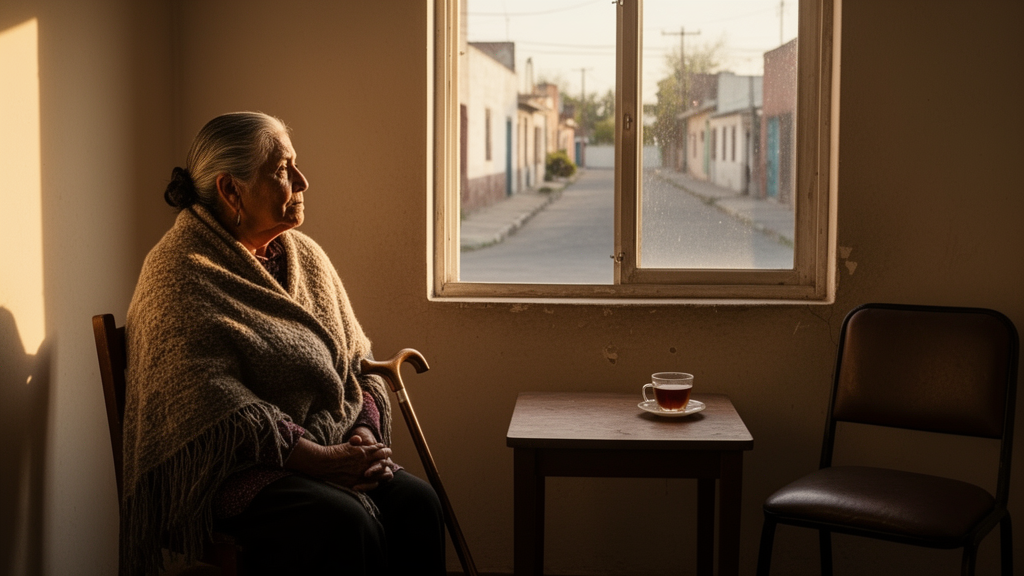
For millions of older adults, the slow erosion of independence begins not with a diagnosis but with a feeling. New research from Mexico suggests that two of those feelings in particular—loneliness and the sense of being ignored—may signal a heightened risk of functional dependence, the inability to carry out everyday tasks such as bathing, dressing, cooking, or managing money without help. The finding, drawn from one of the largest aging surveys in Latin America, adds a striking psychological dimension to a field that has long focused on age, chronic disease, and depression as the primary drivers of late-life disability.
The study, published in PLOS Aging and Health, was led by Laura Alejandra Ramirez-Tirado and colleagues, who analyzed data from 9,368 community-dwelling older adults who participated in the 2021 Mexican National Health and Aging Study, known by its Spanish acronym ENASEM. Unlike research confined to hospitals or clinics, ENASEM captures people living in their own homes and communities, which makes it a powerful window into how aging actually unfolds outside medical settings. The researchers used this cross-sectional dataset to ask a deceptively simple question: do subjective experiences of social disconnection predict dependence in daily activities even after accounting for the traditional risk factors that clinicians already track?
Functional dependence, the outcome at the heart of the study, comes in two distinct forms. Basic activities of daily living, abbreviated BADL, include fundamental self-care tasks such as eating, bathing, toileting, and getting in and out of bed. Instrumental activities of daily living, or IADL, demand a higher level of cognitive and physical integration and include managing finances, preparing meals, shopping, and using transportation. Losing the ability to perform either category of task marks a major turning point in an older person’s life, typically increasing reliance on family caregivers, raising the likelihood of institutionalization, and driving up health care costs. Identifying modifiable predictors of that decline is therefore one of the most consequential goals in aging research.
What sets this study apart is its focus on exposures that are, in the authors’ words, highly modifiable: feelings of loneliness, isolation, and being ignored. Loneliness is the subjective distress that arises when the quality of one’s social relationships falls short of what one wants. Isolation, by contrast, is a more objective state of social disconnection, while feeling ignored captures the painful perception of being overlooked by others. Previous community-based studies have linked these subjective experiences to deteriorating health status in general, but their specific relationship with functional dependence—over and above established risk factors—had remained underexplored, particularly in low- and middle-income countries where aging populations are growing fastest.
The statistical approach the researchers took was deliberately conservative. They first estimated the prevalence of each exposure—loneliness, isolation, and feeling ignored—and the prevalence of dependence in BADL and IADL, calculating 95 percent confidence intervals for each estimate. They then built sequential logistic regression models, a technique that allows investigators to see whether an association survives as progressively more covariates are added. The fully adjusted models controlled for a comprehensive set of traditional risk factors, including age, educational level, socioeconomic circumstances, lifestyle factors, and relevant chronic diseases. Only if an association with functional dependence persisted in those fully adjusted models could the researchers argue that the psychological exposures carried independent weight.
The descriptive results painted a familiar but sobering demographic picture. The prevalence of feelings of loneliness, isolation, and being ignored all increased with age, and at every age the burden was higher among women than among men. Functional dependence followed the same pattern, rising steadily with age and affecting more women than men at any given point. This sex disparity echoes a well-documented global phenomenon: women tend to live longer than men, accumulate more years of disability, and often outlive spouses and close social networks, which can compound both their social disconnection and their physical vulnerability in the final decades of life.
The crucial finding, however, emerged from the fully adjusted models. Even after the researchers accounted for age, education, socioeconomic status, lifestyle, and chronic disease, the effects of isolation and feelings of being ignored on functional dependence remained statistically significant. In other words, an older Mexican adult who felt socially disconnected or overlooked was more likely to be unable to independently perform basic or instrumental activities of daily living, and that excess risk could not be explained away by the conventional clinical profile. Loneliness, isolation, and feeling ignored are not merely emotional byproducts of declining health; in this dataset they appear to travel alongside dependence in their own right.
The implications of that result reach in two directions at once. Clinically, the study suggests that a brief question about social well-being—whether an older patient feels isolated or ignored—could flag individuals at elevated risk of losing independence, potentially before the physical decline becomes obvious. Public health authorities in Mexico, where the population aged 60 and over is expanding rapidly, may find in these results a low-cost lever for prevention: interventions that strengthen social connection, from community programs to policies that reduce marginalization of the elderly, could plausibly delay or reduce functional dependence. Because the exposures are subjective and modifiable, they are, in principle, far easier to change than age or chronic disease diagnoses.
At the same time, the authors and careful readers alike must weigh the inherent limits of the design. The analysis is cross-sectional, meaning it captures a single moment in time; it can establish association but not the direction of causation. It remains possible that emerging functional decline itself deepens feelings of isolation and being ignored, rather than the reverse, or that unmeasured factors—such as untreated pain, sensory impairment, or neighborhood environment—drive both the feelings and the disability. Longitudinal follow-up of the ENASEM cohort would be needed to disentangle these pathways and to test whether improving social well-being actually prevents dependence.
Even with those caveats, the study lands with force in a country confronting one of the fastest demographic transitions in the world. The authors conclude that improving feelings related to social well-being in older adults is important for reducing functional dependence in Mexico, a recommendation that reframes social connection from a soft, optional concern into a measurable component of healthy aging. If subsequent research confirms that feeling ignored today helps predict who needs help bathing or managing money tomorrow, then the fight against late-life disability may need to begin not in the clinic, but in the everyday social worlds of older adults—in whether they are seen, included, and heard.
Subject of Research: The association between subjective social disconnection and functional dependence among older adults in Mexico
Article Title: Feelings of isolation and being ignored associated with functional dependence beyond traditional risk factors among older adults in Mexico
Article References: Ramirez-Tirado, L. A. (2026). Feelings of isolation and being ignored associated with functional dependence beyond traditional risk factors among older adults in Mexico. PLOS Aging and Health, 1(3), e0000034. https://doi.org/10.1371/journal.page.0000034
Image Credits: AI Generated
DOI: 10.1371/journal.page.0000034
Keywords: loneliness, social isolation, functional dependence, older adults, Mexico, ENASEM, activities of daily living, aging, public health, disability, social well-being, PLOS Aging and Health
Cite Scienmag News
Ophelia Keating. (October 8, 2026). Loneliness and Feeling Ignored May Predict Loss of Independence in Older Mexican Adults. Scienmag. https://scienmag.com/loneliness-and-feeling-ignored-may-predict-loss-of-independence-in-older-mexican-adults/
Ophelia Keating. "Loneliness and Feeling Ignored May Predict Loss of Independence in Older Mexican Adults." Scienmag, 8 October 2026, https://scienmag.com/loneliness-and-feeling-ignored-may-predict-loss-of-independence-in-older-mexican-adults/. Accessed 8 October 2026.
Ophelia Keating. "Loneliness and Feeling Ignored May Predict Loss of Independence in Older Mexican Adults." Scienmag. October 8, 2026. https://scienmag.com/loneliness-and-feeling-ignored-may-predict-loss-of-independence-in-older-mexican-adults/


