


Directing a beam of light precisely where it needs to go has long been one of the central engineering challenges of free-space optics. Satellites in orbit must acquire and track one another as their relative positions shift by the second. Airborne LiDAR systems must sweep across broad landscapes to build three-dimensional maps of terrain. Optical wireless links must find receivers scattered across a room or a city, and collaborative robots increasingly need to sense and communicate with partners anywhere in a shared scene. What all of these applications share is a demand for steering light in two dimensions—horizontally and vertically—while keeping the beam narrow, bright, and clean enough to remain useful at a distance.
For decades, engineers have faced an uncomfortable trade-off in meeting that demand. Mechanical scanning systems, built around gimbaled mirrors and rotating assemblies, can cover very large angles, but they carry the penalties of size, weight, power consumption, and moving parts that wear out and drift out of alignment. Chip-based optical phased arrays, by contrast, eliminate almost all mechanical motion by electronically controlling the phase of light emitted from many tiny antennas. Yet most phased arrays scan widely in only one direction. Extending them to true two-dimensional operation typically requires densely packed arrays and large numbers of individually controlled elements, which drives up electrical complexity, fabrication difficulty, and energy consumption. The result has been a persistent gap between what free-space optical systems need and what chip-scale technology has been able to deliver.
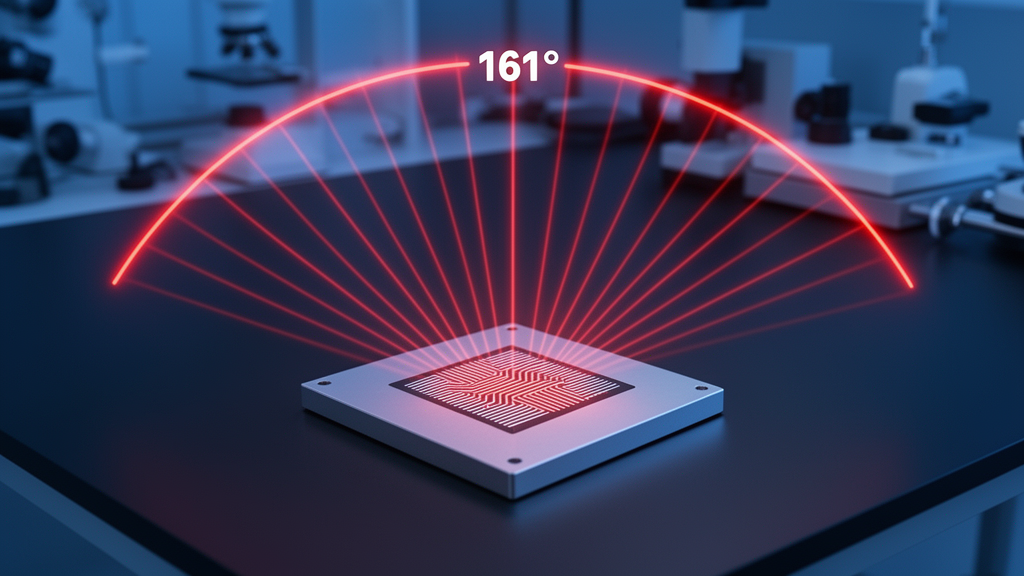
A research team led by Professor Juejun Hu’s group at the Massachusetts Institute of Technology, working with the Singapore-MIT Alliance for Research and Technology and collaborators, has now demonstrated a hybrid photonic platform that closes much of that gap. Reported in the journal Opto-Electronic Advances, the platform achieves two-dimensional beam steering across a measured field of view of 161 degrees while maintaining nearly diffraction-limited beam quality across a broad angular range. The work was made available online on August 23, 2026, in the Early View section of the journal, and it represents a distinctly different architectural philosophy from the phased-array mainstream.
The key insight behind the new platform comes from an unexpected direction: optical projection. Rather than controlling a dense array of optical antennas with thousands of independently tuned phase shifters, the system uses a silicon photonic integrated circuit as a light-routing engine. The circuit directs light through an on-chip network of switches to a selected output waveguide. At that output, a freeform micro-optical reflector turns the guided light upward, out of the chip plane, and shapes it into a clean free-space beam. In effect, the chip behaves like a projector that selects which of several pre-defined optical paths the light will follow, rather than an antenna array that synthesizes a direction wavefront by wavefront.
The second stage of the architecture is where the wide-angle steering happens. After leaving the reflector, the beam passes through a metasurface—a flat optical element patterned with nanoscale structures that impose precise, position-dependent changes on the light. According to Professor Hu, the position of the selected reflector determines the direction in which the metasurface sends the beam, so choosing a different optical path on the chip directly produces a different steering direction. This division of labor is the heart of the design. The photonic integrated circuit handles the discrete selection of output paths with low complexity, while the metasurface performs the heavy optical work of redirecting and correcting the beam across an ultrawide angular range.
Building the platform required weaving together several fabrication traditions that rarely meet on a single substrate. The team combined analytical optical design, numerical modeling, established semiconductor manufacturing, three-dimensional microprinting, and nanofabrication. The photonic integrated circuit itself was produced using a standard silicon photonics foundry process, meaning the light-routing backbone could in principle be manufactured with the same mature industrial tooling that produces commercial silicon photonic chips. The freeform reflectors, which must efficiently transform the guided optical mode traveling inside a waveguide into a Gaussian-like free-space beam, were designed for that conversion task and then printed directly onto the chip in three dimensions, a technique that allows curved micro-optical geometries impossible with conventional planar lithography.
The metasurface followed a similarly disciplined design pipeline. Its pattern was first established through an analytical design framework, giving the team a physically grounded starting point, and was then refined using optical simulations specifically aimed at reducing aberrations at large steering angles. Aberration control is critical here: when a beam strikes a flat optic far off its nominal axis, simple lenses and gratings tend to smear the focus and distort the wavefront. By optimizing the nanoscale pattern against these off-axis effects, the researchers ensured that beams steered toward the edges of the field of view would emerge nearly as clean as those near the center. After careful assembly and alignment of the chip, reflectors, and metasurface, the complete system was tested at telecommunications wavelengths, the near-infrared band used by fiber networks and many free-space optical links.
The measured results are what make the demonstration notable. The system steered a beam in two dimensions across a 161-degree field of view—an extraordinarily wide cone for any chip-scale device—while keeping the output nearly diffraction-limited, meaning the beam spread was close to the fundamental physical limit set by the aperture rather than degraded by optical imperfections. Because steering is achieved by switching among discrete reflector positions rather than continuously phasing an antenna array, the control electronics remain comparatively simple, avoiding the dense wiring and high power draw that plague two-dimensional phased arrays. The trade-off is that the platform steers among a set of discrete directions, but the researchers see that as a starting point rather than a ceiling.
The architecture, in fact, offers several clear paths toward even better performance. Compact piezoelectric translation could add fine or continuous steering between the discrete directions provided by the current reflector array, blending the simplicity of the switching approach with the smooth coverage of a scanner. Lower-loss photonic foundry processes, improved assembly alignment, and direction-specific metasurface optimization could each raise the overall optical efficiency, putting more of the laser’s power into the steered beam. Increasing the effective aperture, or pairing the platform with beam-expanding optics, would narrow the output beam further, which is essential for long-distance links where divergence over kilometers of free space determines whether enough light arrives at the receiver.
Professor Hu notes that these advances will build on the demonstrated wide field of view and high beam quality, moving the technology toward scalable optical projectors for communications, sensing, and other applications requiring agile, wide-angle control of light. If the hybrid approach matures along those lines, the implications reach across the free-space photonics landscape: inter-satellite optical links that steer across the sky from a chip smaller than a coin, airborne LiDAR with no moving gimbal, and point-to-point Li-Fi communication that can retarget a data beam instantly. A patent based on the technology has been filed by 2Pi Inc., signaling that the researchers see a commercial future for a platform that turns beam steering from a mechanical problem into a manufacturing one.
Subject of Research: Chip-scale hybrid photonic integrated circuit and metasurface platform for ultrawide-angle two-dimensional optical beam steering
Article Title: New chip-scale optical platform enables high-quality ultrawide beam steering
Article References: New chip-scale optical platform enables high-quality ultrawide beam steering. (n.d.). Original publication
Image Credits: AI Generated
DOI: Not provided
Keywords: beam steering, photonics, metasurface, photonic integrated circuit, silicon photonics, free-space optics, LiDAR, optical communications, micro-optics, nanofabrication, Li-Fi, optical phased arrays
Cite Scienmag News
Grant Pearson. (October 8, 2026). Chip-Scale Photonic Platform Steers Laser Beams Across 161 Degrees Without Moving Parts. Scienmag. https://scienmag.com/chip-scale-photonic-platform-steers-laser-beams-across-161-degrees-without-moving-parts/
Grant Pearson. "Chip-Scale Photonic Platform Steers Laser Beams Across 161 Degrees Without Moving Parts." Scienmag, 8 October 2026, https://scienmag.com/chip-scale-photonic-platform-steers-laser-beams-across-161-degrees-without-moving-parts/. Accessed 8 October 2026.
Grant Pearson. "Chip-Scale Photonic Platform Steers Laser Beams Across 161 Degrees Without Moving Parts." Scienmag. October 8, 2026. https://scienmag.com/chip-scale-photonic-platform-steers-laser-beams-across-161-degrees-without-moving-parts/


