


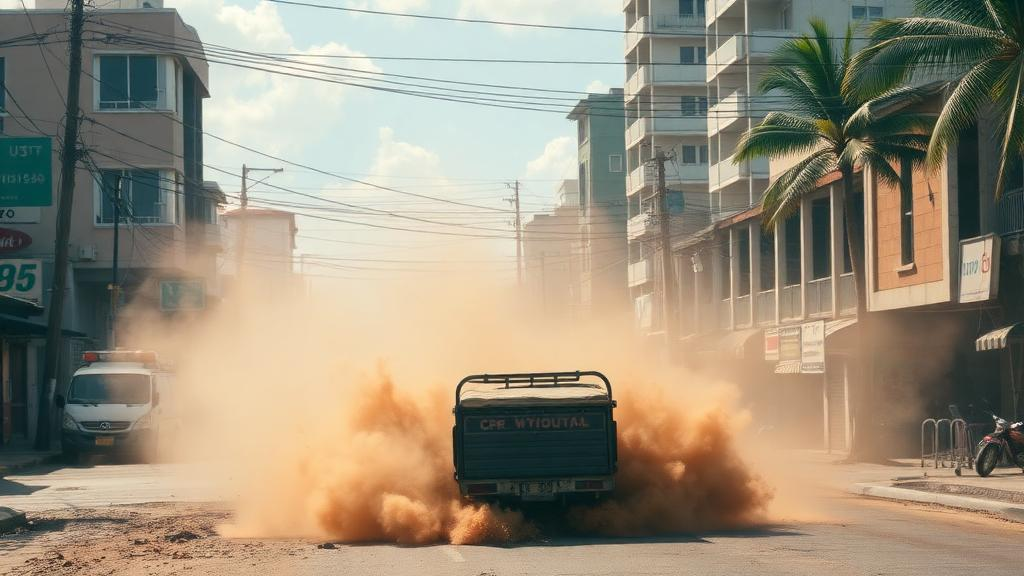
The dust that settles along the streets of a rapidly growing tropical city in Southeast Asia has turned out to be far more than an everyday nuisance. A new study published in Environmental Science and Pollution Research shows that roadside dust can act as a sensitive chemical archive of urban life, recording the fingerprints of traffic, construction, industry, and even the underlying geology of the landscape. By measuring 22 elements across five different land use types, researchers have assembled one of the most detailed pictures yet of how heavy metals accumulate in the streets of a developing city, and what that accumulation means for the people who live, work, and walk among it every day.
The research team, led by scientists at Mindanao State University–Iligan Institute of Technology in the Philippines in collaboration with colleagues at Tohoku University in Japan, sampled roadside dust from commercial, residential, industrial, institutional, and agricultural zones. Each sample was digested and analyzed using inductively coupled plasma mass spectrometry, or ICP-MS, an analytical technique sensitive enough to detect metals at concentrations down to parts per billion. This allowed the team to quantify both the abundant crustal elements that dominate dust by mass and the potentially toxic trace metals that matter most for ecological and human health.
The results revealed a clear hierarchy in the dust chemistry. Iron was the most abundant metal overall, followed by aluminum, titanium, and chromium, a pattern that reflects the geogenic, or naturally derived, composition of the dust. In other words, the bulk of the material swirling along these roads ultimately comes from weathered rock and soil rather than from human activity. This baseline matters, because it provides the reference against which anthropogenic contamination can be detected. When elements such as lead and mercury rise above what the local geology would predict, that is the signal of human influence.
Industrial land use did record the highest average concentrations of both geogenic and trace metals, which might seem alarming at first glance. Yet when the researchers ran the ecological risk assessment, the industrial zone posed only a low ecological risk based on its potentially toxic metals. High total metal concentrations driven by natural crustal material do not necessarily translate into ecological harm. The distinction between abundance and toxicity is a recurring theme in environmental geochemistry, and this study illustrates it neatly: what matters is not just how much metal is present, but which metals and how reactive they are.
The more troubling findings came from the commercial and residential districts. Both showed clear signs of lead and mercury contamination and measurable ecological risk. The highest ecological risk index in the entire study, 236.46, was recorded in the commercial area, a value that signals considerable environmental stress. Commercial zones typically combine dense traffic, frequent braking and tire wear, high pedestrian activity, and a mix of small-scale industrial and service activities, all of which can inject toxic metals into street dust. Lead in particular is a legacy pollutant that persists in urban environments long after its primary sources, such as leaded gasoline, have been phased out, while mercury can enter the streetscape through a variety of combustion and industrial pathways.
To translate contamination into human exposure, the team performed a health risk assessment built on the standard framework of average daily dose calculations. The results were unambiguous about the dominant exposure route: ingestion of dust particles, whether through hand-to-mouth contact or the swallowing of particles deposited on food and surfaces, was the primary pathway by which people take up these metals. Dermal contact, in which dissolved metals pass through the skin, ranked second, and inhalation of resuspended dust ranked third. This ordering is consistent with studies of street dust in cities around the world and underscores why keeping dust out of homes and off hands is a meaningful public health strategy.
The assessment also exposed a demographic vulnerability. Average daily doses were consistently higher for children than for adults across the metals analyzed. The reasons are physical rather than mysterious: children breathe faster relative to their body weight, spend more time close to the ground where dust settles, engage in frequent hand-to-mouth behavior, and absorb ingested metals more efficiently. Among the heavy metals examined, lead contributed the highest exposure dose, while cadmium and mercury contributed substantially lower doses. Even so, the combination of elevated lead exposure and the known neurodevelopmental sensitivity of children to lead makes the commercial and residential findings particularly consequential for urban planning in fast-growing cities.
Identifying where the metals came from required more than concentration measurements alone. The researchers applied two multivariate statistical techniques: principal component analysis, or PCA, and canonical correlation analysis, or CCA. These methods look for elements that vary together across sampling sites, grouping them into components that can be matched to plausible sources. The analysis identified two broad families of origin. One component reflected natural, geogenic sources, dominated by the crustal elements such as iron and aluminum. The other pointed squarely at human activity, including urban development and construction, vehicle emissions, and vehicle components such as brake pads, tires, and engine wear. This kind of source apportionment is what turns a monitoring dataset into actionable policy information, because it tells city officials which activities to target.
The broader significance of the study lies in its implications for the many cities across the tropics and the developing world that are urbanizing at unprecedented speed. In such places, environmental monitoring infrastructure is often thin, and comprehensive air quality networks may be years away. Roadside dust offers a practical alternative: it is cheap to sample, chemically informative, and integrates pollution over time rather than capturing only a momentary snapshot. The authors argue that roadside dust is an effective environmental indicator for assessing heavy metal contamination and the associated ecological and human health risks in rapidly urbanizing cities. In effect, every street corner becomes a passive monitoring station.
For residents of cities like the one studied, the practical takeaways are grounded in the exposure science. Because ingestion dominates, simple measures such as washing hands before eating, damp-cleaning rather than sweeping indoors, and reducing children’s direct contact with roadside dust can meaningfully cut exposure. For policymakers, the message is that commercial corridors deserve particular attention, that traffic-related sources are a controllable driver of contamination, and that land use planning should treat dust chemistry as a design constraint rather than an afterthought. As tropical cities continue to expand, the dust on their streets will keep recording the story of that growth. This study shows how to read it, and why ignoring it would be a mistake.
Subject of Research: Heavy metal contamination and health risks of roadside dust in a rapidly urbanizing tropical city
Article Title: Heavy metal contamination, risk assessment, and source apportionment of roadside dust in a rapidly urbanizing tropical city: Implications for developing urban environments
Article References: Coñado, J. C., Amer, N. B., Romarate, R. A., II, Takahashi, S., Chien, M.-F., & Bacosa, H. P. (2026). Heavy metal contamination, risk assessment, and source apportionment of roadside dust in a rapidly urbanizing tropical city: Implications for developing urban environments. Environmental Science and Pollution Research, 33(30), 15601-15617. https://doi.org/10.1007/s11356-026-38223-8
Image Credits: AI Generated
DOI: 10.1007/s11356-026-38223-8
Keywords: roadside dust, heavy metals, lead contamination, mercury, ICP-MS, ecological risk assessment, health risk assessment, source apportionment, urbanization, tropical city, trace metals, land use
Cite Scienmag News
Violet Maxwell. (October 8, 2026). Roadside Dust in a Booming Tropical City Reveals Hidden Heavy Metal Hotspots. Scienmag. https://scienmag.com/roadside-dust-in-a-booming-tropical-city-reveals-hidden-heavy-metal-hotspots/
Violet Maxwell. "Roadside Dust in a Booming Tropical City Reveals Hidden Heavy Metal Hotspots." Scienmag, 8 October 2026, https://scienmag.com/roadside-dust-in-a-booming-tropical-city-reveals-hidden-heavy-metal-hotspots/. Accessed 8 October 2026.
Violet Maxwell. "Roadside Dust in a Booming Tropical City Reveals Hidden Heavy Metal Hotspots." Scienmag. October 8, 2026. https://scienmag.com/roadside-dust-in-a-booming-tropical-city-reveals-hidden-heavy-metal-hotspots/


