


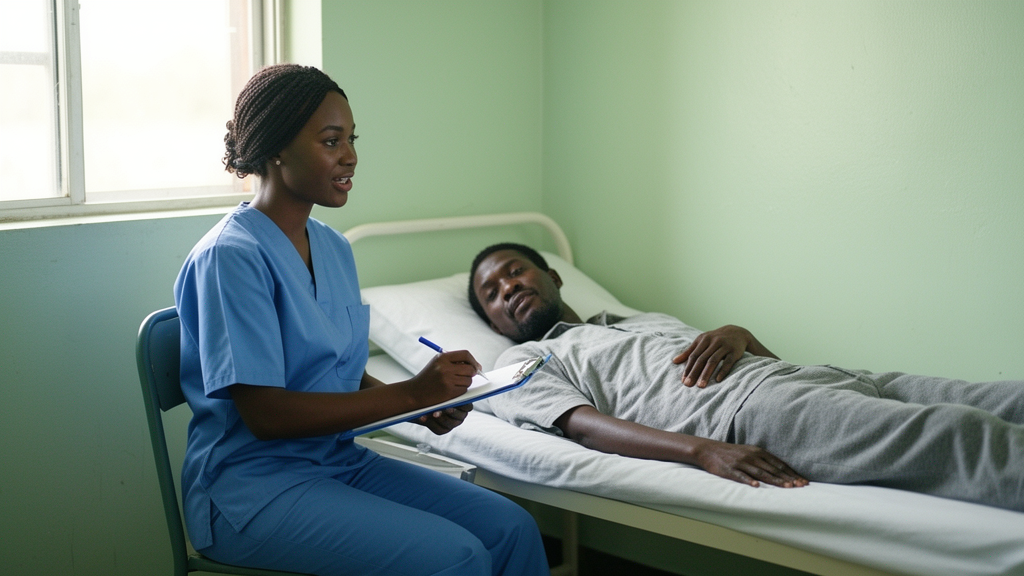
Tuberculosis has long been thought of as a disease of the lungs, but a new study from Nigeria adds to mounting evidence that it is also a disease of the mind. In a quasi-experimental controlled trial published in PLOS Mental Health, researchers found that ordinary health workers with no psychiatric training could deliver effective depression treatment to people undergoing TB therapy, and that lifting the weight of depressive symptoms was strongly linked to whether patients finished their TB treatment and were cured. The findings carry particular weight in a country with fewer than 200 psychiatrists for a population of more than 200 million.
The trial, led by Ngozi Murphy-Okpala of RedAid Nigeria and colleagues, enrolled 442 people with tuberculosis who also showed significant depressive symptoms, defined as a score of five or higher on the nine-item Patient Health Questionnaire, a widely used screening tool scored from 0 to 27. Participants were recruited between January and April 2025 across ten local government areas in three Nigerian states: Anambra and Enugu in the south, and Nasarawa in the north. Eight southern sites, spanning eleven public and private health facilities, served as the intervention arm, while seven facilities in two northern LGAs acted as controls. The researchers deliberately chose control sites that were geographically separated from the intervention areas to reduce the risk of contamination between study groups.
The intervention itself was a pragmatic test of task sharing, the rational redistribution of clinical tasks from scarce specialists to trained non-specialist health workers. At intervention sites, community health workers and non-mental-health nurses delivered a one-stop package of TB and depression care guided by the World Health Organization’s Mental Health Gap Action Programme Intervention Guide. Their toolkit included psychoeducation about diagnosis, treatment duration, adherence and side effects; identification of psychosocial stressors; problem-solving techniques; strengthening of social support; and encouragement to continue regular social and occupational activities. Antidepressant medications drawn from Nigeria’s essential primary care drug list were prescribed when guidelines indicated. A consultant psychiatrist provided refresher training and remote supportive supervision throughout.
Control sites operated the way most Nigerian TB services do: patients received TB treatment from the same cadre of health workers, but anyone screening positive for depression was referred to a specialist mental health provider in a separate setting. The researchers then tracked a sobering real-world detail. According to information gathered by the health workers, not a single participant in the control arm actually completed the referral to a specialist, even though they kept returning for their TB appointments. The referral chain, in other words, functioned on paper but not in practice, a finding that speaks volumes about the barriers separating rural and semi-urban patients from hospital-based psychiatric services concentrated in large cities.
Depressive symptoms were measured with the PHQ-9 at baseline and again at two, eight and 24 weeks, intervals chosen to coincide with expected relief from depression, completion of active TB treatment and completion of the continuation phase of TB therapy. Social support was assessed with the validated Oslo social support scale, and covariates including age, sex, education, marital status, residence and comorbidities were statistically controlled. The 22 health workers who administered the instruments underwent two days of intensive training, roughly 12 to 14 contact hours, with role-plays, supervised mock interviews and reliability testing; data collection began only once inter-rater agreement exceeded a Cohen’s kappa of 0.8. Questionnaires were carefully translated into Igbo and Hausa through iterative forward and back translation.
The statistical core of the study was a mixed analysis of variance comparing symptom trajectories between and within the two arms, analyzed both per protocol and by intention to treat, with missing data handled by last observation carried forward for 120 participants. The headline result was a null one: there was no significant difference in PHQ-9 scores between the integrated-care group and the standard-care group at the end of follow-up (F = 0.95, p = 0.32), and the interaction between study arm and time was likewise non-significant (F = 0.66, p = 0.57). Both groups improved in parallel, with depressive symptom scores falling significantly over the 24 weeks in each arm (p < 0.001).
That parallel improvement is the study’s most provocative wrinkle. Even though no control participant saw a specialist, their depression lifted anyway, apparently in response to TB treatment alone. The authors note that participants in the control arm had mostly moderate depression, with a median PHQ-9 score of 12, and point to earlier research documenting a progressive decline in depressive symptoms during TB therapy, from just over half of patients at baseline to under three percent at six months. Some TB drugs, notably isoniazid, have long been suspected of having antidepressant properties, and the simple resolution of a devastating illness may itself relieve psychological distress. The trial cannot disentangle these mechanisms, but the implication is clear: TB treatment alone can partially treat the depression that accompanies it.
Where the study did find a sharp signal was in the link between mental state and TB outcomes. Depressive symptom scores at the end of follow-up differed significantly according to TB treatment outcome (F = 25.78, p < 0.001): patients whose depression had markedly improved were the ones who completed treatment and achieved cure, while those who dropped out, died or were transferred out carried persistently higher symptom scores. This is the vicious cycle that TB researchers have described as a syndemic: depression discourages care-seeking and adherence, poor adherence prolongs infectiousness and drives drug resistance, and a worsening illness deepens despair. Breaking that cycle, the authors argue, requires TB programs to actively screen for and treat mental health conditions rather than treating them as someone else’s problem.
Regression analysis identified several independent predictors of residual depressive symptoms at 24 weeks: older age, primary-level education, and higher baseline depression scores all predicted worse outcomes, while rural residence and receiving either intervention were associated with lower final scores. The intervention variable itself emerged as a significant predictor (β = -0.17, p = 0.004), a nuance the authors interpret cautiously given the absence of an overall between-group difference. The study has acknowledged limitations: it was not randomized, the control sites were socio-culturally different and fewer in number, and six months of follow-up cannot establish how long any benefit lasts. A randomized trial with allocation concealment remains the gold standard.
Even so, the practical message is hard to ignore. Non-specialist health workers, already the backbone of TB care in Nigeria and much of sub-Saharan Africa, can be trained in days to deliver guideline-based depression care that performs at least as well as a referral system that, in this study, nobody completed. With roughly four in ten people with TB in Africa showing significant depressive symptoms, and depression projected to be among the world’s most burdensome disorders by 2030, the one-stop integrated model now being piloted in Nigeria offers a rare piece of good news: the workforce to close the mental health treatment gap may already be standing in the TB clinic.
Subject of Research: Integrated tuberculosis and depression treatment delivered by non-specialist health workers in Nigeria
Article Title: Effectiveness of integrated tuberculosis and depression treatment led by non-specialist health workers versus standard care among persons with tuberculosis in a low-resource setting: A quasi-experimental non-randomized controlled trial
Article References: Murphy-Okpala, N., Nwafor, C., Eze, C., Njoku, M., Ezeakile, O., Meka, A., Ekeke, N., Iyama, F., Egbule, D., Anyaike, C., Chijioke-Akaniro, O., Chukwu, J., Kirubi, B., Creswell, J., & Onu, J. U. (2026). Effectiveness of integrated tuberculosis and depression treatment led by non-specialist health workers versus standard care among persons with tuberculosis in a low-resource setting: A quasi-experimental non-randomized controlled trial. PLOS Mental Health, 3(9), e0000636. https://doi.org/10.1371/journal.pmen.0000636
Image Credits: AI Generated
DOI: 10.1371/journal.pmen.0000636
Keywords: tuberculosis, depression, task sharing, non-specialist health workers, Nigeria, global health, mental health integration, PHQ-9, mhGAP, treatment adherence, low-resource settings, quasi-experimental trial
Cite Scienmag News
Glenn Wilkins. (October 8, 2026). Nurses without psychiatry training can treat depression in TB patients, Nigerian trial finds. Scienmag. https://scienmag.com/nurses-without-psychiatry-training-can-treat-depression-in-tb-patients-nigerian-trial-finds/
Glenn Wilkins. "Nurses without psychiatry training can treat depression in TB patients, Nigerian trial finds." Scienmag, 8 October 2026, https://scienmag.com/nurses-without-psychiatry-training-can-treat-depression-in-tb-patients-nigerian-trial-finds/. Accessed 8 October 2026.
Glenn Wilkins. "Nurses without psychiatry training can treat depression in TB patients, Nigerian trial finds." Scienmag. October 8, 2026. https://scienmag.com/nurses-without-psychiatry-training-can-treat-depression-in-tb-patients-nigerian-trial-finds/


