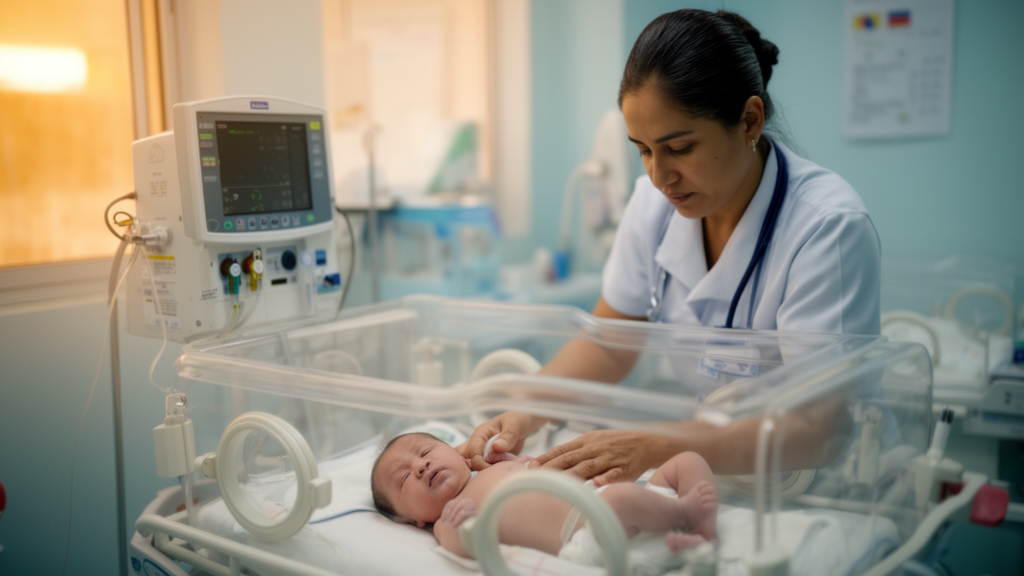
A sweeping analysis of thirteen years of national health records from Ecuador has revealed a striking and uneven picture of newborn health in the South American nation, one that challenges the assumption that broad infant health indicators tell the full story. The study, published in BMC Pediatrics, examined more than a quarter of a million hospital discharges and nearly five thousand infant deaths recorded between 2012 and 2024, focusing on four of the most consequential perinatal conditions tracked by the International Classification of Diseases: disorders related to short gestation and low birth weight, birth asphyxia, respiratory distress of the newborn, and bacterial sepsis of the newborn. What emerged was not a single national trend but four distinct epidemiological narratives unfolding simultaneously, each with different implications for how hospitals, neonatal intensive care units, and public health authorities should allocate their increasingly stretched resources.
The research, conducted by Fabricio González-Andrade of Universidad Tecnológica Indoamérica in Quito, took the form of a retrospective ecological time-series study, a design that aggregates population-level data rather than following individual patients. The investigator drew on thirteen annual national hospital discharge datasets from Ecuador’s National Institute of Statistics and Censuses, using registered live births as the denominator to calculate hospitalization rates, and paired these with six annual mortality datasets covering 2019 through 2024. Because the analysis relied exclusively on publicly available, de-identified administrative and vital statistics data, no individual informed consent or ethics committee approval was required under Ecuadorian regulations governing observational health research. The methodological rigor of the approach was reinforced by adherence to internationally recognized reporting standards for observational studies conducted with routinely collected health data.
The headline finding concerns respiratory distress of the newborn, classified under ICD-10 code P22, which towered over the other conditions in every measure of burden examined. Over the study period, this single condition accounted for 110,091 hospitalizations, more than 1.03 million hospital days, 2,381 deaths, and an estimated 220,778 disability-adjusted life years lost. To put those numbers in perspective, respiratory distress alone generated roughly forty-four percent of all the hospital discharges captured in the analysis. Its hospitalization rate climbed from 25.90 to 41.57 per 1,000 registered live births across the thirteen-year window, a statistically significant overall annual percent change of 3.15 percent, with a confidence interval running from 1.33 to 5.00 percent. That trajectory suggests a steady, compounding pressure on neonatal services rather than a sudden shock, and it implies that demand for surfactant therapy, mechanical ventilation, and specialized nursing care has been growing year after year regardless of other disruptions to the health system.
Birth asphyxia, coded P21, told a very different and arguably more alarming story. Although it did not dominate hospitalization counts, it recorded the highest ecological deaths-to-hospitalizations ratio in the study at 11.22 percent, meaning that for every hundred hospitalizations attributed to asphyxia, more than eleven infant deaths were registered nationally. More significantly, it was the only one of the four conditions to show a statistically significant increase in mortality over the period analyzed, with an annual percent change of 9.60 percent and a confidence interval of 4.33 to 15.13 percent, yielding a P value of 0.007. Birth asphyxia, which results from a failure of oxygen delivery around the time of delivery, is in many settings considered a marker of the quality of intrapartum care, including fetal monitoring, timely recognition of distress, and access to emergency obstetric and neonatal resuscitation services. A rising mortality signal in this category therefore points toward systemic weaknesses in the chain of care surrounding childbirth rather than merely changes in how illnesses are coded.
The two remaining conditions added further nuance to the national picture. Disorders related to short gestation and low birth weight, the P07 category that captures the consequences of prematurity, and bacterial sepsis of the newborn, coded P36, each followed their own trajectories. Sepsis in particular increased rapidly in the early years of the series before reaching a statistical joinpoint in 2017, after which it declined modestly. This pre-existing deceleration proved methodologically important: when the investigator applied exploratory interrupted time-series estimates to the pandemic years of 2020 through 2024, the results for sepsis had to be interpreted against the backdrop of a trend that was already flattening before COVID-19 arrived. In other words, apparent pandemic-era changes in sepsis hospitalizations cannot be straightforwardly attributed to the disruption itself, a caution that applies to many observational studies attempting to isolate the effects of the pandemic on health services.
One of the study’s notable technical strengths is that it avoided the imputation problems that have plagued similar analyses elsewhere. Because complete national hospitalization data were available for every year from 2012 through 2024, including the pandemic period, all years were analyzed as directly observed records. This eliminated the need to model or estimate missing pandemic-era values, a source of considerable uncertainty in time-series research from countries where routine data collection faltered during 2020 and 2021. The analytical toolkit was correspondingly rich: segmented regression to identify joinpoints where trends changed direction, negative binomial regression suited to overdispersed count data, incidence rate ratios to quantify relative risk, deviations from prepandemic projections, and an acute disability-adjusted life year metric combining years of life lost with years lived with disability to translate hospitalizations and deaths into a single measure of population health burden.
The concept of the deaths-to-hospitalizations ratio deserves particular attention, because it illustrates both the power and the limits of ecological surveillance. As a ratio computed from two independent national datasets, it cannot identify whether the infants who died were the same individuals who had been hospitalized, and it cannot distinguish between a condition becoming more lethal, patients arriving at hospitals sicker, or deaths occurring outside hospital settings entirely. The author is explicit on this point, noting that linked birth, hospital, and mortality records are needed to separate true changes in disease occurrence from shifts in referral patterns, diagnostic coding practices, and access to care. Ecuador, like many middle-income countries, has expanded health insurance coverage and hospital infrastructure over the past decade, and such expansions can plausibly increase recorded hospitalizations for conditions like respiratory distress simply because more newborns reach facilities where the diagnosis is made and coded.
Even with those caveats, the policy implications are difficult to ignore. The finding that respiratory distress dominates hospital days is essentially a statement about intensive care capacity: more than a million accumulated hospital days over thirteen years represents an enormous commitment of neonatal cots, ventilators, and skilled staff, and the upward trend in hospitalization rates suggests that this commitment will need to grow. Meanwhile, the rising mortality from birth asphyxia signals a different kind of intervention, one aimed upstream at labor wards, rural referral systems, and the training of birth attendants rather than at neonatal units. The study’s central conclusion, that distinct perinatal conditions generate different patterns of frequency, lethality, and resource use, amounts to an argument against managing infant health through a single aggregate indicator. A national infant mortality rate that appears stable or slowly improving could conceal a worsening asphyxia problem offset by gains elsewhere, and only condition-specific surveillance would reveal it.
The research also arrives at a moment of broader reflection in global health about the architecture of newborn survival programs. Worldwide, the leading causes of neonatal death, prematurity, birth asphyxia and trauma, and infection, have proven stubbornly resistant to interventions that succeeded against infectious diseases of later childhood. Ecuador’s experience, documented here with unusual completeness for the region, offers a case study in how middle-income health systems experience that resistance at the level of hospital wards and vital statistics registries. The absence of external funding for the work, and its foundation entirely in publicly available government data, underscore that the findings reflect the country’s own administrative record rather than a specially constructed research cohort.
For the scientific community, the study stands as a demonstration of how much can be extracted from routine data when the analytical methods are matched to the question. Segmented time-series analysis, negative binomial modeling, and burden estimation with disability-adjusted life years are not exotic techniques, but applying them coherently to thirteen years of national discharge data and six years of mortality data produced findings that no single-year report or aggregate mortality statistic could have surfaced. The author’s call for linked national surveillance, connecting birth registries, hospital discharges, and death certificates at the individual level, is the natural next step, and it would transform ratios like the 11.22 percent asphyxia figure from a population-level signal into a traceable clinical pathway. Until then, Ecuador’s neonatal wards, and the policymakers who fund them, now have a clearer map of where the burden lies: a rising tide of respiratory illness filling hospital beds, and a quieter but more lethal rise in birth asphyxia that demands attention where babies are born, not just where they are treated afterward.
Subject of Research: National trends in infant hospitalization, mortality, and health-service burden from four major perinatal conditions in Ecuador, 2012–2024
Article Title: National trends in hospitalization, mortality, and health-service burden from selected perinatal conditions among infants in Ecuador: a retrospective ecological time-series study, 2012–2024
Article References: González-Andrade, F. (2026). National trends in hospitalization, mortality, and health-service burden from selected perinatal conditions among infants in Ecuador: a retrospective ecological time-series study, 2012–2024. BMC Pediatrics. https://doi.org/10.1186/s12887-026-07780-9
Image Credits: AI Generated
DOI: 10.1186/s12887-026-07780-9
Keywords: infant mortality, hospital discharge, respiratory distress of newborn, birth asphyxia, neonatal sepsis, premature birth, low birth weight, Ecuador, time-series analysis, disability-adjusted life years, neonatology, health services research
Cite Scienmag News
Harold Sullivan. (October 8, 2026). Respiratory Distress Drives Ecuador’s Infant Hospital Burden While Birth Asphyxia Deaths Rise. Scienmag. https://scienmag.com/respiratory-distress-drives-ecuadors-infant-hospital-burden-while-birth-asphyxia-deaths-rise/
Harold Sullivan. "Respiratory Distress Drives Ecuador’s Infant Hospital Burden While Birth Asphyxia Deaths Rise." Scienmag, 8 October 2026, https://scienmag.com/respiratory-distress-drives-ecuadors-infant-hospital-burden-while-birth-asphyxia-deaths-rise/. Accessed 8 October 2026.
Harold Sullivan. "Respiratory Distress Drives Ecuador’s Infant Hospital Burden While Birth Asphyxia Deaths Rise." Scienmag. October 8, 2026. https://scienmag.com/respiratory-distress-drives-ecuadors-infant-hospital-burden-while-birth-asphyxia-deaths-rise/