


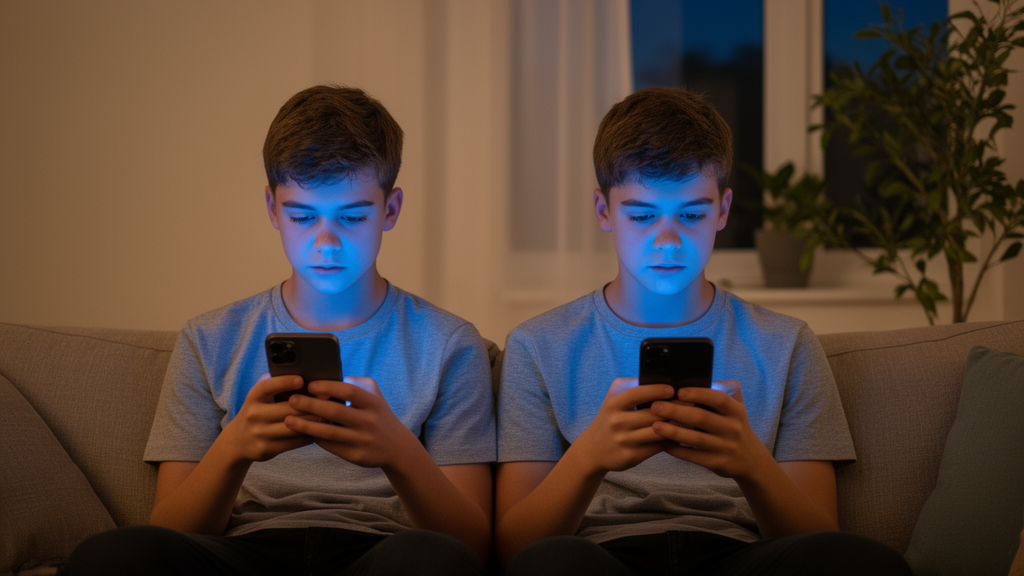
One of the largest investigations ever conducted into the mental health effects of recreational screen use has delivered a finding that is already reshaping a fierce scientific debate: the association between screen time and internalizing problems in young people is real, but much of it may be explained by shared genetic and family factors rather than by screens themselves. The study, published in Nature Human Behaviour, followed 21,797 Swedish twins from preadolescence into young adulthood, using a co-twin control design that allows researchers to separate the effects of screen use from the effects of inherited traits and shared upbringing.
The research team, led by Tong Gong and Yi Lu of Karolinska Institutet, drew on the Child and Adolescent Twin Study in Sweden, a national cohort that has tracked participants at ages 9, 15, 18 and 24. Because the cohort was linked to national patient registers and prescription drug records, the researchers could examine not only self-reported symptoms of depression and anxiety but also clinically diagnosed disorders and antidepressant dispensing over follow-up periods extending more than a decade. This combination of symptom scales and hard clinical endpoints is rare in screen time research, which has often relied on small samples and coarse self-reports.
The headline results were striking at the population level. At ages 15 and 18, screen time showed a clear dose-response pattern with internalizing symptoms: the more hours per day young people spent on screens, the higher their depression and anxiety scores. Comparing heavy users, defined as those spending more than six hours per day, with restrictive users at two hours or less, the standardized differences in symptom scores ranged from 0.20 to 0.38 in the full sample. The associations were markedly stronger in girls than in boys for interactive activities such as gaming, chatting and browsing, with heavy use corresponding to symptom elevations of 0.37 to 0.51 standard deviations in girls, compared with 0.19 to 0.22 in boys.
The clinical picture was even more dramatic. Heavy interactive screen use at age 15 was associated with a roughly two- to threefold increased risk of being diagnosed with a depressive or anxiety disorder by age 28, with weekday heavy use showing an adjusted hazard ratio of 3.37. Even daily gaming at age 9, reported by parents, was linked to a 38 percent higher risk of clinical outcomes through age 22. Passive activities such as watching television, videos and DVDs showed far weaker and mostly non-significant associations, suggesting that what young people do on screens may matter as much as how long they spend there.
But the study’s most consequential findings emerged when the researchers turned to the twin structure of their data. Monozygotic twins share essentially all of their inherited genes, while dizygotic twins share on average half, and both types share their rearing environment. By comparing one twin who used screens heavily with their co-twin who did not, the co-twin control design effectively removes confounding from shared genetics and family background, factors that ordinary observational studies cannot measure. If the screen-mental health link were purely causal, it should persist within identical twin pairs.
It did not, at least not robustly. Within discordant dizygotic pairs, effect estimates attenuated modestly. Within discordant monozygotic pairs, the attenuation was far more pronounced: at age 15, estimates shrank by 32 to 95 percent relative to the full sample and were no longer statistically significant after correction for multiple testing. At age 18, the corresponding estimates were attenuated by 16 to 45 percent. In the longitudinal analyses, the strong cross-age associations between heavy interactive use at 15 and symptoms at 18, and between use at 18 and symptoms at 24, were reduced by roughly 30 to 60 percent within twin pairs and fell below the significance threshold. The pattern of progressive but incomplete attenuation is consistent with a mixture of genetic confounding, shared environmental confounding and possibly a small residual direct effect.
The clinical outcomes told a similar story. The threefold risk elevation associated with heavy weekday interactive use at age 15 dropped by 57 to 59 percent within discordant twin pairs, leaving a point estimate of a 65 percent increased risk that no longer reached significance after multiple-testing correction. Daily gaming at age 9, which showed a significant hazard ratio of 1.38 in the full sample, showed no comparable association within discordant pairs. The authors interpret this cautiously: the analyses had limited statistical power because informative discordant pairs are few, so small direct effects cannot be ruled out entirely, but the evidence for a clear causal effect of screen time on internalizing problems is weak.
The study also probed directionality, a persistent puzzle in this field. Screen use at age 9 did not predict symptoms at 15, but heavy interactive use at 15 and 18 predicted symptoms at 18 and 24 respectively. Intriguingly, the reverse pathway also appeared: adolescents with higher depressive and anxiety symptoms at 15 showed a small but measurable increase in interactive screen use at 18, with an odds ratio of 1.04 per standard deviation of symptoms. Although modest, this reverse association suggests that vulnerable young people may gravitate toward heavier digital engagement, potentially encountering more negative social comparison and mood impacts, a dynamic documented in recent studies of adolescents with mental health conditions.
The findings carry important implications for policy. Public health agencies in several countries have issued guidelines limiting recreational screen time for children and adolescents, but these rest largely on non-causal observational evidence. The new results align with earlier genetically informed work showing that screen behaviors themselves are moderately heritable, with twin-based estimates of 20 to 49 percent, and that genetic confounding accounts for a substantial share of the apparent association between media use and mental health. They also echo the influential analyses by Orben and Przybylski, who found that per-hour effects of screen use on adolescent well-being are small; the co-twin estimates here correspond to roughly 0.03 to 0.05 standard deviations of additional symptoms per extra hour of interactive use at age 18.
Yet the authors caution against dismissing the issue entirely. Within age-18 identical twin pairs, weekend heavy interactive use was still associated with 0.26 standard deviations of additional symptoms compared with restrictive use, an effect size comparable to established risk factors such as bullying victimization and childhood maltreatment, which typically fall in the 0.2 to 0.3 range. The study also has limitations: data collection began in 2004, before smartphones and social media became ubiquitous; the crude categories of interactive and passive use do not capture the complexity of modern digital life; and self-reported screen time is known to be underreported. Sensitivity analyses adjusting for physical activity and bullying victimization left the main findings essentially unchanged. The researchers conclude that heavy recreational screen use remains a legitimate public health concern, particularly during adolescence, but that shared genetic and familial factors partly explain the link to depression and anxiety, and that future research should focus on why and how different types of digital engagement affect vulnerable young people, rather than on screen time alone.
Subject of Research: Longitudinal twin study of recreational screen use and internalizing problems from preadolescence to young adulthood
Article Title: Recreational screen use and internalizing problems from preadolescence to young adulthood in a longitudinal twin cohort with co-twin comparison
Article References: Gong, T., Frans, E., Ohlis, A., Yao, S., Zhang, R., Nilsson, A., Molero, Y., Mosing, M. A., Brikell, I., Larsson, H., Lichtenstein, P., Thorell, L. B., Magnusson, P. K., Kuja-Halkola, R., & Lu, Y. (2026). Recreational screen use and internalizing problems from preadolescence to young adulthood in a longitudinal twin cohort with co-twin comparison. Nature Human Behaviour. https://doi.org/10.1038/s41562-026-02607-0
Image Credits: AI Generated
DOI: 10.1038/s41562-026-02607-0
Keywords: screen time, mental health, depression, anxiety, twin study, co-twin control design, adolescence, genetic confounding, internalizing problems, gaming, Nature Human Behaviour, epidemiology
Cite Scienmag News
Glenn Wilkins. (October 8, 2026). Massive Twin Study Finds Screen Time’s Link to Youth Depression May Be Partly Genetic. Scienmag. https://scienmag.com/massive-twin-study-finds-screen-times-link-to-youth-depression-may-be-partly-genetic/
Glenn Wilkins. "Massive Twin Study Finds Screen Time’s Link to Youth Depression May Be Partly Genetic." Scienmag, 8 October 2026, https://scienmag.com/massive-twin-study-finds-screen-times-link-to-youth-depression-may-be-partly-genetic/. Accessed 8 October 2026.
Glenn Wilkins. "Massive Twin Study Finds Screen Time’s Link to Youth Depression May Be Partly Genetic." Scienmag. October 8, 2026. https://scienmag.com/massive-twin-study-finds-screen-times-link-to-youth-depression-may-be-partly-genetic/


