


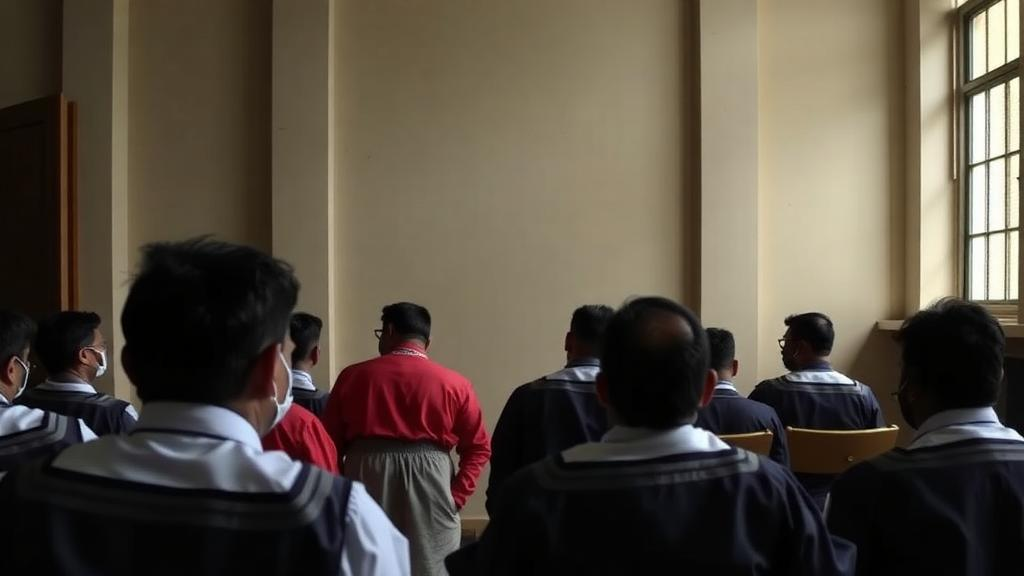
A new study published in SN Social Sciences argues that the celebrated idea of merit in India’s elite universities is not a neutral measure of talent but a caste-coded construct that systematically excludes Dalit students. Researchers Sristi Kumain, Debapriya Ganguly and Taruna Anand of Graphic Era Deemed to be University analyzed Insight Foundation’s 2011 documentary The Death of Merit: Dr. Balmukund Bharti, treating the film as a socio-cultural text that reveals how institutional practices, inherited privilege and everyday humiliation converge to produce what they describe as structurally inequitable higher education. Their central claim is provocative: the academic failure and suicide of a Dalit medical student cannot be understood as an individual tragedy, but as the predictable output of institutions designed around upper-caste dispositions.
The documentary at the heart of the study reconstructs the life and death of Dr. Balmukund Bharti, a student from a historically marginalized community who died by suicide within India’s competitive medical education system. The filmmakers document the accusations, stigma and social isolation that surrounded students admitted through constitutionally mandated reservation policies. In the dominant meritocratic discourse of Indian higher education, such students are frequently labeled quota students or beneficiaries of the reservation system, terms the study identifies as stigmatizing devices that frame Dalit students as intellectually incompetent and undeserving of their seats, regardless of their actual performance.
To build its theoretical framework, the study draws on three intellectual pillars. Ajantha Subramanian’s ethnographic work on the Indian Institutes of Technology, culminating in her book The Caste of Merit, demonstrates how upper-caste students convert generations of accumulated social advantage into apparently earned academic excellence. Pierre Bourdieu’s concepts of cultural capital and reproduction explain how educational systems quietly reward the dispositions, languages and confidence transmitted within privileged families while penalizing those who arrive without them. Stuart Hall’s encoding and decoding model allows the authors to read the documentary itself as a mediated text whose meanings are actively produced and contested rather than passively recorded.
Through this combined lens, merit emerges as what the authors call an institutional construct structured by caste. Upper-caste students typically inherit English fluency, familiarity with elite academic cultures, coaching networks, professional role models and the unmarked comfort of belonging to the dominant social group. None of these advantages appear on an entrance examination scorecard, yet all of them shape who succeeds once inside the institution. When upper-caste privilege is converted into merit, the hierarchy that produced the advantage becomes invisible, and the Dalit student who struggles against unfamiliar codes is recast as the one who lacks ability.
The study pays close attention to the mundane mechanics of exclusion. Dalit students describe being segregated in hostels, avoided in laboratories and classrooms, subjected to open speculation about their admission scores, and denied the informal mentorship that carries privileged students through demanding professional programs. Drawing on Erving Goffman’s account of stigma and Harold Garfinkel’s analysis of degradation ceremonies, the authors show how repeated small humiliations function as public rituals that mark Dalit students as spoiled identities within the institutional community. The cumulative effect, they argue, is not incidental but structural: the dominant institutional culture is calibrated to upper-caste dispositions, rendering marginalized students as undeserving infiltrators in spaces that claim to be democratic.
The psychological toll of this environment is a central thread of the analysis. The authors cite research on the mental health impact of caste and structural inequality in Indian higher education, including work by Komanapalli and Rao on the psychiatric consequences of discrimination and studies linking caste-based exclusion to depression, anxiety and suicidal ideation. Stereotype threat, the well-documented phenomenon in which awareness of a negative group label degrades performance under pressure, compounds the burden. A student who must simultaneously master a rigorous curriculum and manage a daily assault on their belonging operates under conditions their privileged peers never encounter, yet only their outcomes are measured and judged.
The paper situates Bharti’s death within a broader and troubling pattern. The authors reference the 2007 report of the committee chaired by S.K. Thorat that investigated allegations of differential treatment of Scheduled Caste and Scheduled Tribe students at the All India Institute of Medical Sciences in Delhi, which documented hostility, social boycott and discriminatory practices. Subsequent scholarship, including ethnographies of Dalit students at elite Indian universities and analyses of multi-layered exclusion in premier institutions, has repeatedly found that reservation policies open doors that the internal culture of institutions then works to close. The study also invokes the concept of epistemic oppression developed by Kristie Dotson, describing how the knowledge and testimony of marginalized students are systematically discounted, making it difficult even to name the discrimination they experience.
Documentary film, the authors argue, plays a distinctive evidentiary role in this landscape. Citing scholarship on documentary as resistance, they treat The Death of Merit not merely as reportage but as a counter-archive that renders visible what institutional discourse renders invisible. Where university narratives celebrate meritocratic selection and official statistics obscure lived experience, the film preserves testimony, names stigma and locates individual deaths within structural causation. Hall’s encoding and decoding framework helps explain why such texts matter: audiences may read them in dominant, negotiated or oppositional ways, but the documentary intervenes in the public meaning of merit by insisting that caste is an active ingredient in academic outcomes rather than a residue of the past.
The timing of the study gives its argument contemporary urgency. The authors note recent controversy around the University Grants Commission’s 2026 Promotion of Equity in Higher Educational Institutions Regulations, which were stayed by the Supreme Court amid fierce public debate, alongside student protests and campus restrictions reported in the Indian press. These developments, the paper suggests, reveal how contested the politics of caste and equity in education remains, and how resistance to affirmative action frequently redeploys the language of merit to defend inherited advantage. The study’s bibliography traces a sustained scholarly conversation, from Satish Deshpande’s analysis of exclusive inequalities to recent work on the reproduction of caste privilege in elite institutions, indicating that the questions raised by Bharti’s death have only intensified over the past decade and a half.
The authors conclude with a call to re-imagine merit itself as a condition of social justice within India’s contemporary educational landscape. If merit is produced rather than merely revealed, they argue, then institutions bear responsibility for the environments in which students succeed or fail. That means interrogating how cultural capital is distributed before admission, how institutional cultures reward particular social dispositions after it, and how stigma transforms difference into deficit. The Death of Merit, read through this study, becomes more than a record of one student’s suffering; it is an analytical instrument that exposes the machinery by which caste survives inside institutions that claim to have transcended it. Until the conversion of privilege into merit is interrupted, the paper warns, India’s universities will continue to manufacture the exclusions they profess to have abolished, and the deaths of students like Balmukund Bharti will remain legible not as individual failures but as the signature of the system itself.
Subject of Research: Caste, merit and Dalit student suicide in Indian higher education analyzed through a documentary study
Article Title: Merit in the city: examining caste, suicide, and Indian higher education in Insight Foundation’s documentary text The Death of Merit: Dr. Balmukund Bharti (2011)
Article References: Kumain, S., Ganguly, D., & Anand, T. (2026). Merit in the city: examining caste, suicide, and Indian higher education in Insight Foundation’s documentary text The Death of Merit: Dr. Balmukund Bharti (2011). SN Social Sciences, 6(10), Article 510. https://doi.org/10.1007/s43545-026-01812-y
Image Credits: AI Generated
DOI: 10.1007/s43545-026-01812-y
Keywords: caste, merit, Dalit students, Indian higher education, suicide, documentary film, cultural capital, reservation policy, social exclusion, stigma, Bourdieu, Ajantha Subramanian
Cite Scienmag News
Courtney Benton. (October 8, 2026). How Caste Hides Inside Merit: A Documentary’s Case From India’s Elite Universities. Scienmag. https://scienmag.com/how-caste-hides-inside-merit-a-documentarys-case-from-indias-elite-universities/
Courtney Benton. "How Caste Hides Inside Merit: A Documentary’s Case From India’s Elite Universities." Scienmag, 8 October 2026, https://scienmag.com/how-caste-hides-inside-merit-a-documentarys-case-from-indias-elite-universities/. Accessed 8 October 2026.
Courtney Benton. "How Caste Hides Inside Merit: A Documentary’s Case From India’s Elite Universities." Scienmag. October 8, 2026. https://scienmag.com/how-caste-hides-inside-merit-a-documentarys-case-from-indias-elite-universities/


