


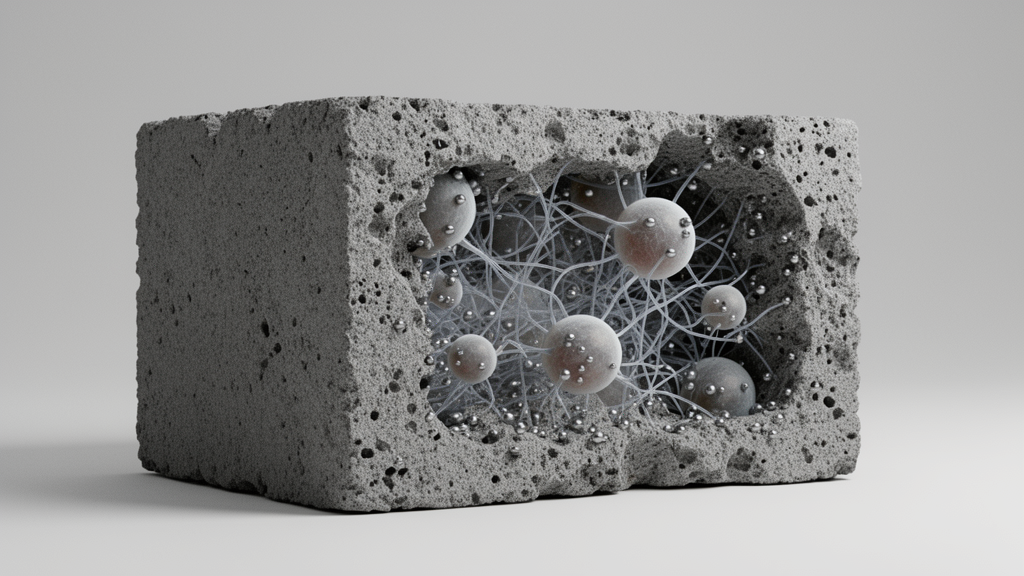
Lead remains one of the most stubborn contaminants in the world’s water supplies, and a research team in Türkiye now reports a hybrid material that pulls the toxic metal out of water with remarkable speed and durability. Writing in Environmental Geochemistry and Health, chemists and materials scientists from Eskişehir Osmangazi University, Anadolu University and Eskişehir Technical University describe a composite they call JEONS5, built by passively immobilizing cells of the fungus Neurospora on a geopolymer support. The combination, they argue, offers a sustainable candidate for treating lead-contaminated aquatic systems, pairing the mechanical robustness of an inorganic ceramic-like matrix with the chemical richness of fungal cell surfaces.
The logic behind the design draws on two well-established strands of environmental chemistry. Geopolymers, first described by Joseph Davidovits in 1991, are aluminosilicate materials formed by alkali activation of precursors such as metakaolin, and they have repeatedly shown promise as adsorbents for dissolved metals. Biosorption, meanwhile, exploits the dense array of functional groups on microbial cell walls, which can bind metal ions through complexation and exchange. The challenge has always been practicality: free-floating microbial biomass is difficult to handle, separate and reuse in real treatment systems. Immobilization solves that problem by anchoring the cells onto a solid carrier, and the new study demonstrates that a geopolymer can serve as that carrier through simple passive contact rather than elaborate chemical grafting.
To understand what makes JEONS5 tick, the team subjected the material to a battery of analytical techniques. Zeta potential measurements mapped the surface charge of the composite across the relevant pH range, while Fourier-transform infrared spectroscopy identified the chemical groups available for binding, including hydroxyl, amine, carbonyl, C–N, Si–O and Al–O functionalities. Scanning electron microscopy paired with energy-dispersive X-ray spectroscopy revealed the morphology of the fungal cells integrated into the geopolymer matrix and confirmed the presence of lead after uptake. X-ray diffraction, X-ray fluorescence and X-ray photoelectron spectroscopy rounded out the picture, allowing the researchers to track how the surface chemistry of the hybrid changed as it captured Pb2+ ions from solution.
Batch experiments established the operating conditions for maximum performance. At a pH of 5.0 and a modest sorbent dosage of just 0.04 grams, the material removed more than 95 percent of lead from a solution containing 100 milligrams of Pb2+ per liter. That dosage figure is notable in itself, because it means only a small quantity of the composite is needed to treat a given volume of contaminated water, which directly affects the cost and footprint of any future treatment process. The team also found that uptake was essentially independent of temperature, suggesting the binding interaction is not strongly thermally activated and that performance should hold steady across a range of ambient conditions.
Speed is where the material truly stands out. Equilibrium was reached in roughly 30 minutes, and more than 75 percent of the total lead uptake occurred within the first five minutes of contact. For water treatment engineers, that kind of kinetics matters enormously: rapid uptake translates into shorter contact times, smaller reactor volumes and higher throughput in continuous systems. The kinetic data fit a pseudo-second-order model well, a pattern typically interpreted as indicating that the rate-limiting step involves chemical interactions between the metal ions and the binding sites rather than simple diffusion to the surface.
Equilibrium data, meanwhile, were best described by the Langmuir isotherm model, which assumes a finite number of uniform binding sites on the sorbent surface. From that fit the team calculated a maximum uptake capacity of 1.05 × 10⁻³ moles per gram, equivalent to 217.56 milligrams of lead per gram of material. That figure places JEONS5 among the more capable biosorbents reported for lead, and the authors attribute the capacity to the joint activity of the geopolymer framework and the fungal cells, each contributing distinct binding chemistry to the composite.
Because real treatment plants rarely operate in batch mode, the researchers also tested the material in a fixed-bed column configuration, the geometry most commonly used in industrial adsorption. The column showed a breakthrough point at 20 minutes and an exhaustion point at 350 minutes, defining the window during which the bed delivers treated water below the target concentration. The shape of the breakthrough curve was fairly well captured by Chu’s simplistic model, a modern analytical tool for fixed-bed adsorption data, which gives engineers a way to predict column performance without resorting to computationally intensive simulations.
Perhaps the most consequential result concerns reuse. Regeneration tests showed that JEONS5 retained sorption and desorption efficiencies above 90 percent through its first ten loading and unloading cycles, and even at the end of the twentieth cycle the material still delivered 50 percent of its original sorption efficiency. Reusability is the economic linchpin of any adsorbent technology, since a material that must be replaced after a handful of cycles quickly becomes more expensive than conventional alternatives. Twenty usable cycles, with the possibility of recovering the captured lead during desorption, points toward a genuinely practical process rather than a laboratory curiosity.
The mechanistic picture that emerges from the spectroscopic evidence is one of multiple pathways operating in parallel. The authors conclude that lead capture proceeds through surface complexation, in which Pb2+ coordinates directly with functional groups on the composite; ion exchange, in which lead displaces other cations from the geopolymer framework; and electrostatic interactions, in which the charged surface attracts the metal ions. This redundancy is a strength, because a sorbent that relies on a single mechanism can be vulnerable to changes in water chemistry, whereas a multi-pathway material should perform more robustly across diverse contaminated waters.
The study, funded by the Scientific and Technological Research Council of Türkiye under project number 123Y131, arrives amid growing pressure to find low-cost, low-waste methods for heavy metal remediation. Lead exposure remains a serious public health concern worldwide, with no known safe blood level, and contaminated water is a major exposure route. A sorbent that combines abundant raw materials, a simple passive immobilization step, rapid kinetics, a high capacity and demonstrated reusability addresses several of the barriers that have kept biosorption technologies out of mainstream practice. The researchers argue that JEONS5 has enormous potential for treating Pb2+-contaminated aquatic systems, and the next test for the material will be demonstrating that performance on real industrial effluents, where competing ions and organic matter complicate the chemistry far beyond the clean laboratory solutions used in this study.
Subject of Research: A geopolymer-immobilized fungal biosorbent for removing toxic lead ions from contaminated water
Article Title: Geopolymer fungal cell integration achieved through passive immobilization: a new sustainable candidate to effectively remove toxic lead contamination
Article References: Geopolymer fungal cell integration achieved through passive immobilization: a new sustainable candidate to effectively remove toxic lead contamination. (n.d.). https://doi.org/10.1007/s10653-026-03515-y
Image Credits: AI Generated
DOI: 10.1007/s10653-026-03515-y
Keywords: geopolymer, Neurospora, biosorption, lead removal, heavy metal remediation, water treatment, immobilized cells, hybrid sorbent, adsorption kinetics, Langmuir isotherm, fixed-bed column, sustainable materials
Cite Scienmag News
Sloane Callahan. (October 8, 2026). Fungal Cells Locked Inside Geopolymer Create a Fast, Reusable Lead-Scrubbing Material. Scienmag. https://scienmag.com/fungal-cells-locked-inside-geopolymer-create-a-fast-reusable-lead-scrubbing-material/
Sloane Callahan. "Fungal Cells Locked Inside Geopolymer Create a Fast, Reusable Lead-Scrubbing Material." Scienmag, 8 October 2026, https://scienmag.com/fungal-cells-locked-inside-geopolymer-create-a-fast-reusable-lead-scrubbing-material/. Accessed 8 October 2026.
Sloane Callahan. "Fungal Cells Locked Inside Geopolymer Create a Fast, Reusable Lead-Scrubbing Material." Scienmag. October 8, 2026. https://scienmag.com/fungal-cells-locked-inside-geopolymer-create-a-fast-reusable-lead-scrubbing-material/


