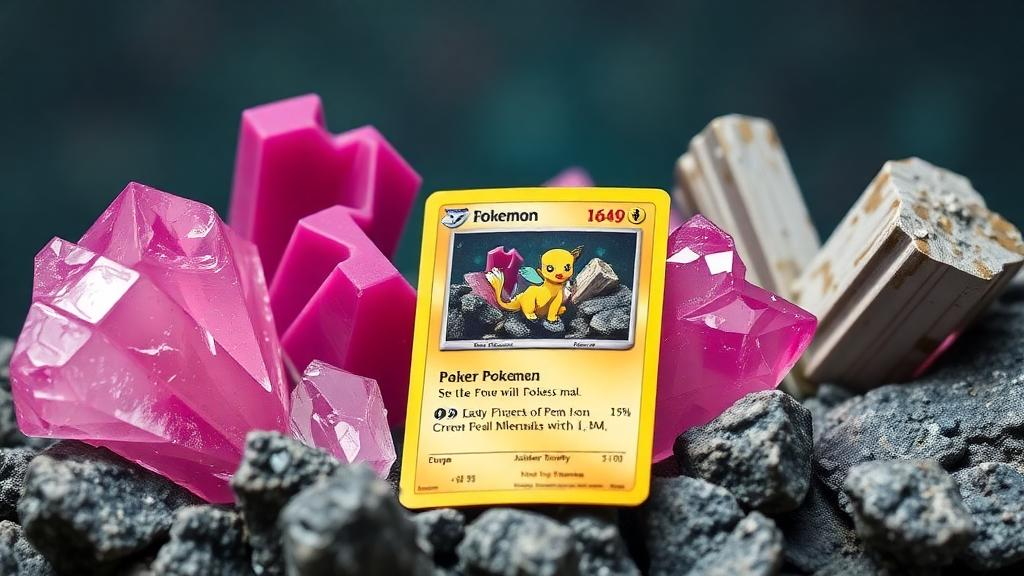
For nearly three decades, the Pokémon Trading Card Game has quietly assembled one of the world’s largest archives of mineral imagery, and a new study suggests it has also assembled one of the most misleading. A peer-reviewed analysis published in Geoscience Communication examined 223 mineral illustrations drawn from roughly 20,000 cards released between January 1999 and July 2026, and found that the franchise has cultivated a strikingly consistent visual stereotype of what a mineral looks like. The findings quantify, for the first time, how a global entertainment brand shapes public intuition about the very materials that make up the solid Earth.
The study’s author, Cheng-Hung Chen of the Earthquake-Disaster and Risk Evaluation and Management Center at National Central University in Taiwan and the Institute of Earth Sciences at Academia Sinica, screened every card in the English-language game using two independent online databases, inspecting each illustration by hand, including reprints and promotional releases. Cards qualified only if they clearly depicted crystal faces, repeating geometric clusters, identifiable gemstones, or natural ice crystals. Franchise-specific items with crystalline appearances, such as Evolution Stones and the Terastal phenomenon, were deliberately excluded, because the research focused on the geological backgrounds created by illustrators rather than pre-defined game objects.
What emerged from this screening is what Chen calls a universal crystal template. Nearly half of the illustrated minerals, 99 of 223 cards, appear in caves. Most are shown fully exposed rather than embedded in host rock, and when host rock is present it lacks the petrological textures needed for identification. Using the official heights of the depicted Pokémon creatures as scale references, the analysis found that more than half of the illustrated crystals exceed 30 centimeters along their longest axis. These crystals are typically euhedral, meaning well formed with distinct faces, pristine, unweathered, and highly symmetrical, terminating in elongate prismatic habits.
The statistical signature of this template is remarkably tight given the diversity of its creators. The 223 cards were produced by 85 different artists, yet the visual patterns remain almost identical across the dataset. Tetragonal and hexagonal crystal systems together account for roughly 84 percent of identifiable forms, usually drawn as columnar crystals capped by a single pyramid. Dark-colored minerals, earthy luster, opaque crystals, and fractured textures are severely underrepresented. Instead, the cards favor bright colors, glassy translucency, vitreous luster, and high geometric symmetry, an aesthetic that closely matches commercial gemstone displays rather than the raw ores found in the field.
Mineral identity is similarly concentrated. Chen manually inferred 22 mineral groups across the dataset, but just six of them, ice, quartz, calcite, zircon, corundum, and fluorite, account for 83.4 percent of all illustrations. Ice and quartz alone dominate, representing about 32 percent and 28 percent respectively. Common rock-forming silicates such as feldspar, pyroxene, amphibole, and mica are almost entirely absent, likely because they lack the crystalline aesthetics the public recognizes. Gemstones like diamond and beryl are also rare, probably because people encounter them as polished gems rather than natural crystals.
To test whether these six groups actually look different from one another, Chen applied Multiple Correspondence Analysis, a statistical technique that converts categorical visual features into a geometric map where frequently co-occurring traits plot close together. The results were revealing. The confidence ellipses for ice, quartz, corundum, and zircon overlap extensively, indicating that these distinct mineral categories share nearly identical visual representation. Calcite formed an isolated cluster, but mainly because it is consistently drawn as stalactitic cave deposits rather than its common rhombohedral cleavage. Fluorite was the only group whose distinctive cubic and octahedral habits resisted the template.
The ice case is particularly damning for artistic fidelity. Terrestrial ice crystallizes almost exclusively in the hexagonal system, yet more than half of the inferred ice crystals in the cards are drawn as tetragonal prisms. Because ice identification in the artwork relies on contextual clues such as Pokémon types, move names, and cold environments rather than crystal morphology, this discrepancy shows that illustrators prioritize a culturally familiar crystal archetype over actual crystallography. Other illustrations go further, depicting incompatible crystal systems within a single scene, crystals floating without visible support, faceted gemstones embedded directly in rock, and self-luminous crystals with no identifiable light source.
The template’s grip was tested in an unexpected way: through artificial intelligence. Chen compared human interpretation of the cards against two large language models, ChatGPT-5.3 and Gemini 3.0, and a specialized rock-scanning app. On a control set of 43 photographs of real mineral specimens, the tools performed well, achieving accuracies of 95 percent for Gemini, 86 percent for ChatGPT, and 74 percent for Rock Identifier. On the stylized card illustrations, however, agreement with the human baseline collapsed to between 45 and 56 percent for the language models and just 12 percent for the rock-scanning app. Agreement dropped further for fantasy-style artwork, falling to between 26 and 45 percent for the language models.
According to Chen, this decline in machine performance is itself quantitative evidence of the media-driven stereotype. The AI systems systematically overidentified quartz while misclassifying clear tetragonal prisms as hexagonal quartz, because the stylized shapes mimic the universal template and strip away the diagnostic features that geologists rely on. The models also struggle to infer three-dimensional symmetry from two-dimensional artwork and lack the contextual reasoning a trained observer uses, for example recognizing that a transparent crystal emerging from snow or water is inconsistent with quartz formation and must be ice. The study concludes that current AI should be treated as a supporting tool rather than a definitive identification system when interpreting stylized media.
The real-world contrast is stark. Most natural minerals occur as interlocking grains, veins in igneous or metamorphic rocks, or weathered fragments in placer deposits, and minerals commonly appear as paragenetic assemblages rather than isolated crystals. Only 6 percent of the dataset depicts multiple mineral species coexisting. Giant euhedral crystals do exist in nature, but they require exceptionally stable geochemical conditions, as at Mexico’s Naica Mine, and are genuinely uncommon. The cards’ preference for vibrant blue over the whites, grays, and colorless forms typical of quartz, feldspar, and calcite further reinforces a stylized visual identity driven by visual impact rather than geological sampling.
Yet the study’s conclusion is not a complaint about artistic license but an invitation. Because the cards are freely accessible online and familiar to millions of children worldwide, Chen argues they can serve as engaging visual hooks in school workshops and museum tours, where comparisons with real specimens introduce authentic mineral forms and environments. The dataset even contains educational Easter eggs, cards depicting cleavage, conchoidal fracture, spinel twins, amethyst geodes, and coexisting mineral assemblages, that depart from the dominant template. The approach has precedent in the Pokémon Fossil Museum, including its 2026 exhibition at the Field Museum in Chicago, where visitors compare Fossil Pokémon with real fossils to explore paleontology.
Future card releases could build on this collection without sacrificing creativity, the study suggests, by collaborating with mineralogists to depict a wider variety of crystal habits, scientifically recognizable properties such as calcite birefringence or fluorite fluorescence, and realistic mineral associations like those found in pegmatites. More broadly, the work demonstrates that quantifying media-driven stereotypes does more than produce teaching tools; it empowers audiences to consume popular culture with a critical eye. During routine gameplay, players may notice the Earth science imagery in card backgrounds and reflect on the natural world that inspired it, bridging the gap between familiar entertainment and genuine geological knowledge.
Subject of Research: Visual representation of minerals in the Pokémon Trading Card Game and its implications for mineralogy education
Article Title: Pokémon Trading Cards reveal visual stereotypes of natural minerals
Article References: Chen, C.-H. (2026). Pokémon Trading Cards reveal visual stereotypes of natural minerals. Geoscience Communication, 9(4), 451-460. https://doi.org/10.5194/gc-9-451-2026
Image Credits: AI Generated
Keywords: Pokémon Trading Card Game, mineralogy, crystal morphology, science communication, geoscience education, visual stereotypes, Multiple Correspondence Analysis, artificial intelligence, popular culture, crystal systems, quartz, public perception of science
Cite Scienmag News
Violet Maxwell. (October 8, 2026). How Pokémon Cards Built a False Image of Real Minerals. Scienmag. https://scienmag.com/how-pokemon-cards-built-a-false-image-of-real-minerals/
Violet Maxwell. "How Pokémon Cards Built a False Image of Real Minerals." Scienmag, 8 October 2026, https://scienmag.com/how-pokemon-cards-built-a-false-image-of-real-minerals/. Accessed 8 October 2026.
Violet Maxwell. "How Pokémon Cards Built a False Image of Real Minerals." Scienmag. October 8, 2026. https://scienmag.com/how-pokemon-cards-built-a-false-image-of-real-minerals/