


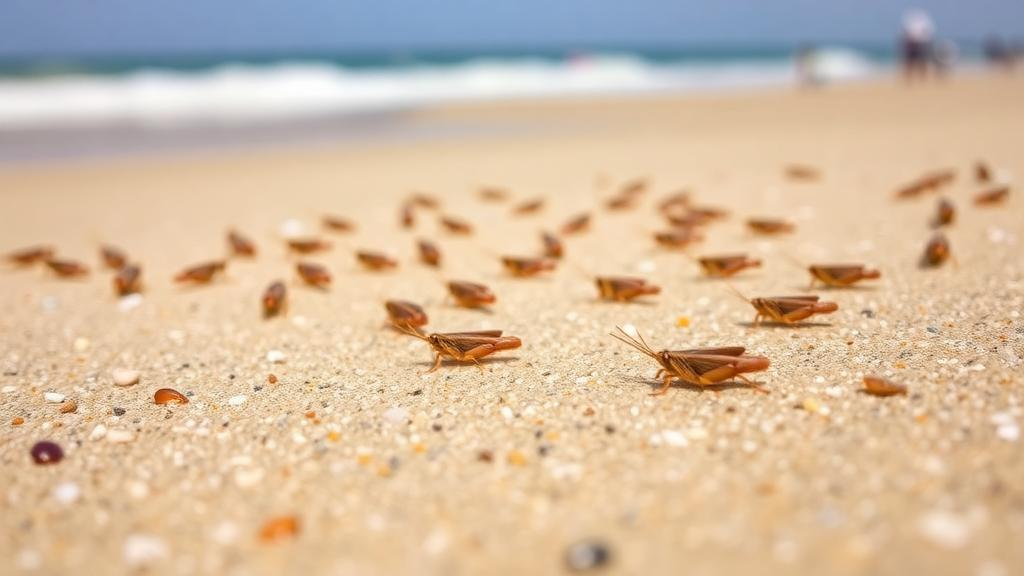
Stand on the damp sand of a California beach and, according to a new study, you are almost certainly standing on top of an active earthworks site. Beneath your feet, armies of centimeter-long crustaceans known as sand hoppers are excavating fresh burrows every single night, and the sheer volume of sediment they displace turns out to be staggering. Researchers from the University of California, Santa Barbara report that these shrimp-like amphipods, belonging to the genus Megalorchestia, can move up to 50 kilograms of sand per meter of shoreline per day, a rate of bioturbation that places them among the most powerful sediment movers on the planet. The finding, published in the Journal of Geophysical Research: Earth Surface, suggests that these unassuming beach dwellers are not merely inhabitants of the coast but active engineers of it, working at a scale comparable to major rivers and longshore drift processes.
Sand hoppers are familiar to anyone who has flipped over a mound of washed-up kelp on a California shore. The tiny, flea-like creatures shelter beneath seaweed wrack or burrow 10 to 30 centimeters into the sand during the day, emerging after dark to feed on decaying kelp. What makes them remarkable from a geological standpoint is their burrowing behavior. Unlike many burrowing animals that dig a single home and reuse it, sand hoppers construct an entirely new burrow each day in search of sand with precisely the right moisture content. Too wet, and the saturated sand behaves like a liquid, collapsing the burrow immediately. Too dry, and the powdery grains above the high tide line cannot hold a tunnel at all. The crustaceans seek what the researchers describe as a Goldilocks sweet spot in between, where the moisture is just right for a burrow to remain intact.
That daily search for the perfect building conditions means that sand hoppers are constantly excavating sand that has only recently been reworked by waves and wind, effectively resetting the surface of the beach on a nightly basis. David Hubbard, a marine scientist at UC Santa Barbara and a co-author of the study, has spent years studying these creatures up close, yet even he was unprepared for the scale of their activity. In a field experiment at Isla Vista Beach, the team returned one morning to find that some of their metal sampling frames, sectioned off the previous evening, had been completely buried under mounds of freshly excavated sand. The frames were invisible, and only the flags the researchers had prudently placed beside them allowed the plots to be relocated at all.
The experiment itself was elegantly simple. Tim Baxter, a physical geographer who led the work as a postdoctoral researcher with geography professor Ian Walker at UC Santa Barbara and is now a research fellow at the University of Oxford, designed the study around a straightforward question: how much sand are these animals actually digging? On a summer night at Isla Vista Beach, a bluff-backed stretch of shore adjacent to the UCSB campus, the team waited for high tide to pass and the water to recede, leaving the sand smoothed by waves. They then installed an array of metal frames in the zone where sand hoppers prefer to burrow, the damp band of sand between the saturated intertidal area and the dry powder above the high tide line. Overnight, the crustaceans within each frame dug their daily burrows, and in the morning the researchers collected and weighed every grain of sand that had been pushed to the surface.
The numbers were striking. Extrapolated across the shoreline, the excavated sand amounted to as much as 50 kilograms per meter of beach per day, a figure that stunned the team. Baxter described the result as the biggest shock of the study, noting that the researchers had not really expected such an impressive volume. When the team scaled their measurements across 25 kilometers of Southern California coastline, the total sediment displaced by sand hoppers proved comparable to the daily sediment loads of some major Southern California rivers and to the longshore drift processes that transport sand along the intertidal beach. In other words, an animal barely a centimeter long is moving sediment at a rate that competes with the physical forces conventionally credited with shaping the coast.
To appreciate why this matters, it helps to understand how sandy beaches function. Though they appear static, beaches behave like rivers of sediment, with sand constantly transported by waves, winds and currents. Each beach is one component of a larger system called a littoral cell, which cycles sediment from its sources, including eroding cliffs, dunes, and rivers and streams carrying material from coastal watersheds, through the beach itself, and onward along the coast. Beaches act as reservoirs within this conveyor belt of sand. While the physical processes of coastal sediment transport are well characterized, the contribution of the animals living in this highly dynamic environment has remained poorly understood, and the new study provides some of the clearest evidence yet that biology belongs in the sediment budget.
The implications extend beyond the beach surface itself. Sand hoppers are already recognized as a fundamental link in the coastal food web, consuming kelp wrack and in turn becoming prey for shorebirds and fish. Their burrowing adds another layer of ecological importance. The constant churning buries organic material such as kelp and carrion deposited on the beach, making it available to a different community of organisms living deeper in the sand, Hubbard explained. The burrows also aerate the sediment, delivering oxygen that supports aerobic microbial processes in layers of sand that would otherwise remain oxygen-poor. In effect, the crustaceans run a daily mixing and composting operation across the entire supralittoral zone.
The geomorphological consequences may be equally significant. By loosening the sand, the excavations make sediment more available to erosional forces of wind and water, Baxter noted, and the constant reworking potentially increases the roughness of the beach surface. That roughness, in turn, has implications for the formation of coastal sand dunes, landforms that depend on sand being picked up from the beach and deposited inland. This connection carries real-world weight, because coastal dunes have increasingly been embraced as a nature-based strategy for coping with coastal flooding and sea level rise. As self-building and self-healing landforms, dunes can absorb the force of increased wave and storm action, and understanding the biological processes that help feed sand into dune systems could improve how these natural defenses are managed.
The study also speaks to a broader shift in the earth sciences. The field of biogeomorphology, which examines the interactions between living organisms and the landscapes they inhabit, has gained considerable momentum over the past few decades, yet the influence of animals and plants on landforms remains understudied relative to purely physical processes. Baxter suggested that part of the reason is a lingering assumption that the effects of animals are temporary, localized and small. The sand hopper results challenge that assumption directly, demonstrating that biological activity can operate at scales that rival the great sediment engines of the coast. What the team set out to show, Baxter said, is that these activities and interactions operate on a far larger scale than commonly appreciated, and that their impacts deserve far more attention.
For now, the humble sand hopper has earned a new title: one of the highest rates of bioturbation of anything on the planet, in Hubbard’s words. The next time a walk along a California beach reveals a pockmarked surface of tiny burrow entrances and miniature sand mounds, it may be worth pausing. Each of those small craters marks a night’s work by an animal weighing a fraction of a gram, and together those nights of labor move sediment in quantities that reshape the coastline, feed the food web, cycle nutrients through the sand, and perhaps even help build the dunes that stand between coastal communities and the rising sea.
Subject of Research: Bioturbation and sediment transport by burrowing sand hopper crustaceans on California beaches
Article Title: Tiny beach-dwelling crustaceans are big-time sand movers, shaping the California coast
Article References: Tiny beach-dwelling crustaceans are big-time sand movers, shaping the California coast. (n.d.). Original publication
Image Credits: AI Generated
DOI: Not provided
Keywords: sand hoppers, Megalorchestia, bioturbation, sediment transport, California beaches, coastal geomorphology, littoral cell, coastal dunes, UC Santa Barbara, Journal of Geophysical Research, biogeomorphology, amphipods
Cite Scienmag News
Grant Pearson. (October 8, 2026). Sand hoppers: the tiny crustaceans moving tons of California beach sand every day. Scienmag. https://scienmag.com/sand-hoppers-the-tiny-crustaceans-moving-tons-of-california-beach-sand-every-day/
Grant Pearson. "Sand hoppers: the tiny crustaceans moving tons of California beach sand every day." Scienmag, 8 October 2026, https://scienmag.com/sand-hoppers-the-tiny-crustaceans-moving-tons-of-california-beach-sand-every-day/. Accessed 8 October 2026.
Grant Pearson. "Sand hoppers: the tiny crustaceans moving tons of California beach sand every day." Scienmag. October 8, 2026. https://scienmag.com/sand-hoppers-the-tiny-crustaceans-moving-tons-of-california-beach-sand-every-day/


