


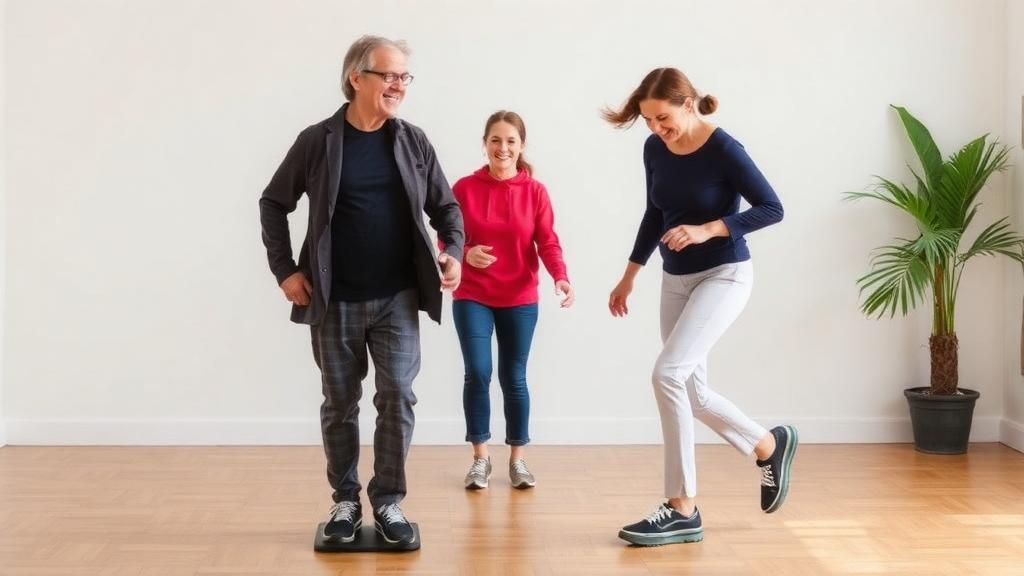
Fewer than one in ten adults with intellectual disability meet daily physical activity recommendations, and the consequences reach far beyond fitness. Poor balance, muscle weakness, and a heightened fear of falling combine to make this population one of the most sedentary and fall-prone groups in society. A new qualitative study published in Heliyon offers a strikingly direct answer to this problem: instead of designing an exercise app for adults with intellectual disability, researchers in Sweden designed one with them, and the resulting design preferences reveal how much conventional app development has overlooked.
The study, led by Oscar Bergens, Eva Flygare Wallén, and Marlene Sandlund, brought together nine adults aged 40 to 60 with mild to moderate intellectual disability in a co-creation process spanning fifteen months. Over five two-hour workshops held at a community centre familiar to all participants, the co-creators tested a reference exercise application, critiqued its shortcomings, and progressively shaped a new digital tool for balance and muscle-strengthening exercise. The researchers then analysed the workshop discussions using the Optimised Honeycomb Model for user experience, which organises design considerations into seven facets—useful, useable, desirable, findable, accessible, credible, and valuable—grouped under three dimensions: Use, Feel, and Think.
The starting point was blunt. When the co-creators tried the existing reference application, developed previously with older adults, they found it too difficult to use. Navigation between functions was confusing, and several participants simply gave up. Their verdict, delivered in unison during the second workshop, was unambiguous: the app was too difficult. Rather than adapt the existing tool, the group concluded that a completely new solution was needed, one built from the ground up around the cognitive and sensory realities of its intended users.
The first design principle to emerge was radical simplification. The co-creators insisted on minimising the number of choices presented at any moment, limiting the home screen to just three options: exercise programmes, an exercise diary, and exercise tips. They paired this with a consistent colour scheme of green, blue, and pink, applied throughout the app so that each page carried a unique visual identifier, reducing navigation errors. Images—a person exercising, for instance—would signal where to find content, and an introductory video would explain how everything worked before users ever had to guess.
Accessibility discussions went deeper still. The co-creators, several of whom had additional impairments such as colour-blindness, poor eyesight, or limited literacy, insisted that every function be presented simultaneously through text, colour, and image, so that no single disability would block participation. They specified black text on lighter backgrounds for readability and rejected jargon such as sets and repetitions in favour of plain constructions like do x number of times. Several volunteered to help write the app’s texts themselves, reasoning that they were better equipped than professional developers to phrase instructions clearly for people like them. For timing exercises, they proposed a visual bar that slowly declines, ending with a sound cue—an elegant solution to the difficulty many adults with intellectual disability experience in perceiving time.
Usability debates centred on a genuine tension: whether users should build their own exercise programmes, which offers ownership but demands complex decisions, or follow pre-set routines, which are simpler but less flexible. The group settled on pre-set programmes available in three difficulty levels and three lengths of five, ten, and twenty minutes, each containing only three to five exercises. Ten exercises, they agreed, would simply be too many. Exercise videos, they decided, should be filmed in ordinary domestic settings such as living rooms and kitchens to convey that exercise can happen anywhere, presented one movement at a time with distinct pauses, and always in the same order when repeated. One participant criticised a commercial video that told viewers to take it at your own pace while racing ahead—a mismatch between instruction and demonstration the group was determined to avoid.
Motivation proved the most psychologically nuanced facet. Drawing on their experience with the mobile game Candy Crush Saga, the co-creators envisioned a virtual gaming world in which completing exercises advances a character and earns rewards such as badges—when I reach 10,000 steps, then I get a pink shoe, as one participant put it. Yet they were equally clear-eyed about the risks: one had abandoned Candy Crush because the reward progression was too slow, and the group flagged dangers of reward addiction, boredom, and discouragement after lapses. They therefore balanced extrinsic incentives with intrinsic ones, emphasising fun, enjoyment, and growing self-awareness of one’s own abilities. One participant described how using the reference app had taught her, after surgery left her unsteady, exactly what her balance could and could not do—a form of empowerment no badge could replicate.
Safety and credibility emerged as inseparable concerns. Because effective balance training must be sufficiently intensive to produce improvement, it inherently carries fall risk—a tension the co-creators negotiated directly. They called for instructions on safe execution, warm-up routines, and guidance on involving support staff. Trust also flowed from recognition: participants were more willing to attempt an exercise when it matched something their physiotherapist had already prescribed. Most strikingly, they wanted to be the faces of the app itself, volunteering as instructors, exercising in everyday clothing, and smiling to signal confidence in future users. Preferably ourselves, one said when asked who should demonstrate the exercises—because then it comes from us.
The Think dimension surfaced practical integration strategies. Knowing that intended users receive an overwhelming number of notifications, the co-creators specified reminders with unique sounds, verbal cues, or animations so the app’s prompts would stand out. They described highly individual exercise habits—some watching videos the night before and exercising from memory, others needing support staff to start the app—and insisted the design accommodate all of these patterns, with minimal equipment and easy-to-remember instructions. They even requested activity suggestions beyond formal programmes, such as short exercises doable while walking or waiting for a bus.
Perhaps the study’s most moving finding concerns the seventh facet, value. The co-creators spoke of feeling alienated by a society that labels them as different, talks about them rather than to them, and rarely designs services with them in mind. Building an app from their own guidance reversed that dynamic. One participant asked for a picture of the development group on the app so people can see that we are a part of this, and another insisted the front page declare this is for everyone—open not only to people with intellectual disability but to anyone seeking better balance, including language learners who benefit from simplified instructions. The researchers conclude that universal design assumptions fail this population and that involving end-users across the entire development cycle, from ideation to refinement, is essential. The co-creators themselves made the case most simply: an app that talks to them, not about them, is one they will actually use.
Subject of Research: Co-creation of a digital balance and muscle-strengthening exercise application with adults with intellectual disability
Article Title: Exploring user experience perspectives in co-creation of a balance exercise application for adults with intellectual disability: A qualitative study
Article References: Bergens, O., Flygare Wallén, E., & Sandlund, M. (2026). Exploring user experience perspectives in co-creation of a balance exercise application for adults with intellectual disability: A qualitative study. Heliyon, 12(15), Article e45563. https://doi.org/10.1016/j.heliyon.2026.e45563
Image Credits: AI Generated
DOI: 10.1016/j.heliyon.2026.e45563
Keywords: intellectual disability, co-creation, user experience, balance training, exercise application, digital health, accessibility, fall prevention, physical activity, qualitative research, inclusive design, Honeycomb Model
Cite Scienmag News
Drew Townsend. (October 7, 2026). Adults With Intellectual Disability Co-Design a Balance Exercise App Built Around Safety, Simplicity and Belonging. Scienmag. https://scienmag.com/adults-with-intellectual-disability-co-design-a-balance-exercise-app-built-around-safety-simplicity-and-belonging/
Drew Townsend. "Adults With Intellectual Disability Co-Design a Balance Exercise App Built Around Safety, Simplicity and Belonging." Scienmag, 7 October 2026, https://scienmag.com/adults-with-intellectual-disability-co-design-a-balance-exercise-app-built-around-safety-simplicity-and-belonging/. Accessed 7 October 2026.
Drew Townsend. "Adults With Intellectual Disability Co-Design a Balance Exercise App Built Around Safety, Simplicity and Belonging." Scienmag. October 7, 2026. https://scienmag.com/adults-with-intellectual-disability-co-design-a-balance-exercise-app-built-around-safety-simplicity-and-belonging/


