


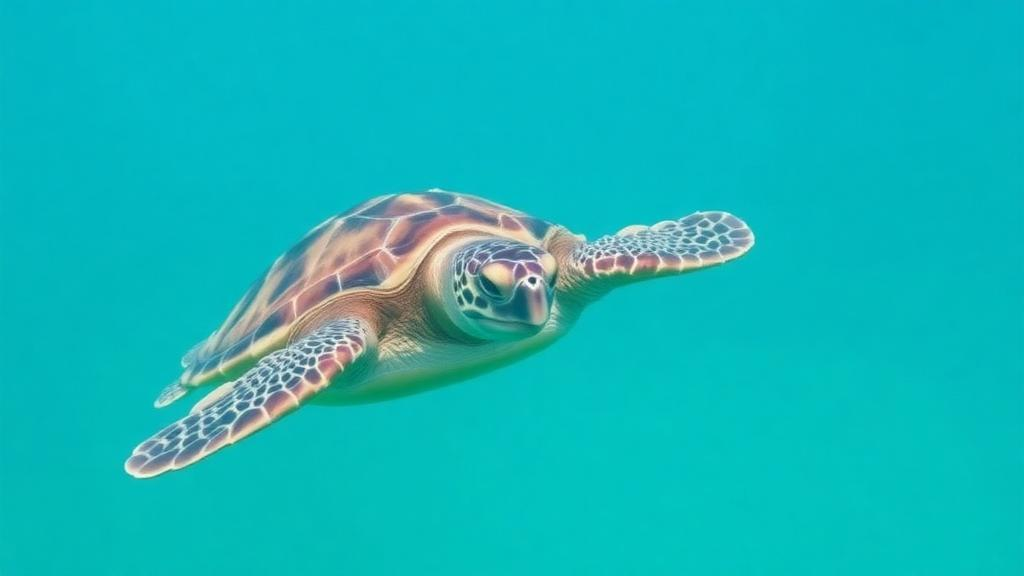
For decades, one of the most cherished ideas in marine biology has been that female sea turtles return, with near-mystical precision, to the very beach where they hatched, laying every clutch of eggs they will ever produce on the same stretch of sand. A new satellite-tracking study of critically endangered hawksbill turtles in the Republic of Seychelles now shows that this picture is far too simple. Researchers working on Frégate Island found that half of the turtles they tracked abandoned their primary nesting beach mid-season, laying clutches on other beaches of the same island or even on entirely different islands kilometres away. The findings, published in Ecology and Evolution, carry profound implications not only for how scientists count and conserve turtle populations, but for how these ancient reptiles might weather the coming decades of sea level rise and coastal erosion.
The research team, led by Nupur Kale of Swansea University and colleagues, combined two very different ways of watching turtles. Since 2017, foot patrols had walked the sandy pocket beaches of Frégate Island each day of the nesting season, from October through March, tagging every nesting female with titanium flipper tags and recording the location of each clutch. Then, during the peak of the 2023–2024 season, the team fitted ten adult hawksbills with Fastloc-GPS Argos satellite tags at Grand Anse beach, a 300-metre strip of sand framed by rocky headlands. The tags recorded haul-out events—periods when a turtle came ashore for at least twenty minutes—along with GPS positions accurate to within tens of metres, allowing the researchers to reconstruct exactly where and when each female nested after tagging.
The technical detail matters here, because distinguishing a genuine nesting event from other landfalls requires careful filtering. The team used three converging lines of evidence: haul-out records, GPS locations on land, and the elapsed time between haul-outs, which they checked against the known inter-nesting interval for the region of roughly twelve to seventeen days. From 1,552 filtered GPS locations, they established that the mean inter-nesting interval of their tagged turtles was 13.8 days. Seven of the ten turtles renested on Frégate Island or nearby, while one migrated straight to her foraging grounds. Two females made especially striking journeys: one travelled 27.3 kilometres north to Marianne Island, and another moved 19 kilometres to Ile aux Récifs, each laying multiple clutches at their new island destinations.
The headline result was a near-even split in behavioural strategies. Four of the tagged turtles proved study-beach faithful, returning repeatedly to Grand Anse. Five were study-beach unfaithful, switching to Marina beach, Anse Parc, Anse Victorin, or islands beyond Frégate altogether. Of the nineteen clutches laid after tagging, only 37 percent fell within 300 metres of the first nest. In other words, the majority of eggs produced by these females were deposited somewhere other than the beach where scientists were watching—a mismatch with far-reaching consequences for the numbers that emerge from monitoring programmes.
Those consequences became stark when the team compared clutch frequency estimates. From eight seasons of foot patrol data covering 575 individual turtles, the mean estimated clutch frequency was 1.9 clutches per female per season. From satellite telemetry, the same parameter came out at 3.7 clutches—nearly double. The discrepancy arises because foot patrols can only count what happens on the beaches they cover; clutches laid on other islands or on inaccessible stretches of coast simply vanish from the record. Similar gaps between patrol-based and telemetry-based estimates have previously surfaced in Florida, at Ascension Island, and in Brazil, suggesting the problem is systemic rather than local.
The bias propagates directly into abundance estimates, which conservation managers rely on to assess population status. Using a standard equation that converts clutch counts into the number of adult females, the researchers modelled how estimates change as the assumed proportion of clutches laid elsewhere increases. With 198 clutches observed on Grand Anse in 2023–2024, assuming all clutches were laid there and a clutch frequency of 1.9 yields roughly 260 adult females. But if 60 percent of clutches were laid on other beaches—as the telemetry suggested—the same data imply 651 females using the beach at least occasionally, a 2.5-fold difference. The pattern held across every clutch-frequency scenario tested, demonstrating that fidelity assumptions distort abundance estimates independently of how clutch frequency itself is measured.
Historical records support the idea that turtles seen only once on a beach are fundamentally different from repeat visitors. In a classic study from Greece more than thirty years ago, loggerheads seen nesting multiple times in a season had an 80 percent chance of returning in later years, whereas single-observation turtles had just a 13 percent chance. The Seychelles data echo this: 91 percent of flipper-tagged females that laid more than one clutch on Grand Anse in 2017–2018 and 2018–2019 remigrated, compared with only 56 percent of those recorded laying a single clutch. The new conceptual framework proposed by the authors distinguishes beach tenacious individuals, which nest exclusively on one beach, from beach flexible individuals, which spread their clutches across multiple sites within and between seasons. Whether a turtle appears faithful to a monitored beach depends on how large that beach is relative to the animal’s true range of fidelity.
To test how widespread this flexibility is, the team reviewed 51 studies published between 1971 and 2026 covering five sea turtle species at 43 nesting beaches worldwide. Study-beach unfaithful behaviour was documented in loggerheads most often, at 25.6 percent of individuals, followed by leatherbacks at 14.5 percent, green turtles at 9.3 percent, hawksbills at 7.9 percent, and olive ridleys at 6.3 percent. The method used shaped the detection rate dramatically: genetic analysis flagged unfaithful individuals in 46 percent of cases, satellite tracking in 19.4 percent, and flipper tagging in just 14.7 percent. Geography mattered too. Mainland sites recorded unfaithful turtles at rates 2.4 times higher than island sites, and 3.2 times higher than oceanic islands specifically. The most extreme movements were staggering: a green turtle was recorded nesting at sites 2,250 kilometres apart, a leatherback 1,849 kilometres apart, and a loggerhead 725 kilometres apart.
Why the island–mainland divide? The authors suggest geomorphology plays a central role. Mainland coastlines offer long, contiguous stretches of suitable nesting habitat with few physical barriers, so females may be less selective and drift between neighbouring beaches. Islands, by contrast, present small, isolated patches of sand, which may intensify selection for precise natal homing—perhaps enabling navigation to a discrete target more reliably than along a continuous shore. Yet even among islands, habitat stability appears to modulate the strategy. At Jumby Bay in Antigua, where beaches are sheltered and stable, generations of hawksbills have returned to a single kilometre of sand with remarkable tenacity. Grand Anse, by contrast, suffers seasonal erosion during the nesting season, and the authors suggest this unpredictability may push a higher proportion of females toward flexibility. At nearby Cousin Island, where beaches are longer and more stable, foot patrols alone yielded a clutch frequency of 3.6 clutches—close to the telemetry-derived figure at Frégate—hinting that fidelity is a plastic trait shaped by local conditions rather than a fixed species characteristic.
The evolutionary and conservation stakes are considerable. Beach tenacity pays dividends when conditions are stable: familiarity with a site’s thermal regime, predator landscape, and access routes can translate into consistent reproductive success. But fidelity can become an ecological trap when conditions deteriorate, a phenomenon documented in Baltic eiders whose loyalty to breeding sites reduced adult survival as eagle predation intensified. For sea turtles facing accelerating erosion and inundation from sea level rise, rigid homing could be a liability. Beach flexible females, by spreading clutches across sites, effectively hedge their bets against localised disturbance, much as poison frogs distribute tadpoles among multiple pools to reduce the risk of desiccation. A population containing both strategies may thus maintain output in good times while retaining the adaptive capacity to colonise new habitat as old beaches vanish. The practical message for managers is equally clear: single-site monitoring systematically underestimates clutch frequency and can misstate adult female abundance, potentially distorting the Red List and Regional Management Unit assessments that guide conservation priorities. Quantifying true fidelity will require sharing resighting data across regional programmes and, wherever possible, pairing traditional patrols with satellite telemetry—a combination that is finally revealing just how restless these supposedly loyal navigators really are.
Subject of Research: Nesting beach fidelity strategies in hawksbill sea turtles revealed by satellite tracking
Article Title: Sea Turtle Nesting Beach Fidelity Revealed by Satellite Tracking
Article References: Kale, N., Hays, G. C., Mortimer, J. A., Zora, A., Stokes, K. L., & Esteban, N. (2026). Sea Turtle Nesting Beach Fidelity Revealed by Satellite Tracking. Ecology and Evolution, 16(10), Article e74341. https://doi.org/10.1002/ece3.74341
Image Credits: AI Generated
DOI: 10.1002/ece3.74341
Keywords: sea turtles, hawksbill turtle, satellite tracking, nesting beach fidelity, site fidelity, Seychelles, clutch frequency, population monitoring, conservation, climate change, ecological trap, Fastloc-GPS
Cite Scienmag News
Margaret Porter. (October 7, 2026). Satellite Tags Reveal Sea Turtles Break the Rules of Beach Loyalty. Scienmag. https://scienmag.com/satellite-tags-reveal-sea-turtles-break-the-rules-of-beach-loyalty/
Margaret Porter. "Satellite Tags Reveal Sea Turtles Break the Rules of Beach Loyalty." Scienmag, 7 October 2026, https://scienmag.com/satellite-tags-reveal-sea-turtles-break-the-rules-of-beach-loyalty/. Accessed 7 October 2026.
Margaret Porter. "Satellite Tags Reveal Sea Turtles Break the Rules of Beach Loyalty." Scienmag. October 7, 2026. https://scienmag.com/satellite-tags-reveal-sea-turtles-break-the-rules-of-beach-loyalty/


