


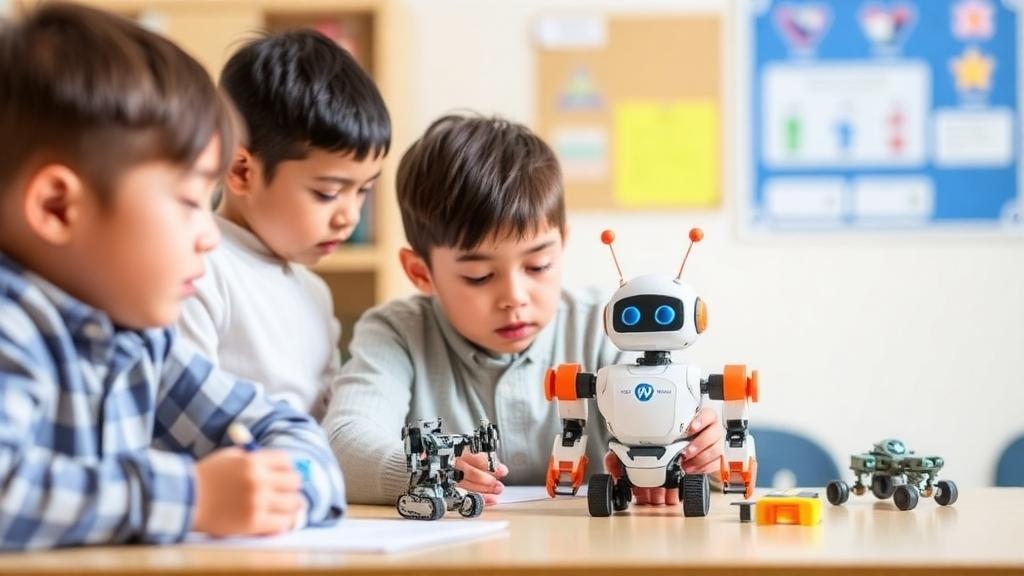
Children who spent nine classroom sessions building and programming LEGO robots made dramatically larger gains in STEM literacy than classmates taught the same curriculum through textbooks and worksheets, according to a quasi-experimental study of 68 twelve-year-olds in Kuala Lumpur. But the research, published in Discover Education, carries a twist that matters far beyond one Malaysian school: the gains were strikingly uneven across different kinds of knowledge, and the students who could make a robot dance often could not explain on paper how they had done it.
The research team, led by Khairul Azhar Jamaludin of Universiti Kebangsaan Malaysia together with colleagues at Universiti Malaya, framed the problem around a persistent weakness in educational robotics research. Studies of robot-based learning frequently report broad improvements in engagement, problem solving or computational thinking, yet STEM literacy itself has been defined in wildly different ways across the literature, spanning disciplinary knowledge, attitudes, skills and engagement. Without anchoring assessment to what a specific curriculum actually intends to teach, the authors argue, it is impossible to know whether a robotics intervention is producing the competencies a school system has promised. Their solution was to define what they call context-specific STEM literacy: a set of four competency domains drawn directly from Malaysia’s Year 6 Reka Bentuk dan Teknologi (RBT) curriculum, the national design and technology subject.
Those four domains were recognition of programming symbols and functions, recognition of programming interfaces and hardware, construction of pseudocode, and flowchart-based problem solving. The researchers built a curriculum-aligned test covering all four, validated it with three subject experts, piloted it for clarity, and confirmed good internal consistency with a Cronbach’s alpha of 0.85. The instrument combined thirty multiple-choice items with structured problem-solving tasks in which students had to analyse real-life technology scenarios and translate them into pseudocode sequences and flowcharts, yielding a total raw score from zero to eighty.
The intervention itself was a classroom-adapted version of FIRST LEGO League, the well-known robotics programme, redesigned through the ADDIE instructional design model so that every task mapped onto RBT curriculum standards rather than serving as a competition enrichment activity. Students in the experimental group, thirty-four children, moved through three deliberately sequenced phases: familiarisation, in which they learned the robot hub, motors, sensors and basic programming symbols; application, in which small teams built and programmed robots to complete movement challenges through iterative cycles of testing and debugging; and abstraction, in which they translated robot actions into step-by-step procedures, pseudocode and flowcharts. The control group, another thirty-four students, covered identical curriculum content through conventional teacher explanation, textbook work and worksheets, delivered by the same teacher with equivalent instructional time. Pre-test scores confirmed the two groups started from statistical parity.
The headline result is hard to ignore. After the intervention, the robotics group averaged 78.44 percent on the STEM literacy post-test against 64.85 percent for the control group, a difference the authors report as t(66) = 8.43, p < 0.001, with a Cohen’s d of 2.04, an unusually large effect for classroom research. Both groups improved significantly from their starting points, but the experimental group’s within-group gain carried an effect size of 2.69 compared with 1.22 for the controls. An analysis of covariance controlling for baseline performance reinforced the picture: group membership accounted for roughly 63 percent of the variance in post-test scores, with the adjusted means separated by about thirteen percentage points.
The more scientifically interesting story, however, sits one level down, in the domain-by-domain breakdown. All four competencies improved significantly, but the magnitude of improvement varied systematically. Programming symbol recognition showed an effect size of 1.87 and interface and hardware recognition 1.69, while pseudocode construction reached only 1.24 and flowchart-based problem solving just 0.83. In other words, the competencies most tightly coupled to visible, hands-on interaction with the robots grew fastest, while those demanding abstract symbolic representation grew more slowly, even though students had been explicitly taught to bridge the two.
Qualitative data from classroom observations, student reflections and teacher reflections explained why. Three themes emerged. First, a gap between task execution and written representation: students confidently built, programmed and debugged their robots, yet hesitated when asked to express the same logic on paper. One student told the researchers, I know what the robot should do, but I don’t know how to put it in steps; another said, When I see the robot, I understand. When it’s on paper, I get confused. Second, difficulty spiked during the transition to abstraction. Participation patterns shifted in the later sessions, with students taking longer, asking more clarification questions and, in some cases, showing frustration. We have to think about the robot and the steps and the symbols, it’s too much, one student said, while another observed simply that building is easier than writing. Third, students leaned heavily on the robotics context itself, mimicking robot movements with hand gestures or mentally simulating actions to answer written questions, suggesting their understanding remained tethered to the physical environment rather than transferring freely to decontextualised problems.
The authors interpret this pattern through cognitive load theory, which holds that working memory becomes strained when learners must coordinate multiple interacting elements simultaneously. Recognising a programming symbol or a sensor is a recognition task anchored in repeated, direct experience; constructing pseudocode requires translating concrete experience into formal, sequential, symbolic representations without immediate physical feedback. The study also acknowledges that the nine-session intervention gave students far more practice executing robotics tasks than practising representational translation, and that younger learners typically need repeated cycles of guided practice before procedural understanding consolidates into stable symbolic reasoning. The team is candid about other caveats: the close alignment between intervention activities and the assessment may have inflated gains, a novelty effect cannot be ruled out, the sample came from a single school, and the quasi-experimental use of intact classes limits causal certainty. The findings, they stress, speak to the integrated learning environment rather than to any inherent superiority of robots as a medium.
Why does this matter internationally? Because the core contribution is methodological. Aggregate STEM literacy scores would have shown a clean, celebratory win for robotics and concealed the uneven development underneath. By assessing curriculum-aligned domains separately and pairing the numbers with qualitative evidence, the study demonstrates that a single intervention can simultaneously excel at building situated, procedural understanding and underdeliver on abstract, algorithmic reasoning, a distinction most robotics studies never measure. For curriculum designers, the practical implication is concrete: robotics lessons should embed explicit scaffolding for representational translation, for example by having students verbalise the sequence of actions after a task and then convert that sequence into pseudocode and a flowchart, so that competence in manipulating a machine is deliberately connected to competence in symbolising its logic.
The researchers call for larger, multi-school samples, longitudinal designs tracking whether these gains persist, and deeper investigation of instructional strategies that carry students from hands-on interaction to formal computational representation. For now, the study offers a strikingly clear message for the growing global movement to put robots in classrooms: the robots work, but the paper is where the real learning challenge begins, and educators who ignore that gap may be training skilled operators rather than fluent computational thinkers.
Subject of Research: Effects of robotics-based learning on curriculum-specific STEM literacy development among primary school students
Article Title: A quasi experimental study of robotics based learning and differential development of context specific STEM literacy among primary school students
Article References: Jamaludin, K. A., Ebrahim, M. I., Nasri, N., Rashid, S. M. M., Kamaruzaman, F. M., Nasri, N. M., Hashim, H., & Alias, N. (2026). A quasi experimental study of robotics based learning and differential development of context specific STEM literacy among primary school students. Discover Education, 5(1), Article 1136. https://doi.org/10.1007/s44217-026-02250-x
Image Credits: AI Generated
DOI: 10.1007/s44217-026-02250-x
Keywords: robotics-based learning, STEM literacy, primary education, quasi-experimental study, FIRST LEGO League, pseudocode, flowcharts, cognitive load theory, constructionism, Malaysia, design and technology curriculum, computational thinking
Cite Scienmag News
Denise Maddox. (October 7, 2026). Robotics Lessons Boost STEM Skills Unevenly in Primary School Study. Scienmag. https://scienmag.com/robotics-lessons-boost-stem-skills-unevenly-in-primary-school-study/
Denise Maddox. "Robotics Lessons Boost STEM Skills Unevenly in Primary School Study." Scienmag, 7 October 2026, https://scienmag.com/robotics-lessons-boost-stem-skills-unevenly-in-primary-school-study/. Accessed 7 October 2026.
Denise Maddox. "Robotics Lessons Boost STEM Skills Unevenly in Primary School Study." Scienmag. October 7, 2026. https://scienmag.com/robotics-lessons-boost-stem-skills-unevenly-in-primary-school-study/


