


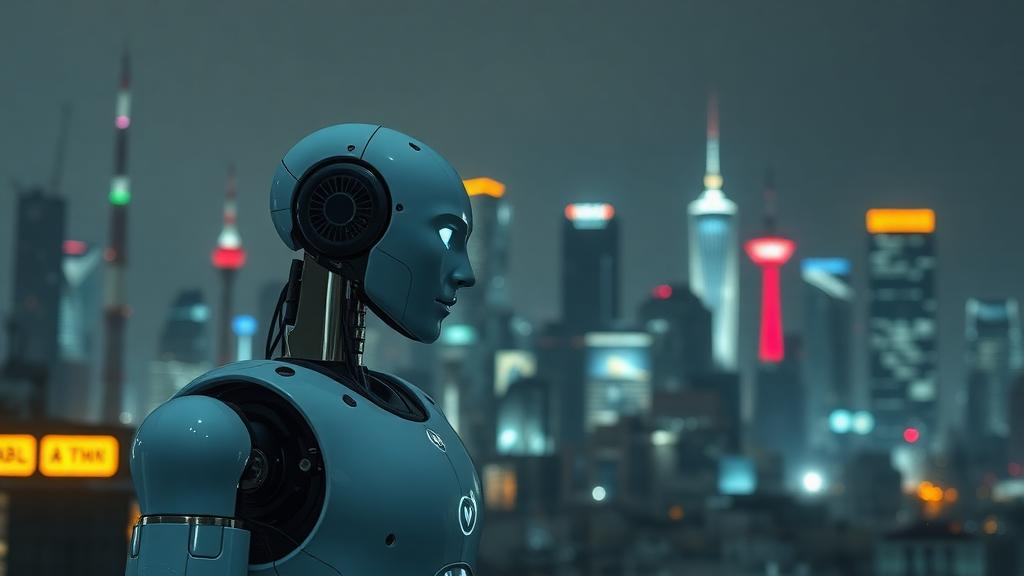
Robots have quietly crossed a threshold that engineers have anticipated for decades. They are no longer confined to the caged, predictable environments of factory floors; they are rolling down sidewalks delivering parcels, scrubbing the floors of hospitals and shopping malls, and inspecting streets, bridges and utility networks in cities around the world. A new Perspective published in Nature Cities argues that this migration deserves to be understood as a distinct urban phenomenon, which the authors term robotic urbanization. Led by Ying Li, Tim Guangyu Wu and ChengHe Guan of NYU Shanghai, together with colleagues from industry and the University of Oxford, the paper contends that whether robots take hold in a city depends not primarily on the sophistication of their algorithms but on the same forces that have always shaped urban life: who invests, who works and lives there, what has already been built, and how public space is governed.
The framing is deliberately historical. Just as suburbanization was propelled by the diffusion of the automobile and post-Fordist restructuring redrew the economic geography of industrial regions, the authors situate robotic urbanization within a lineage of technology-driven urban transformations. Previous scholarship on smart cities has often focused on data, sensors and dashboards, treating the city as an information problem. The new Perspective shifts attention to embodied intelligence: machines with physical presence that occupy sidewalk space, consume energy, perform labor and interact, however awkwardly, with pedestrians. This distinction matters because a physical robot is not merely another node in a network; it competes for the same scarce urban resources as people, vehicles and street furniture, and its failures are visible in ways that a software glitch never is.
Technically, the authors organize the evidence along three axes: capability, space and stage of deployment. Capability refers to what a machine can actually do, from teleoperated delivery pods with limited autonomy to humanoid platforms designed for general-purpose manipulation. Recent advances in learned locomotion, such as robust navigation policies for wheeled-legged robots published in Science Robotics, have dramatically improved the ability of machines to handle uneven curbs, stairs and cluttered pavements. Yet the gap between laboratory demonstration and reliable daily service remains substantial. Perception systems trained in one city can degrade in another with different lighting, weather, signage and pedestrian behavior, which is one reason deployments cluster in a small number of favorable environments rather than spreading uniformly.
Space is the second axis, and it is where the urban perspective bites hardest. Not all streets are equally robot-friendly. Researchers have begun quantifying this with tools such as the Robotability Score, presented at the 2025 CHI Conference on Human Factors in Computing Systems, which scores urban streets for how harmoniously they can accommodate robot navigation. Complementary work in German cities has assessed the operative accessibility of autonomous delivery robots, finding that sidewalk width, surface quality, curb design and pedestrian density strongly determine where last-mile robot delivery is viable. The economics reinforce this spatial selectivity: studies of sustainable last-mile distribution show that pairing autonomous delivery robots with public transportation can reduce costs and emissions, but only along corridors where the physical and regulatory environment permits operation.
The third axis, stage, captures the trajectory from pilot projects to routine infrastructure. Here the authors draw on the sociology of technology, noting that many municipal robot projects fail not because the hardware breaks but because they are lost in what one study called the diffusion chasm: the gap between a successful demonstration and institutionalized, budgeted, maintained public service. Cities that have hosted high-profile experiments, including San Francisco, Tokyo and Dubai, reveal how regulatory experimentation zones, corporate presence and political ambition interact to accelerate or stall adoption. Sidewalk delivery robots in particular have become a test case for regulators, with research documenting how cities have improvised permitting regimes, speed limits and operational rules for a technology category that existing law never anticipated.
Underlying all of this is a political economy that the authors refuse to gloss over. Robotic urbanization is driven by identifiable actors: robotics firms seeking markets, logistics companies seeking labor savings, and city governments seeking prestige or service efficiency. Economic evidence on industrial robotics shows that adoption concentrates in specific regions and firms, and studies from China, Europe and the United States suggest that the employment effects of robotization are uneven, with automation reshaping rather than simply eliminating work. The Perspective warns that the benefits and costs of urban robots, including cleaner streets and cheaper deliveries on one side and displaced workers, occupied sidewalks and new safety risks on the other, will not be distributed evenly across neighborhoods or social groups. Who owns the robot fleet, and who captures the productivity gains, are questions of urban governance, not engineering.
The authors also emphasize the material metabolism of embodied AI, an issue that has gained prominence in recent critiques of urban artificial intelligence. Robots consume electricity, require water-intensive manufacturing supply chains, depend on rare materials and generate maintenance burdens that cities must absorb. Drawing on concepts such as carbon lock-in, the paper cautions that early deployment decisions, including charging infrastructure, depot locations and dedicated lanes, could entrench patterns for decades, just as highway construction locked cities into automobile dependence. Maintenance, a long-neglected theme in urban studies, becomes central: a fleet of thousands of sidewalk robots requires repair networks, spare parts logistics and skilled technicians, all of which constitute new urban infrastructure in their own right.
Human factors complete the picture. Research on human-robot interaction shows that public perceptions of robots are shaped by perceived intelligence, appearance and behavior during even non-interactive tasks, such as a delivery robot waiting at a curb. Visual experiments on urban belonging have found that the presence of robots in streetscapes can provoke both anxiety and a sense of futuristic belonging, depending on context and design. The authors argue for anticipatory policy design, an approach in which regulators consider the social consequences of robots in public spaces before deployment at scale, rather than reacting to incidents after the fact. Responsible urban innovation, they suggest, requires treating robots as participants in the social life of the street, subject to norms of courtesy, accessibility and accountability.
The Perspective concludes that robotic urbanization will flourish in some cities and barely appear in others, precisely because the four urban forces it identifies, investment, labor and demography, built environment and governance, differ so widely across the urban world. For city leaders, the practical implication is that the decisive choices are not about which robot to buy but about which public interests will be encoded in permits, procurement contracts, data-sharing requirements and street design standards. For researchers, the agenda is to integrate computational urban science with the social sciences, so that the spread of embodied machines can be measured, modeled and contested in public. As robots move from the factory into the fabric of the city, the question is no longer whether they can navigate our streets, but whether our institutions can navigate them.
Subject of Research: Robotic urbanization: how embodied AI and service robots deploy across cities
Article Title: Robotic urbanization and embodied intelligence for cities
Article References: Li, Y., Wu, T. G., Zhou, J., Han, B., Yang, J., Keith, M., Zhang, B., & Guan, C. (2026). Robotic urbanization and embodied intelligence for cities. Nature Cities. https://doi.org/10.1038/s44284-026-00536-7
Image Credits: AI Generated
DOI: 10.1038/s44284-026-00536-7
Keywords: robotic urbanization, embodied AI, urban robotics, delivery robots, smart cities, human-robot interaction, urban governance, sidewalk robots, last-mile delivery, urban infrastructure, automation, Nature Cities
Cite Scienmag News
Courtney Benton. (October 7, 2026). Robots Are Leaving the Factory and Reshaping the City, Scientists Warn. Scienmag. https://scienmag.com/robots-are-leaving-the-factory-and-reshaping-the-city-scientists-warn/
Courtney Benton. "Robots Are Leaving the Factory and Reshaping the City, Scientists Warn." Scienmag, 7 October 2026, https://scienmag.com/robots-are-leaving-the-factory-and-reshaping-the-city-scientists-warn/. Accessed 7 October 2026.
Courtney Benton. "Robots Are Leaving the Factory and Reshaping the City, Scientists Warn." Scienmag. October 7, 2026. https://scienmag.com/robots-are-leaving-the-factory-and-reshaping-the-city-scientists-warn/


