


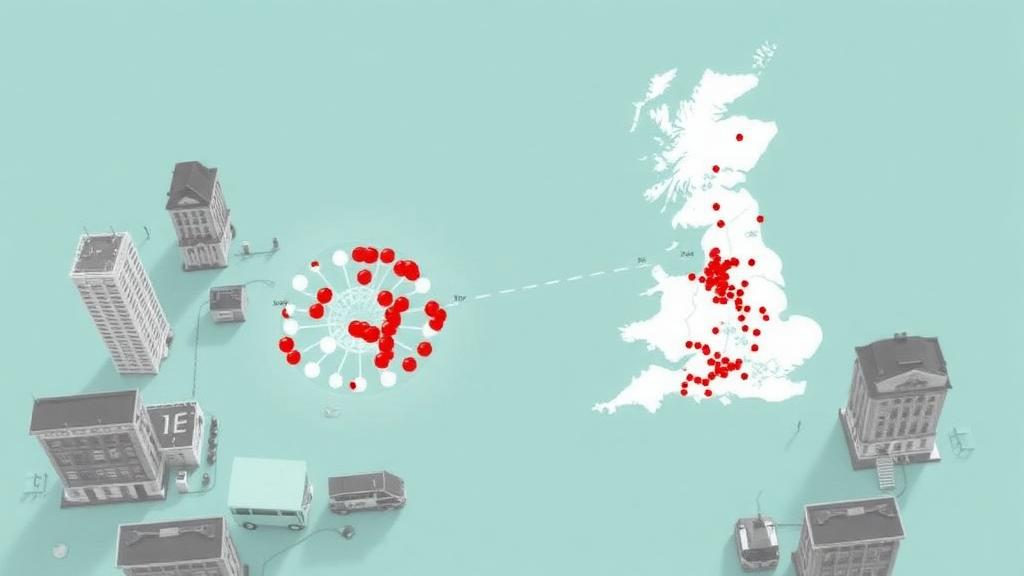
England’s falling birth rate has usually been described as a national story, a smooth average decline attributed to changing values, economic pressure and the steady postponement of parenthood. A new study argues that this picture misses the most important feature of the phenomenon: where it happens. Published in the Journal of Population Research, the analysis by Swapnil Bhagat shows that low fertility in England is not spread evenly across the map but is organised into geographically coherent regimes, with a distinctive low-fertility, high-education cluster concentrated in inner London. The finding reframes fertility postponement from a purely individual life-course decision into a spatially embedded regional phenomenon with direct consequences for planning and population forecasting.
The study assembles an unusually rich set of official data for England’s local authorities. It combines 2024 local-authority total fertility rates from the Office for National Statistics with Census 2021 measures of the share of residents holding Level 4 or above qualifications, roughly equivalent to a degree or higher. To this it adds residence-based housing affordability ratios, earnings data, the English Indices of Deprivation 2019, internal migration estimates, official 2022-based population projection outputs and local-authority boundary files. All of these sources are publicly available, meaning the analysis relies on no restricted or newly collected personal data. The design allows the education-fertility relationship to be tested not just as a statistical average but as a geographic pattern.
The central statistical result is stark. In adjusted models that control for housing affordability, earnings and deprivation, the share of highly educated residents remains strongly and negatively associated with the local total fertility rate. In other words, places with more degree-holders have fewer births per woman, and this is not simply because educated people live in expensive or deprived areas. The education gradient survives when the usual economic suspects are held constant. This matters because much demographic research treats the education-fertility link as a property of individuals aggregated without regard to place; here it appears as a property of places themselves.
To test whether these patterns are geographically organised, the study applies local indicators of spatial association, a technique introduced by geographer Luc Anselin that identifies clusters of similar values among neighbouring areas. The results show that raw fertility rates, educational composition and even the residuals of adjusted fertility models all remain spatially clustered. Neighbouring local authorities tend to resemble one another in their fertility levels and in the strength of the education association. Statistical dependence of this kind violates the assumptions of ordinary regression, which is why the study turns to spatial autoregressive models that explicitly account for neighbouring areas influencing one another.
The low-fertility, high-education regime is most clearly visible in London. Boroughs including Camden, Islington, Westminster, Southwark, Lambeth and Wandsworth form a concentrated block of places where high qualification levels and very low period fertility coincide. These are areas characterised by dense professional labour markets, high housing costs and large populations of young adults in education and early-career employment. The clustering suggests that postponement behaviour is transmitted or reinforced locally, through shared labour markets, housing markets and social environments, rather than emerging independently in each place from a national average trend.
The spatial autoregressive analysis adds a technical but important nuance. Impact decomposition in these models separates the effect of local education levels from the effect of education in neighbouring areas. The education association splits into a direct local component and an indirect spillover component, meaning that a local authority’s fertility is shaped partly by the educational composition of the places around it. This supports what the author calls a spatial-demographic interpretation of fertility postponement: the phenomenon behaves like a regional system, not a collection of isolated jurisdictions. Policies aimed at supporting families may therefore need to be designed at spatial scales larger than a single borough.
A second strand of the study carries a warning for anyone who uses official population projections in local statistical models. Projection outputs, such as projected working-age growth and old-age dependency ratios, already encode assumptions about migration, age structure and fertility. Using them as independent explanatory variables in regression models risks circularity, because the projected outcomes are partly built from the very behaviours being explained. The study therefore analyses projection models separately, as projection-sensitivity exercises rather than causal claims. This methodological caution is relevant well beyond England, wherever local researchers combine official forecasts with current outcomes.
The appendix diagnostics reinforce this distinction. For the current-fertility spatial autoregressive model, residual spatial autocorrelation is reduced but not fully eliminated, which the author reads as evidence that current fertility retains genuine spatial structure deserving substantive analysis. For the projection-sensitivity models, residuals are much closer to spatial independence, consistent with the interpretation that projected outcomes are strongly shaped by spatially organised demographic assumptions rather than by the covariates in the models. In plain terms, current fertility has a geography of its own, while projections largely inherit the geography of their assumptions.
The broader significance lies in what this means for how England understands its demographic future. If low fertility is concentrated in identifiable urban regimes, then national averages conceal sharp local divergence, and the places driving the decline are also the places absorbing much of the country’s internal migration and economic growth. Fertility postponement has long been linked to rising educational enrolment and the expansion of higher education, and the persistence of a two-child family ideal across Europe suggests that much of the decline reflects timing rather than completed family size. But the spatial clustering found here indicates that timing decisions are made in contexts, and those contexts differ profoundly across the country.
For planners, the message is that fertility postponement is not only a life-course process aggregated to places but a regional-planning issue. Housing affordability, labour market structure and educational composition interact across administrative boundaries, and the spillover effects documented in the study mean that neighbouring authorities share demographic fates. For demographers, the message is methodological: spatial dependence must be modelled, and official projections must be handled with care to avoid treating assumed futures as observed data. As England’s birth rates continue to fall, the geography of that decline, clustered in educated urban England and radiating through neighbouring areas, may prove as consequential as its overall magnitude.
Subject of Research: Spatial patterns of fertility postponement and their relationship to education across English local authorities
Article Title: Spatial regimes of fertility postponement in England : education, local clustering and projection sensitivity across local authorities
Article References: Bhagat, S. (2026). Spatial regimes of fertility postponement in England : education, local clustering and projection sensitivity across local authorities. Journal of Population Research, 43(4), Article 32. https://doi.org/10.1007/s12546-026-09440-2
Image Credits: AI Generated
DOI: 10.1007/s12546-026-09440-2
Keywords: fertility postponement, total fertility rate, spatial demography, education gradient, local authorities, England, London, LISA, spatial autoregressive model, population projections, housing affordability, place-based demography
Cite Scienmag News
Courtney Benton. (October 7, 2026). England’s Fertility Decline Is Not Random: It Clusters in Educated Urban Places. Scienmag. https://scienmag.com/englands-fertility-decline-is-not-random-it-clusters-in-educated-urban-places/
Courtney Benton. "England’s Fertility Decline Is Not Random: It Clusters in Educated Urban Places." Scienmag, 7 October 2026, https://scienmag.com/englands-fertility-decline-is-not-random-it-clusters-in-educated-urban-places/. Accessed 7 October 2026.
Courtney Benton. "England’s Fertility Decline Is Not Random: It Clusters in Educated Urban Places." Scienmag. October 7, 2026. https://scienmag.com/englands-fertility-decline-is-not-random-it-clusters-in-educated-urban-places/


