


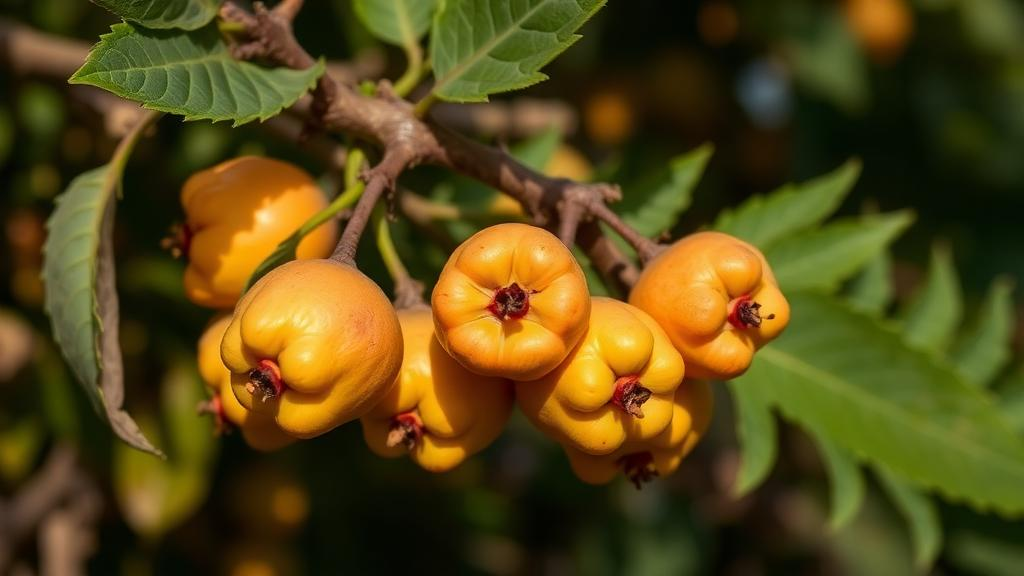
In the salt-scorched plains of Kachchh, Gujarat, where annual rainfall barely reaches 300 to 400 millimetres and soil salinity exceeds 4 dS per metre, the Indian jujube, known locally as ber, thrives where most fruit trees would perish. A new open-access study published in Discover Plants has now systematically documented, for the first time, the remarkable hidden diversity of 30 wild ber accessions collected across this hyper-arid landscape. The findings suggest that these neglected landraces, shaped by generations of natural selection under extreme drought and salinity, could hold the genetic keys to breeding fruit crops capable of withstanding a warming, water-starved world.
The research team, led by Rahul Dev of ICAR-NBPGR together with colleagues from ICAR-CSSRI and ICAR-CAZRI, conducted field surveys during February and March 2019 across five talukas of arid Kachchh: Bhuj, Mandvi, Nakhatrana, Bhachau and Rapar. The collection zone stretched across roughly 170 kilometres, mapping the Central and Western Kachchh ber-growing belt, with geographic extremes running from 23.0347 to 23.6881 degrees north latitude and 69.2051 to 70.7156 degrees east longitude. Bhuj taluka contributed the largest share of accessions with 17 samples, followed by Nakhatrana with 8, Mandvi with 4 and Abdasa with a single accession. Each collection was geo-referenced, and passport data on site conditions, associated vegetation and conservation status were recorded in the field.
The Indian jujube, Ziziphus mauritiana, is an evergreen tree of the Rhamnaceae family cultivated for thousands of years across the Indo-Pak subcontinent and much of Asia and Africa. The genus Ziziphus encompasses roughly 50 to 170 species, though only a handful, notably Z. mauritiana, Z. jujuba and Z. nummularia, are grown for their edible drupes. Ber earns its nickname, the poor man’s apple, from its dense nutritional profile: the fruits are rich in carbohydrates, sugars, dietary fibre, vitamins C and A, and minerals such as calcium and phosphorus, while also containing appreciable phenolic compounds, flavonoids and other antioxidants. Its deep taproot and ability to dormant during drought allow the tree to endure scorching temperatures and saline or alkaline soils, making it a staple of arid agriculture in Rajasthan, Gujarat and beyond.
To capture the full phenotypic breadth of the Kachchh germplasm, the researchers measured seventeen morphological and quality traits on each accession, spanning plant height, canopy spread, branch number, stem girth, leaf area, fruit dimensions, fruit weight and total soluble solids. Fruit measurements were taken with digital calipers accurate to 0.01 millimetres, and derived morphometric indices, including a Fruit Size Index calculated as length multiplied by width, a Shape Index of length divided by width, and roundness ratios, quantified fruit geometry. Canopy volume was estimated using the contour method, treating each crown as a geometric solid, while approximate fruit volume and surface area were computed from ellipsoidal formulas. The team then applied principal component analysis, hierarchical clustering with Ward’s minimum variance algorithm and Pearson correlation analysis, using Python-based tools including scikit-learn, SciPy, Matplotlib and Seaborn.
The descriptive statistics alone tell a striking story of phenotypic dispersion. Plant height ranged from 144 centimetres in the compact Ber_Bhuj_1 to 455 centimetres in the towering Ber_Bhuj_30, with a coefficient of variation of 30.36 percent. Canopy volume proved the most variable vegetative trait of all, spanning 0.58 to 8.34 cubic metres with a coefficient of variation of 66.24 percent. Primary branch counts diverged from just 2 to as many as 20 per plant, and leaf area ranged from 1.38 to 9.76 square centimetres, signalling highly diverse photosynthetic capacity across the population. Ber_Abda_20 displayed the widest horizontal footprint, while Ber_Bhuj_30 dominated in height and canopy volume.
Fruit traits revealed equally compelling variation, though with a different structure. Mean fruit length was 10.67 millimetres, ranging from 8.29 to 13.05 millimetres, and mean width was 11.27 millimetres, with both dimensions showing moderate variability of around 10 percent. Weight and volume parameters varied more dramatically: five-fruit weight spanned 1.54 to 7.48 grams, fruit volume ranged from 353.20 to 1332.10 cubic millimetres, and test weight ranged from 308 to 1496 grams, all with coefficients of variation between 29 and 32 percent. Ber_Abda_20 consistently topped every weight and volume parameter. Most striking of all was total soluble solids, the key biochemical marker of sweetness, which ranged from a modest 3.40 degrees Brix to an exceptional 17.50 degrees Brix, a coefficient of variation of nearly 38 percent, with the highest sugar accumulation recorded in accession Ber_Bhuj_21. Fruit roundness, surface area and shape index, by contrast, emerged as the most stable traits across the population.
The multivariate statistics distilled this complexity into an elegant framework. Principal component analysis compressed the seventeen traits into four components with eigenvalues above 1, together explaining 85.55 percent of total variance. The first component alone accounted for 50.14 percent and was heavily loaded with fruit dimensions, five-fruit weight, size index, fruit volume, surface area, test weight and total soluble solids, effectively isolating the high-yielding, high-sugar genotypes Ber_Abda_20 and Ber_Bhuj_30. The second component, explaining 20.50 percent, mathematically contrasted vegetative vigour, captured by plant height, canopy spread, stem girth and branch count, against fruit shape characteristics, cleanly separating large vegetative trees from compact, fruit-dominant plants. The third and fourth components, contributing 8.62 and 6.29 percent respectively, were tied to fruit symmetry parameters and to leaf area and stem girth modifications.
Hierarchical clustering then sorted the 30 accessions into four distinct phenotypic groups. Cluster 1 contained five high-vigour, large-fruited accessions including Ber_Bhuj_21, Ber_Nakh_22, Ber_Bhuj_24, Ber_Bhuj_29 and Ber_Bhuj_30, characterised by tall plants, broad canopies and large fruits. Cluster 2 was a unique single-accession group containing only Ber_Abda_20, an ideotype combining moderate vegetative vigour with exceptionally large fruits and maximum sugar content. Cluster 3 comprised eight compact accessions such as Ber_Bhuj_1 and Ber_Bhuj_2, defined by low vigour and small, round fruits, while the remaining 16 intermediate accessions formed Cluster 4. Correlation analysis reinforced the picture: plant height correlated strongly with canopy volume at r equal to 0.91, fruit weight correlated tightly with size index at r equal to 0.58, and total soluble solids rose with plant spread and canopy volume, confirming that larger architectures favour greater photosynthetic accumulation and sweeter fruit. Notably, stem girth showed no association with fruit weight, hinting that quality traits can be selected independently of tree size.
The implications extend well beyond taxonomy. Four accessions, Ber_Abda_20, Ber_Bhuj_21, Ber_Bhuj_29 and Ber_Bhuj_30, stand out as elite candidates for cultivar development and field trials, with potential roles either as candidate varieties or as robust rootstocks tailored for hyper-arid, saline environments. The strong correlation patterns between structural traits and fruit quality indices also offer reliable selection proxies that could accelerate early-stage seedling culling in future breeding programmes. Just as importantly, the study sounds a conservation alarm: wild ber diversity across India remains poorly characterised and is threatened by habitat loss, overgrazing and the spread of improved cultivars. By demonstrating that Kachchh’s under-studied germplasm ranks among the most resilient and variable ber populations yet reported, the research makes a persuasive case that the genetic resources of India’s harshest landscapes are not a curiosity but a strategic asset for food security in the climate era.
Subject of Research: Agro-morphological and biochemical diversity of wild ber (Ziziphus spp.) germplasm from the Kachchh region of Gujarat, India
Article Title: Multivariate analysis of agro morphological and biochemical variation in ber germplasm from the Kachchh region of Gujarat India
Article References: Dev, R., Singh, T., Kumar, C., Tetarwal, A., & Dayal, D. (2026). Multivariate analysis of agro morphological and biochemical variation in ber germplasm from the Kachchh region of Gujarat India. Discover Plants, 3(1), Article 373. https://doi.org/10.1007/s44372-026-00808-5
Image Credits: AI Generated
DOI: 10.1007/s44372-026-00808-5
Keywords: Ziziphus mauritiana, ber, germplasm diversity, Kachchh, Gujarat, principal component analysis, cluster analysis, fruit quality, total soluble solids, arid horticulture, climate resilience, plant breeding
Cite Scienmag News
Alan Morgan. (October 7, 2026). Wild Jujubes of Kachchh Reveal a Treasure Trove of Climate-Resilient Diversity. Scienmag. https://scienmag.com/wild-jujubes-of-kachchh-reveal-a-treasure-trove-of-climate-resilient-diversity/
Alan Morgan. "Wild Jujubes of Kachchh Reveal a Treasure Trove of Climate-Resilient Diversity." Scienmag, 7 October 2026, https://scienmag.com/wild-jujubes-of-kachchh-reveal-a-treasure-trove-of-climate-resilient-diversity/. Accessed 7 October 2026.
Alan Morgan. "Wild Jujubes of Kachchh Reveal a Treasure Trove of Climate-Resilient Diversity." Scienmag. October 7, 2026. https://scienmag.com/wild-jujubes-of-kachchh-reveal-a-treasure-trove-of-climate-resilient-diversity/


