


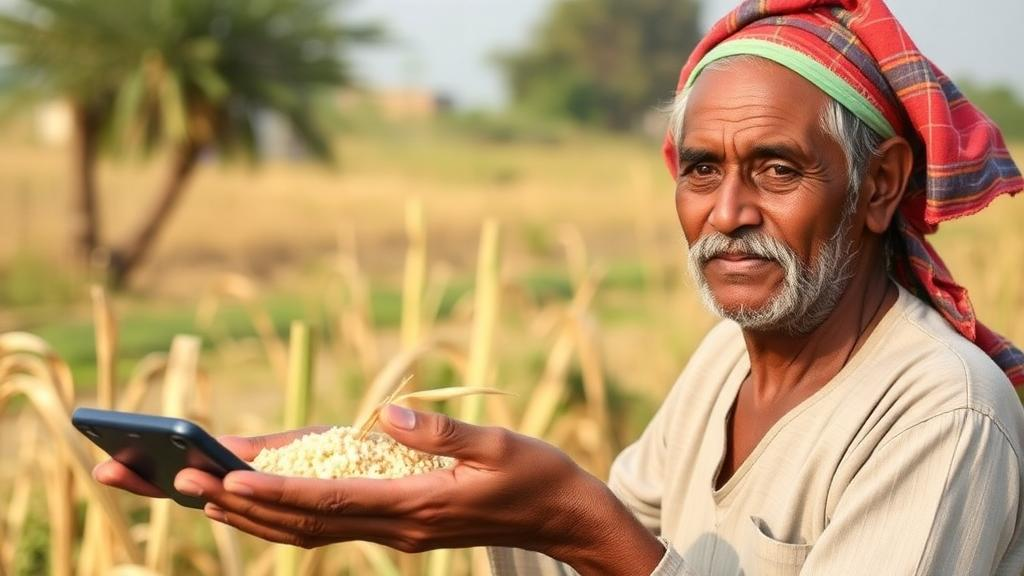
In the semi-arid heartland of Rayalaseema, a region of Andhra Pradesh in southern India where rainfall is unreliable and farming livelihoods hang on the edge of drought, access to a small loan may be one of the most powerful tools for change. A new study published in SN Social Sciences by V. Vedavathi and Fateh Khan Lodi of Annamacharya University and Geeta Kesavaraj of Vel Tech Rangarajan Dr. Sagunthala R&D Institute of Science and Technology provides some of the clearest quantitative evidence yet that microcredit does more than plug short-term cash gaps. It appears to unlock the adoption of modern farming technologies and to lift farm incomes in one of India’s most climate-vulnerable agricultural zones.
The research team surveyed 400 small and marginal farmers across selected districts of Rayalaseema, deliberately sampling both recipients and non-recipients of microcredit. This two-group design allowed the researchers to compare outcomes between farmers who had access to small loans and those who did not, holding the shared environment of drought risk, soil constraints, and market conditions broadly constant. The region is a natural laboratory for this question: agriculture there is dominated by rainfed farming, water scarcity is chronic, and farmers have historically faced limited access to formal credit, leaving many dependent on informal lenders whose high interest rates discourage investment in anything beyond immediate survival.
The headline finding is striking. Sixty percent of microcredit recipients adopted agricultural innovations, ranging from improved inputs to modern cultivation techniques, compared with only 35 percent of non-recipients. That near-doubling of the adoption rate matters because technology adoption is widely regarded as the central pathway through which smallholders can escape low-productivity traps. In the framework of innovation diffusion, farmers without discretionary capital cannot afford the upfront cost or the risk of trying a new practice; credit relaxes that constraint, giving them the liquidity to experiment and the buffer to absorb a failed season.
But the authors did not stop at simple comparisons, which can be misleading. Farmers who take microcredit may differ systematically from those who do not, in education, landholding, motivation, or social connections, and those differences, rather than the credit itself, could drive the observed gains. To address this problem of selection bias, the team deployed two complementary econometric techniques. Structural Equation Modelling, or SEM, was used to map the network of factors that influence both microcredit access and farmer empowerment, testing whether the hypothesized relationships between socio-economic variables, credit use, and outcomes fit the observed data. Endogenous Switching Regression, or ESR, was then applied to estimate the income effects of credit while explicitly correcting for the fact that credit receipt is a choice rather than a random assignment.
The statistical diagnostics suggest the models are trustworthy. The comparative fit index, which measures how well the structural model reproduces the observed covariance patterns, reached 0.977, and the Tucker-Lewis index came in at 0.933, both above the commonly recommended thresholds of roughly 0.90 or 0.95. The root mean square error of approximation, which penalizes model complexity and measures the discrepancy per degree of freedom, was 0.094, indicating a reasonable approximation of the data despite falling slightly above the strictest conventional cutoff. In practical terms, the fitted model captures the relationships among credit access, empowerment, and farm outcomes with enough fidelity to support the study’s substantive conclusions.
The SEM analysis also identified which farmers are best positioned to convert credit into agricultural improvement. Education emerged as a significant socio-economic factor, consistent with the idea that literate farmers can better evaluate new technologies, navigate loan procedures, and interpret extension advice. Membership in cooperative societies was another strong predictor of productive credit utilization. Cooperatives serve as conduits for information, collective bargaining, and peer demonstration effects, so a farmer embedded in such a network is more likely to know what a loan could profitably finance and more likely to see neighbors succeeding with the same investments. These findings echo a broader literature suggesting that financial inclusion works best when it is bundled with social and informational infrastructure rather than delivered as cash alone.
The income results are where the study becomes most consequential for policy. Using the switching regression framework, the researchers found that farmers with credit access earned substantially higher returns than their counterparts without it. The effect was particularly pronounced among larger landholders: farmers owning more than 10 hectares saw their income rise from 40,833 rupees without credit to 66,733 rupees with credit, an increase of 63 percent. That figure illustrates a sobering dynamic in rural finance. Larger farmers, who can offer collateral, absorb risk, and scale the returns on any technology they adopt, are best able to translate a loan into profit. Small and marginal farmers, who make up the majority of India’s agricultural workforce, benefit as well, but the study’s findings imply that credit alone may not fully equalize opportunity across the landholding spectrum.
Indeed, the authors are careful about the limits of microcredit. Its impact, they conclude, is constrained by structural issues that no loan officer can fix: inadequate irrigation infrastructure, poor market access, and the broader climate risks of a semi-arid region where a single failed monsoon can wipe out the returns on any investment. A farmer may borrow to buy drip irrigation equipment or improved seed, but if canal water never arrives or the nearest regulated market is hours away over rough roads, the technology cannot deliver its full yield and income potential. This is a recurring theme in development economics: financial instruments are necessary but not sufficient, and their effectiveness depends on the physical and institutional environment in which they operate.
The policy implications follow directly. The study argues for interventions that integrate financial inclusion with infrastructure development and agricultural extension services. In practice, that means pairing microcredit programs with investments in water harvesting and irrigation, rural roads and market linkages, and front-line advisory services that help farmers choose and correctly deploy new technologies. It also means designing credit products that fit the cash-flow realities of rainfed agriculture, where income arrives in one or two lumpy harvests and drought years can interrupt repayment. Financial literacy programs, which the authors’ framework positions as a driver of farmer empowerment, can further raise the return on every rupee borrowed by helping households plan investment and manage debt.
For the wider world of climate adaptation research, the Rayalaseema study adds a valuable data point from a region that sits squarely on the front line of climate stress. Semi-arid farming systems across the developing world, from the Sahel to southern Africa to South Asia, face the same triad of constraints: scarce credit, slow technology diffusion, and mounting climate risk. Evidence that microcredit can nearly double technology adoption rates, and that adoption translates into measurable income gains, strengthens the case for microfinance as a component of resilient farming strategies. At the same time, the 63 percent income boost concentrated among larger landholders is a caution that well-intentioned financial inclusion can widen gaps unless it is deliberately paired with the infrastructure, cooperatives, and extension support that allow the smallest farmers to benefit too. In Rayalaseema, the loan is only the beginning; what farmers can do with it depends on everything else around them.
Subject of Research: The effect of microcredit on sustainable farming technology adoption and farm income among smallholders in Rayalaseema, India
Article Title: Microcredit and sustainable farming practices in Rayalaseema, India with emphasis on technology adoption and income enhancement
Article References: Vedavathi, V., Kesavaraj, G., & Lodi, F. K. (2026). Microcredit and sustainable farming practices in Rayalaseema, India with emphasis on technology adoption and income enhancement. SN Social Sciences, 6(10), Article 450. https://doi.org/10.1007/s43545-026-01723-y
Image Credits: AI Generated
DOI: 10.1007/s43545-026-01723-y
Keywords: microcredit, sustainable agriculture, technology adoption, smallholder farmers, Rayalaseema, India, structural equation modelling, endogenous switching regression, farm income, climate resilience, financial inclusion, rural development
Cite Scienmag News
Alan Morgan. (October 7, 2026). Microcredit Lifts Technology Adoption and Incomes for Farmers in Drought-Prone India. Scienmag. https://scienmag.com/microcredit-lifts-technology-adoption-and-incomes-for-farmers-in-drought-prone-india/
Alan Morgan. "Microcredit Lifts Technology Adoption and Incomes for Farmers in Drought-Prone India." Scienmag, 7 October 2026, https://scienmag.com/microcredit-lifts-technology-adoption-and-incomes-for-farmers-in-drought-prone-india/. Accessed 7 October 2026.
Alan Morgan. "Microcredit Lifts Technology Adoption and Incomes for Farmers in Drought-Prone India." Scienmag. October 7, 2026. https://scienmag.com/microcredit-lifts-technology-adoption-and-incomes-for-farmers-in-drought-prone-india/


