


The flipped classroom has become one of the most widely adopted innovations in higher education, promising to transform passive lecture halls into active learning spaces. Students watch recorded lectures or study materials before class, freeing precious face-to-face time for discussion, problem-solving, and application. Yet a persistent weakness has haunted the model since its inception: not every student arrives prepared, and not every student knows how to manage their own learning outside the classroom. A new quasi-experimental study published in BMC Psychology suggests that a deceptively simple technique—building concept maps together—may be the missing ingredient that helps flipped classrooms deliver on their promise.
The research, conducted by Jieyu Tao, Azni Yati Kamaruddin, and Nur Nabihah Mohamad Nizar of Universiti Malaya in Malaysia, together with Zhen Chen of Chizhou University in China, focused on second-year undergraduates enrolled in an Educational Psychology course at a private Chinese university. The team recruited 112 students and split them into two groups. An experimental group of 63 students experienced a flipped classroom enriched with collaborative concept mapping, while a control group of 49 students followed a conventional flipped classroom format. The study employed a pre-test-post-test design, allowing the researchers to statistically control for differences in students’ starting knowledge, a crucial safeguard when participants are not randomly assigned.
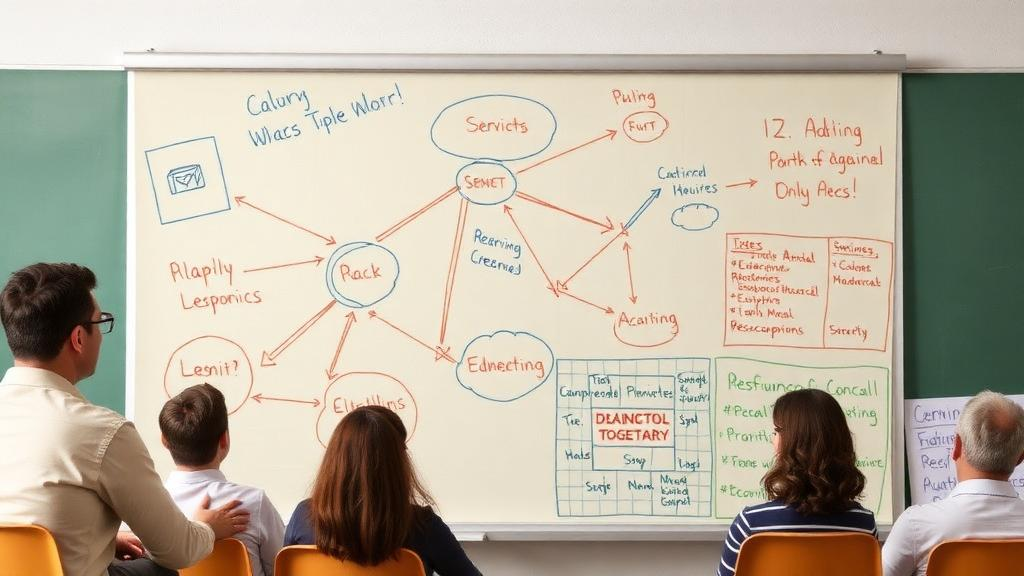
Concept mapping itself is far from new. The technique, in which learners draw nodes representing concepts and label the links between them, forces students to make their mental models explicit. Instead of memorizing isolated facts, learners must decide how ideas relate to one another—whether a concept is a kind of another, a cause of it, or merely a stage in a process. When this activity is done collaboratively, an additional layer of cognitive work emerges: students must negotiate the meaning of links, defend their organizational choices, and reconcile conflicting understandings. In theory, this negotiation should exercise exactly the cognitive and metacognitive muscles that flipped classrooms demand but often fail to train.
That theoretical link matters because the flipped model places an unusual burden on self-regulated learning. In a traditional lecture course, the instructor paces the content; in a flipped course, students must plan their pre-class study, monitor their comprehension of recorded material, and adjust their strategies when understanding breaks down. Students with underdeveloped self-regulation skills frequently arrive at class unprepared, and the interactive sessions lose their foundation. The researchers hypothesized that embedding collaborative concept mapping into the flipped cycle would give students a structured scaffold for organizing pre-class content, thereby strengthening both their strategic learning and their eventual achievement.
To measure these outcomes, the team used two parallel knowledge tests of academic achievement, administered before and after the instructional period, and assessed self-regulated learning strategies with an adapted version of the Motivated Strategies for Learning Questionnaire designed for Chinese adult learners. The questionnaire distinguishes between cognitive and metacognitive strategies—such as rehearsal, elaboration, organization, critical thinking, and planning—and resource management strategies, which include managing time, study environment, and effort. The researchers also collected qualitative feedback from students at the post-test stage, providing a window into how participants actually experienced the new approach rather than relying solely on numerical scores.
The results were striking in their pattern. After controlling for pre-test scores, the experimental group achieved significantly higher academic achievement than the control group, and students in the concept-mapping condition also reported significantly higher overall use of self-regulated learning strategies. When the researchers drilled down to the dimensional level, the advantage was concentrated in cognitive and metacognitive strategy use, where the experimental group clearly outperformed their peers. Interestingly, no significant group difference emerged for resource management strategies, suggesting that the intervention sharpened how students processed and monitored course content rather than how they organized their time and surroundings. The multivariate group effect was evaluated using Pillai’s Trace, with follow-up univariate analyses and reported confidence intervals for effect sizes, reflecting a careful statistical treatment of the domain-level differences.
The qualitative feedback added nuance to the quantitative gains. Most students perceived the collaborative concept mapping approach as genuinely helpful for understanding, organizing, and reviewing course content—three activities that map directly onto the cognitive strategies the questionnaire measured. Building a shared map appears to function as a form of externalized thinking: the diagram on the screen or whiteboard becomes a common object that the group can inspect, critique, and refine together. For a content-intensive subject like educational psychology, where theories, theorists, and terminology interlock in dense networks, this kind of structured knowledge organization may be particularly valuable. Students can literally see the architecture of the discipline take shape under their hands.
Not everything was seamless, however. Some participants reported practical and collaborative challenges, a finding the authors candidly acknowledge. Group work of any kind carries friction—unequal participation, scheduling difficulties, and disagreements over how the map should be structured—and concept mapping is no exception. The honest inclusion of these difficulties strengthens the study’s credibility and offers practical guidance: instructors considering the approach should anticipate the need for clear role assignments, time management within mapping sessions, and possibly training in collaborative norms before the technique can yield its full benefits.
The study’s design choices deserve attention when weighing its implications. As a quasi-experiment with intact class groups, it cannot rule out every alternative explanation, but the pre-test covariate control and the use of parallel test forms mitigate the most obvious threats. The sample of 112 students in a single course at a single institution limits generalizability, and the self-reported strategy measures depend on students’ accurate introspection about their own study behavior. Still, the convergence between the quantitative outcomes and the qualitative feedback—students both scored higher and said the method helped them understand and organize material—makes the case for collaborative concept mapping considerably stronger than either line of evidence alone.
For educators, the practical message is accessible and actionable. The intervention did not require new technology, expensive platforms, or a complete redesign of the course; it required integrating a structured, collaborative knowledge-organization activity into the existing flipped cycle. The authors suggest the findings carry implications for instructional design in similar content-intensive courses that demand structured knowledge organization and self-regulation support. As higher education continues to experiment with blended and flipped formats, this study offers a reminder that the success of such models depends less on the videos students watch and more on the cognitive work they do—and that sometimes, the most effective way to spark that work is to hand students a marker and ask them to draw what they know, together.
Subject of Research: Collaborative concept mapping in flipped classroom instruction and its effects on self-regulated learning strategies and academic achievement
Article Title: The effects of collaborative concept mapping on self-regulated learning strategies and academic achievement in a flipped educational psychology course: a quasi-experimental study
Article References: Tao, J., Kamaruddin, A. Y., Mohamad Nizar, N. N., & Chen, Z. (2026). The effects of collaborative concept mapping on self-regulated learning strategies and academic achievement in a flipped educational psychology course: a quasi-experimental study. BMC Psychology. https://doi.org/10.1186/s40359-026-05713-w
Image Credits: AI Generated
DOI: 10.1186/s40359-026-05713-w
Keywords: collaborative concept mapping, flipped classroom, self-regulated learning, academic achievement, educational psychology, quasi-experimental study, metacognitive strategies, cognitive strategies, higher education, instructional design, MSLQ, BMC Psychology
Cite Scienmag News
Glenn Wilkins. (October 6, 2026). Drawing Ideas Together: Collaborative Concept Maps Boost Learning in Flipped Classrooms. Scienmag. https://scienmag.com/drawing-ideas-together-collaborative-concept-maps-boost-learning-in-flipped-classrooms/
Glenn Wilkins. "Drawing Ideas Together: Collaborative Concept Maps Boost Learning in Flipped Classrooms." Scienmag, 6 October 2026, https://scienmag.com/drawing-ideas-together-collaborative-concept-maps-boost-learning-in-flipped-classrooms/. Accessed 6 October 2026.
Glenn Wilkins. "Drawing Ideas Together: Collaborative Concept Maps Boost Learning in Flipped Classrooms." Scienmag. October 6, 2026. https://scienmag.com/drawing-ideas-together-collaborative-concept-maps-boost-learning-in-flipped-classrooms/


