


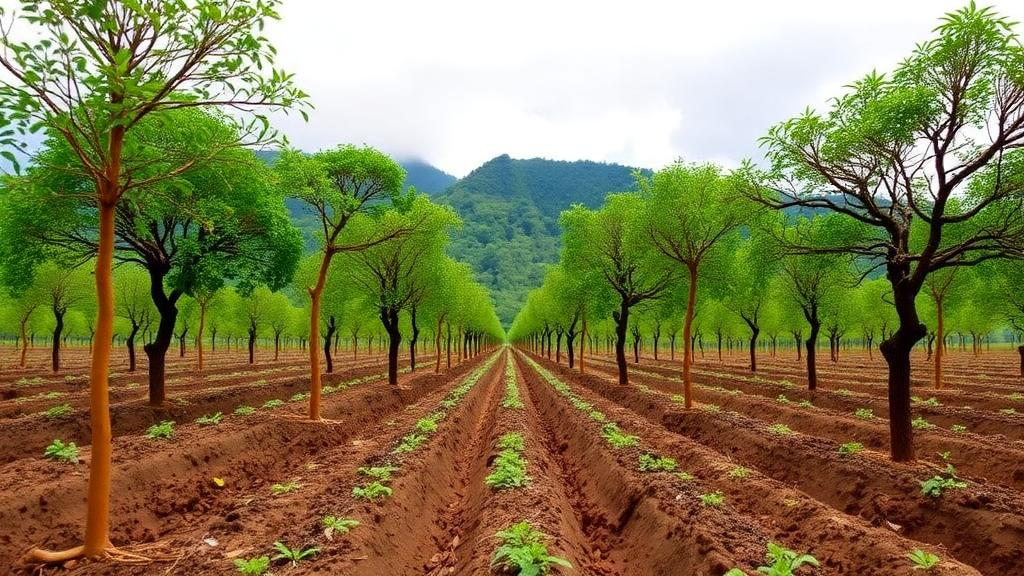
Deep in the foothills of the Ecuadorian Amazon, a quiet experiment in land management has been underway for decades, and scientists have now measured its consequences in the soil itself. A large-scale field study across the province of Zamora Chinchipe has found that farms which integrate trees into their production, whether through cacao and coffee agroforestry or silvopastoral livestock systems, store significantly more carbon in their topsoil and maintain better fertility than simplified monocultures and treeless pastures. The findings, published in the Journal of Agriculture and Food Research, offer some of the most comprehensive on-the-ground evidence yet that tree-based farming can simultaneously feed people, protect soils, and lock away climate-warming carbon.
Soil is the largest carbon reservoir in terrestrial ecosystems, holding more carbon than the atmosphere and all vegetation combined. Yet when forests are converted to intensive agriculture, surface soils can lose between 30 and 75 percent of their organic carbon, releasing carbon dioxide into the atmosphere while stripping the land of the fertility that sustains crops. The Food and Agriculture Organization has identified the rebuilding of soil organic carbon as a cornerstone of climate-smart agriculture, making it essential to understand which land-use systems actually deliver carbon gains under real farm conditions.
Zamora Chinchipe, in southeastern Ecuador, provided an ideal natural laboratory. The province sits within the Ecuadorian Amazon, with a humid to sub-humid climate, mean annual temperatures between 18 and 30 degrees Celsius, and annual precipitation of roughly 1,900 to 2,100 millimeters. Its topography ranges from steep mountain terrain to inter-Andean valleys transitioning into the Amazon basin, producing an extraordinary diversity of soils and ecosystems. Those soils, however, are generally shallow, acidic, and of relatively low fertility, and they face mounting pressure from agricultural expansion and, increasingly, mining.
To capture that diversity, the research team evaluated 187 farms across six land-use types: cacao agroforestry systems, coffee agroforestry systems, cacao monocultures, natural forest, extensive pastures, and silvopastoral systems that combine trees, grass, and cattle. The farms were selected in coordination with local producer associations and spread across the cantons of Zamora, Chinchipe, Palanda, Yantzaza, Paquisha, and Centinela del Cóndor. Between 2023 and 2024, the researchers collected 187 composite soil samples from the top 20 centimeters of the profile, each built from six subsamples mixed together. Sampling locations on different farms were separated by at least five kilometers to reduce spatial dependence, and undisturbed soil cores were taken to measure bulk density, a key indicator of compaction.
The laboratory work was exhaustive. Texture was assessed with the Bouyoucos hydrometer method, pH was measured potentiometrically, and available nitrogen, phosphorus, sulfur, boron, and a suite of cations were quantified using standardized colorimetric, spectrometric, and turbidimetric procedures. Soil organic matter was determined by loss-on-ignition and converted to organic carbon using a conventional factor of 0.58, allowing carbon stocks to be expressed in megagrams per hectare. Because the data did not meet the assumptions of parametric statistics, the team relied on the non-parametric Kruskal-Wallis test with Dunn’s post hoc comparisons and Bonferroni correction, supplemented by Spearman rank correlations and a principal component analysis.
The headline result concerns carbon. Coffee agroforestry systems recorded the highest topsoil carbon stocks, averaging more than 80 megagrams per hectare, and differed significantly from most other land uses. Silvopastoral systems and pastures followed closely, while cacao monocultures registered the lowest values. When the researchers compared paired systems directly, the pattern became striking: cacao grown under shade trees stored roughly 20 percent more carbon than cacao monoculture, silvopastoral systems held about 24 percent more than treeless pastures, and forest soils carried approximately 27 percent more carbon than cacao monocultures. Forest stands themselves averaged around 69.45 megagrams of carbon per hectare in the surface layer, a figure consistent with other Amazonian studies even if somewhat below values reported elsewhere in the region.
Fertility told a parallel story. Coffee agroforestry showed the most favorable nutrient profile for nitrogen and sulfur, while cacao agroforestry stood out for calcium, magnesium, and manganese. Pastures, by contrast, generally exhibited the lowest concentrations of sulfur, calcium, and magnesium, along with lower pH values and elevated iron, a signature of acidification and nutrient depletion associated with continuous grazing, trampling, and the removal of nutrients without replenishment. The correlation analysis reinforced these patterns, revealing strong positive associations between calcium and magnesium and between pH and both bases, while carbon stocks correlated positively with nitrogen. Soil pH remained acidic everywhere, ranging from roughly 4.5 to 6.0, with the highest values in cacao agroforestry and the lowest in forest soils.
The mechanisms behind these differences are well understood in principle. Trees in agroforestry systems continuously deposit litter and organic residues, feeding nutrient cycling and raising the soil’s cation exchange capacity. Their deep root systems pump nutrients upward from lower horizons and return them to the surface, buffering acidity and improving structure. In pastures, dense grass roots do promote aggregation and can accumulate substantial carbon, with species such as Brachiaria humidicola capable of building hundreds of grams of root biomass per square meter in the top 15 centimeters. But the study’s authors caution that carbon accumulation in pastures can coexist with chemical degradation, meaning high carbon numbers alone do not guarantee soil health or long-term sustainability.
The implications extend beyond soil science. Many of the participating farms already hold organic certification, and the researchers note that agroforestry and silvopastoral systems can generate higher returns per unit of labor than full-sun monocultures, with income from timber, fruit, and other tree products helping to offset lower cacao yields. By offering viable production alternatives, tree-based systems may also reduce pressure on remaining natural forests, a critical point in a province where extractive mining is expanding. Previous work in the Ecuadorian Amazon has shown that shaded cacao systems store about 40 percent more carbon in aboveground biomass than monocultures, and the new soil data suggest the belowground benefits run in the same direction.
The authors are careful to frame their findings as associations rather than proof of causation, and they acknowledge limitations: the assessment covered only the top 20 centimeters of soil, leaving deeper carbon dynamics unmeasured, and factors such as elevation, slope, and the conventional carbon conversion factor introduce uncertainty. They call for future sampling at depths of 30 to 60 and 60 to 120 centimeters to capture the full vertical distribution of carbon. Even so, the message from Zamora Chinchipe is clear. In tropical production landscapes, keeping trees on farms is not a compromise between agriculture and the environment; it is one of the most practical strategies available for sustaining fertility, storing carbon, and building resilience in the soils on which both livelihoods and the climate depend.
Subject of Research: Effects of tree-based production systems on topsoil fertility and carbon storage in the tropical Ecuadorian Amazon
Article Title: Tree-based production systems and their relationships with topsoil fertility and carbon storage in tropical regions
Article References: Jiménez, L., Carrera, R., Fierro, N., Lasso, J., Roa, J., Ochoa, P., Loján, C., Donoso, R., & Capa-Mora, D. (2026). Tree-based production systems and their relationships with topsoil fertility and carbon storage in tropical regions. Journal of Agriculture and Food Research, Article 103350. https://doi.org/10.1016/j.jafr.2026.103350
Image Credits: AI Generated
DOI: 10.1016/j.jafr.2026.103350
Keywords: soil organic carbon, agroforestry, silvopastoral systems, cacao, coffee, Ecuadorian Amazon, soil fertility, carbon stocks, land use change, tropical soils, pasture degradation, climate-smart agriculture
Cite Scienmag News
Alan Morgan. (October 6, 2026). Trees on Farms Boost Tropical Soil Carbon and Fertility, Landmark Ecuador Study Finds. Scienmag. https://scienmag.com/trees-on-farms-boost-tropical-soil-carbon-and-fertility-landmark-ecuador-study-finds/
Alan Morgan. "Trees on Farms Boost Tropical Soil Carbon and Fertility, Landmark Ecuador Study Finds." Scienmag, 6 October 2026, https://scienmag.com/trees-on-farms-boost-tropical-soil-carbon-and-fertility-landmark-ecuador-study-finds/. Accessed 6 October 2026.
Alan Morgan. "Trees on Farms Boost Tropical Soil Carbon and Fertility, Landmark Ecuador Study Finds." Scienmag. October 6, 2026. https://scienmag.com/trees-on-farms-boost-tropical-soil-carbon-and-fertility-landmark-ecuador-study-finds/


