


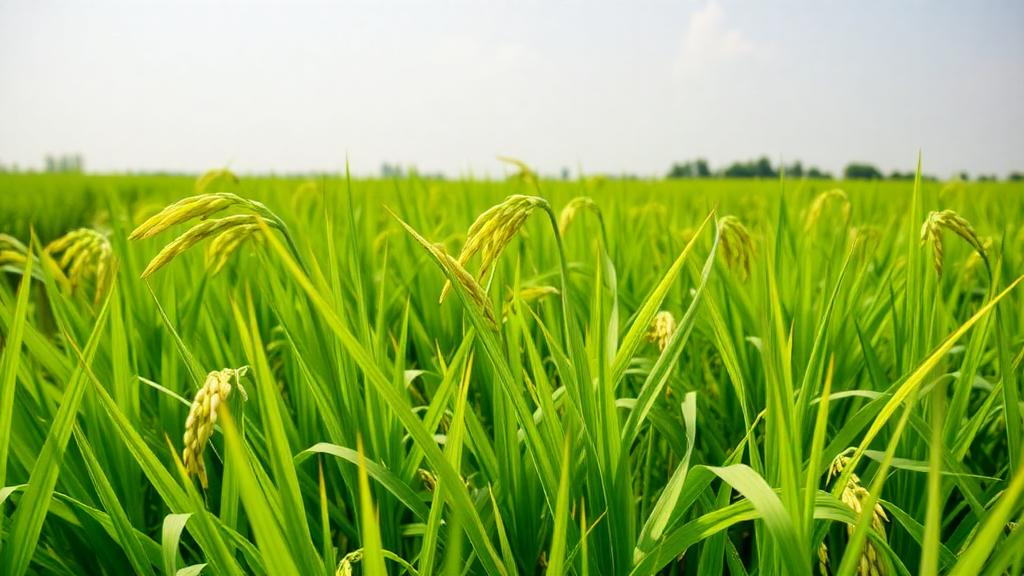
Rice feeds more people than any other staple crop, but the way it is grown has long imposed a hidden environmental bill. Flooded paddies exhale methane, nitrogen fertilizers release nitrous oxide, and a large fraction of applied nitrogen escapes into the air as ammonia. A new three-year field study from the middle reaches of the Yangtze River in China suggests that two familiar agronomic tools, when paired, can attack both sides of the ledger at once: boosting grain yields substantially while keeping greenhouse gas emissions and nitrogen losses near record lows.
The research, published in the journal Plant and Soil, was led by Wenjia Yang, Xiaowei Ma, Jun Hou and Bing Cao of Yangtze University and the Beijing Academy of Agriculture and Forestry Sciences. The team set out to test a deceptively simple hypothesis. Controlled-release blended fertilizers, whose polymer coatings meter out nitrogen in step with crop demand, are known to raise yields and nitrogen use efficiency. But when these fertilizers are broadcast on the soil surface, as is common in practice, much of the nitrogen sits far from the densest concentration of rice roots, leaving it vulnerable to volatilization and runoff. Dense planting, the researchers reasoned, could close that gap by expanding the root absorption zone and intercepting nitrogen before it escapes.
To test the idea, the team ran a three-year field experiment with five treatments: a zero-nitrogen control, the conventional farmer’s practice, an optimized nitrogen practice, a single basal application of controlled-release blended fertilizer, and that same fertilizer combined with dense planting. Rather than tracking yield alone, they assembled an unusually complete environmental audit. They measured fluxes of methane and nitrous oxide from the paddies, ammonia volatilization from the floodwater, inorganic nitrogen in the soil and surface water, redox potential, dissolved oxygen, and the abundances of functional genes that govern the microbial nitrogen cycle. They then folded these measurements into greenhouse gas intensity, carbon footprint, and net ecosystem economic benefit calculations.
The yield results were striking. Compared with the farmer’s practice, the controlled-release fertilizer alone increased grain yield by 10 to 30 percent. Adding dense planting pushed yields a further 10 to 15 percent higher, and the mechanism behind the boost was a genuine synergy: the denser stands produced more effective panicles per unit area while each panicle also carried more grains. In other words, the combination did not simply cram more plants into the same space at the expense of individual performance; it lifted both components of the yield equation simultaneously, under a reduced nitrogen input regime.
The environmental accounting was equally revealing. The controlled-release fertilizer cut cumulative methane emissions by 18 to 35 percent, nitrous oxide emissions by 13 to 52 percent, and ammonia volatilization by 40 to 49 percent relative to conventional practice. These reductions trace back to the fertilizer’s core design. By releasing nitrogen gradually, the coating prevents the floodwater from becoming a concentrated nitrogen soup, which suppresses the microbial processes that generate nitrous oxide and the chemical equilibrium that drives ammonia into the air. The smoother nitrogen supply also alters the soil’s redox dynamics and dissolved oxygen profile, conditions that favor methanotrophs, the microbes that consume methane before it reaches the atmosphere.
Dense planting introduced one complication. Relative to the controlled-release fertilizer alone, the combined treatment showed a modest methane rebound of 13 to 14 percent, likely because denser canopies and root systems alter the carbon inputs and gas transport pathways in the flooded soil. The combination also did not further reduce nitrous oxide or ammonia losses beyond what the fertilizer achieved on its own. For a reader scanning only the emission columns, that might look like a step backward.
But the full accounting tells a different story. When emissions are expressed per unit of grain, the combined treatment held greenhouse gas intensity and carbon footprint at levels comparable to the fertilizer alone, because the yield gains diluted the per-kilogram emissions. The modest methane rebound was more than offset by the larger harvest. This yield-driven dilution is a critical insight for climate-smart agriculture: the goal is not simply to minimize absolute emissions from a field, but to minimize the emissions embedded in every bowl of rice produced.
The economics strengthened the case further. The combined treatment boosted net ecosystem economic benefits by 9 to 97 percent compared with the farmer’s practice, a range that reflects both higher grain output and savings on fertilizer and labor, since the controlled-release product requires only a single basal application rather than multiple split dressings. For smallholder farmers in central China, where rice paddies dominate the landscape and nitrogen overuse remains widespread, a practice that simultaneously raises income and cuts pollution addresses the two pressures that most often pull in opposite directions.
The study also connects to a broader scientific conversation about nitrogen-cycling microbes in paddy soils. By measuring the abundances of functional genes involved in nitrification and denitrification, the researchers could link treatment effects on nitrous oxide to shifts in the microbial communities that produce and consume this potent greenhouse gas, which has roughly 273 times the warming power of carbon dioxide over a century. Previous work by the same group and collaborators had shown that root-zone fertilization with controlled-release urea reduces nitrous oxide and ammonia losses under different irrigation regimes, and that combining controlled-release blended fertilizer with densification lowers ammonia volatilization. The new study extends that framework to a full greenhouse gas and carbon footprint assessment over multiple seasons, which is essential because single-year trials can be misleading in variable climates.
The authors conclude that controlled-release blended fertilizer combined with dense planting represents a promising strategy for sustainable rice production in the middle reaches of the Yangtze River, one of China’s most important rice belts. The findings arrive at a moment when rice systems worldwide face intensifying scrutiny: rice cultivation contributes a substantial share of agricultural methane, and global assessments consistently identify nitrogen management as a key lever for reducing the sector’s climate impact. If the yield-and-emissions synergy documented here holds across other rice regions, soil types, and cultivars, the humble act of planting rice a little closer together, with nitrogen delivered on the plant’s schedule rather than the farmer’s, could become one of the most cost-effective climate interventions in staple crop production. The next step, the researchers suggest, is verifying how the approach performs under the wider range of water management practices and soil conditions that define real-world rice farming across Asia.
Subject of Research: Effects of controlled-release fertilizer combined with dense planting on rice yield, greenhouse gas emissions, and carbon footprint
Article Title: Dense planting amplifies yield benefits of controlled-release urea while maintaining low environmental footprint in rice
Article References: Yang, W., Ma, X., Wang, X., Hou, J., Zou, G., & Cao, B. (2026). Dense planting amplifies yield benefits of controlled-release urea while maintaining low environmental footprint in rice. Plant and Soil. https://doi.org/10.1007/s11104-026-09125-y
Image Credits: AI Generated
DOI: 10.1007/s11104-026-09125-y
Keywords: rice, controlled-release fertilizer, dense planting, greenhouse gas emissions, methane, nitrous oxide, ammonia volatilization, carbon footprint, nitrogen use efficiency, paddy field, sustainable agriculture, Yangtze River
Cite Scienmag News
Alan Morgan. (October 6, 2026). Dense Planting Supercharges Slow-Release Fertilizer for Greener, Higher-Yielding Rice. Scienmag. https://scienmag.com/dense-planting-supercharges-slow-release-fertilizer-for-greener-higher-yielding-rice/
Alan Morgan. "Dense Planting Supercharges Slow-Release Fertilizer for Greener, Higher-Yielding Rice." Scienmag, 6 October 2026, https://scienmag.com/dense-planting-supercharges-slow-release-fertilizer-for-greener-higher-yielding-rice/. Accessed 6 October 2026.
Alan Morgan. "Dense Planting Supercharges Slow-Release Fertilizer for Greener, Higher-Yielding Rice." Scienmag. October 6, 2026. https://scienmag.com/dense-planting-supercharges-slow-release-fertilizer-for-greener-higher-yielding-rice/


