


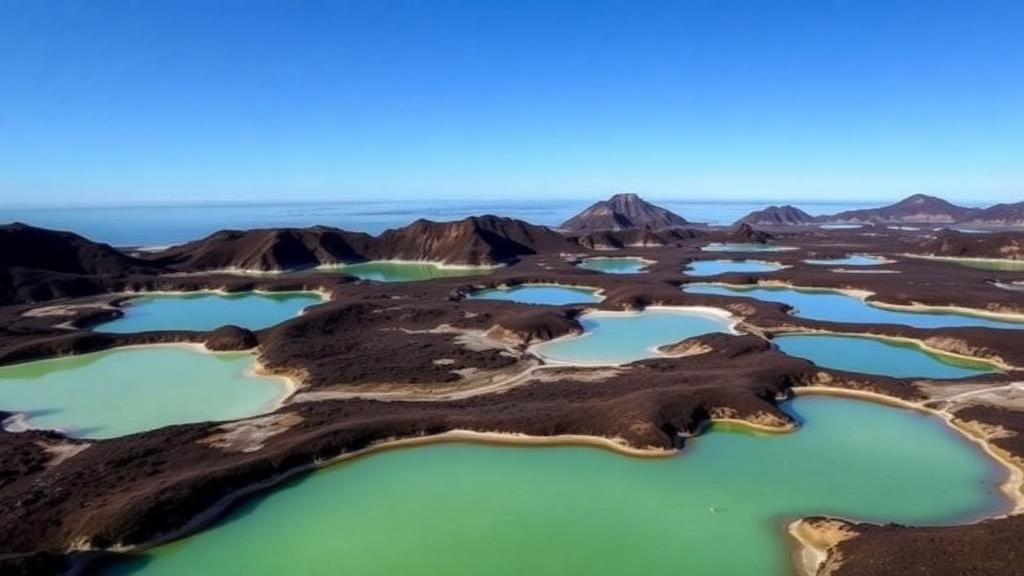
High in the caldera of Flores Island, the westernmost island of the Azores archipelago, three crater lakes sit quietly in maars blasted out by eruptions a little more than three thousand years ago. They look like postcard scenery, but a new study shows they are also natural laboratories for understanding how lakes breathe out greenhouse gases. Researchers from the University of the Azores, the University of Florence and partner institutions spent a full year sampling the Comprida, Negra and Funda lakes, combining geochemical measurements of carbon dioxide and methane fluxes with cutting-edge DNA sequencing of the microbial communities living in the lake sediments. Their findings, published in Environmental Earth Sciences, reveal that even in volcanic terrain, biology rather than geology largely controls what these lakes release to the atmosphere.
The choice of study site was deliberate. Volcanic lakes are usually treated as special cases in greenhouse gas budgets because they can receive magmatic and hydrothermal carbon from below, potentially inflating their emissions far above those of ordinary lakes. The Azores, with active volcanism and widespread hydrothermal manifestations, is an ideal place to test how much of a lake’s carbon output is geological and how much is biological. Previous work across the archipelago estimated that 45 Azorean lakes together emit roughly 171,000 tonnes of carbon dioxide per year, of which about 42 percent was attributed to volcanic origin. But the Flores lakes had only been measured once before, leaving large uncertainties, and their methane emissions had never been quantified at all.
The three lakes differ dramatically despite sitting within a few kilometers of each other inside the Seven Lakes Caldera. Comprida is the smallest and shallowest, just 14.3 meters deep with a surface area of 0.06 square kilometers, occupying an elongated maar formed by a row of at least five craters during a single eruption dated to 3,180 calibrated years before present. Negra, formed in the same eruption, is the deepest lake in the entire Azores at 119 meters, with water that can linger for 17 years before being flushed out. Funda, the largest at 0.38 square kilometers, lies in a steep-walled maar created by a phreatomagmatic eruption around 3,250 years ago and drains a watershed more than eight times its own surface area. These differences in depth, volume and residence time turned out to matter enormously for how the lakes behave chemically and biologically.
The team conducted four field surveys between May 2023 and February 2024, capturing the full seasonal cycle of these monomictic lakes, which stratify thermally in summer and mix completely in winter. They measured diffuse carbon dioxide flux using a static floating chamber equipped with an infrared detector, mapping the lake surfaces point by point, and applied both the Graphical Statistical Approach and sequential Gaussian simulation to convert those measurements into total lake-wide emission estimates. For methane, they deployed floating chambers along transects during the November and February surveys and also calculated theoretical fluxes from dissolved gas concentrations using a thin boundary layer model, finding the two methods agreed closely. Water chemistry was profiled at depth intervals in every lake, and sediment cores were collected for microbial analysis using full-length 16S rRNA gene sequencing on a PacBio platform.
The headline numbers show that carbon dioxide dominates these systems by two to three orders of magnitude over methane. Funda Lake emerged as the strongest emitter, releasing about 1.06 tonnes of carbon dioxide per day during the first survey and 1.02 tonnes during the second, while Comprida and Negra released at most around 0.39 and 0.22 tonnes per day respectively. Yet crucially, none of the measured fluxes came close to the threshold of 35 grams per square meter per day above which a magmatic contribution cannot be excluded. Carbon isotope data reinforced this conclusion: the delta-13C values of dissolved inorganic carbon in all three lakes were more negative than both the atmospheric and mantle signatures, pointing to a biogenic origin for the escaping carbon dioxide rather than a deep volcanic source.
Seasonality left a clear fingerprint on the emissions. Carbon dioxide fluxes were consistently lower during the August survey than in May, a counterintuitive result the researchers attribute to warmer surface waters boosting photosynthetic activity, which strips dissolved carbon dioxide from the water before it can escape. In eutrophic lakes this effect can be strong enough to push surface waters below atmospheric equilibrium, turning them into temporary carbon dioxide sinks. Methane behaved differently: fluxes were two to three times higher during the November survey, when Negra and Funda were still stratified and bottom waters were warm, than in February after full mixing. Warmer sediments favor methane-producing archaea, so the stratified autumn conditions gave methanogenesis a head start that winter mixing then erased.
The microbial data provide the mechanistic explanation for these patterns. In summer, Negra Lake was dominated by autotrophic Nostocaceae, cyanobacteria that fix carbon dioxide through photosynthesis, consistent with its relatively low surface fluxes. Meanwhile Comprida and Funda harbored abundant fermentative taxa such as Clostridiaceae and Enterobacteriaceae, which break down organic matter anaerobically and release carbon dioxide in deeper sediments. When winter mixing broke down the stratification in Negra and Funda, the microbial balance shifted sharply: fermenters, sulfate-reducing Desulfatiglandaceae and syntrophic Syntrophaceae all surged, indicating intensified anaerobic respiration and a potential pulse of carbon dioxide from sediments that had been accumulating organic matter under oxygen-poor conditions.
Methane cycling followed its own microbial logic. In Funda Lake, syntrophic families that feed methanogens, including Smithellaceae, Syntrophaceae and Syntrophorhabdaceae, were already well established during summer stratification and grew further in winter, but so did Methylomonadaceae, aerobic bacteria that oxidize methane. The researchers suggest that winter mixing oxygenates deeper water, giving methanotrophs the oxygen they need to consume methane before it reaches the surface, which helps explain the lower winter fluxes. Comprida Lake told a different story: syntrophic groups were scarce, but methane-oxidizing Methylococcaceae and Methylomonadaceae exploded in winter, suggesting that in this less productive lake, biological oxidation is the dominant brake on methane escape. In deep Negra Lake, by contrast, methanotrophs declined in winter, possibly because even full mixing could not deliver enough oxygen to the lake’s great depths, allowing methane to accumulate.
Trophic status emerged as a unifying theme. Negra and Funda are classified as being in poor and bad ecological status respectively under the EU Water Framework Directive, with chlorophyll-a values reaching 45 and 86.4 micrograms per liter, while Comprida remains in good status with far lower productivity. The eutrophic lakes support larger microbial communities engaged in anaerobic degradation, which translates into higher greenhouse gas production. The study’s total emission estimates reflect this: when the lakes were stratified, Funda released about 1.23 tonnes of carbon dioxide equivalent per day, compared with 0.33 and 0.23 tonnes for Comprida and Negra. Methane emissions, ranging from 0.64 to 6.28 kilograms per day across the lakes, remained below global averages for lakes of comparable size, but the authors warn that ongoing eutrophication, potentially worsened by climate-driven increases in nutrient runoff, could push these numbers upward.
The broader message is that volcanic setting alone does not make a lake a carbon hotspot. In Flores’s maar lakes, the geology provides the basin, but the biology writes the emissions budget. Microbial communities act as dynamic regulators, mediating the balance between carbon fixation and respiration, between methanogenesis and methane oxidation, and shifting that balance with every seasonal turn of the water column. As climate change alters stratification patterns and nutrient loading in lakes worldwide, the authors argue that integrating microbial functional profiles into biogeochemical assessments will be essential for predicting how these small but numerous ecosystems will feed back on the global carbon cycle.
Subject of Research: Carbon dioxide and methane fluxes and their microbial controls in monomictic volcanic crater lakes on Flores Island, Azores
Article Title: CO2 and CH4 fluxes from monomictic volcanic lakes in a remote oceanic island: Flores island case study (Azores)
Article References: Ferreira, L., Andrade, C., Cruz, J. V., Tassi, F., Pimentel, A., Braga, D., Frias, J., Raposeiro, P., & Toubarro, D. (2026). CO2 and CH4 fluxes from monomictic volcanic lakes in a remote oceanic island: Flores island case study (Azores). Environmental Earth Sciences, 85(16), Article 417. https://doi.org/10.1007/s12665-026-13139-1
Image Credits: AI Generated
DOI: 10.1007/s12665-026-13139-1
Keywords: volcanic lakes, greenhouse gases, carbon dioxide flux, methane emissions, Azores, Flores Island, maar lakes, microbial communities, eutrophication, biogeochemistry, lake stratification, methanotrophs
Cite Scienmag News
Violet Maxwell. (October 6, 2026). Volcanic Lakes on a Remote Atlantic Island Reveal How Microbes Steer Greenhouse Gas Emissions. Scienmag. https://scienmag.com/volcanic-lakes-on-a-remote-atlantic-island-reveal-how-microbes-steer-greenhouse-gas-emissions/
Violet Maxwell. "Volcanic Lakes on a Remote Atlantic Island Reveal How Microbes Steer Greenhouse Gas Emissions." Scienmag, 6 October 2026, https://scienmag.com/volcanic-lakes-on-a-remote-atlantic-island-reveal-how-microbes-steer-greenhouse-gas-emissions/. Accessed 6 October 2026.
Violet Maxwell. "Volcanic Lakes on a Remote Atlantic Island Reveal How Microbes Steer Greenhouse Gas Emissions." Scienmag. October 6, 2026. https://scienmag.com/volcanic-lakes-on-a-remote-atlantic-island-reveal-how-microbes-steer-greenhouse-gas-emissions/


