


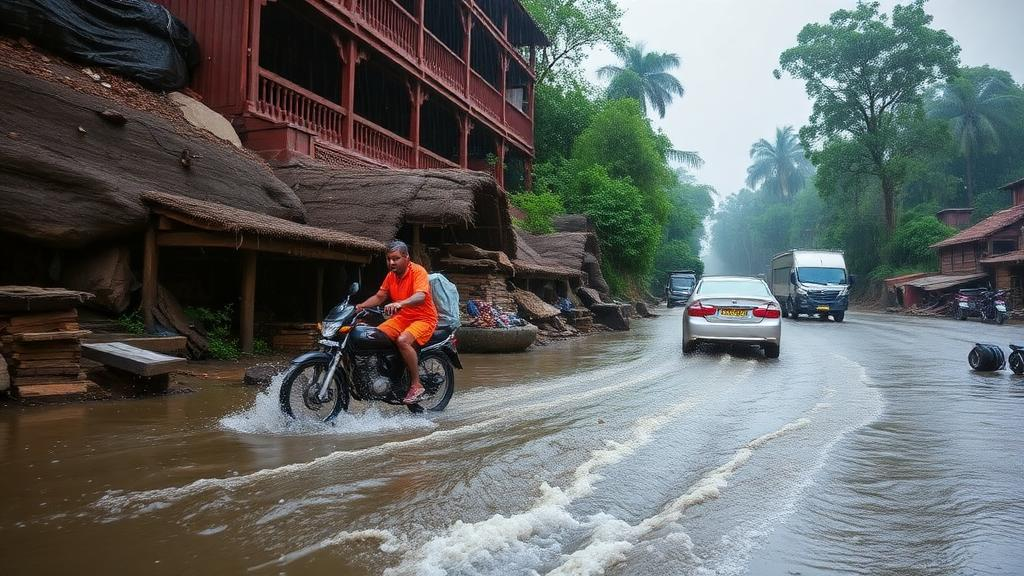
One of India’s driest river basins may be heading toward a future defined not by scarcity, but by sudden, violent bursts of rain. A new study published in Theoretical and Applied Climatology projects that extreme precipitation events in the semi-arid Banas River Basin of Rajasthan, in northwestern India, could intensify dramatically over the coming decades, with the heaviest multi-day rainfall totals potentially exceeding 720 to 820 millimeters by the end of the century under the highest emission scenario. For a region where such totals were historically almost unthinkable, the findings represent a striking shift in how water managers, farmers, and city planners across the basin may need to think about flood risk.
The research, led by Vineet Kumar Sharma of the Department of Civil Engineering at Malaviya National Institute of Technology Jaipur, together with Archana Sarkar of the National Institute of Hydrology in Roorkee and Rohit Goyal of Malaviya National Institute of Technology, is among the first detailed basin-scale assessments of future short-duration precipitation extremes for the Banas Basin based on bias-corrected projections from the latest generation of global climate models. The team analyzed outputs from 13 General Circulation Models participating in the Coupled Model Intercomparison Project Phase 6, known as CMIP6, which underpins much of the current international assessment of climate change.
To measure extremes, the researchers focused on three widely used precipitation indices: Rx1day, which captures the maximum rainfall falling in a single day; Rx3day, the maximum accumulated over three consecutive days; and Rx5day, the maximum over five consecutive days. These indices matter because they correspond directly to the kinds of rainfall bursts that overwhelm drainage systems, saturate soils, and trigger flash floods and runoff. The team established a historical baseline using observations from 1985 to 2019, then examined three future windows: the near-century from 2020 to 2040, the mid-century from 2041 to 2070, and the far-century from 2071 to 2100.
The projections were run under four Shared Socioeconomic Pathways, the standard scenario framework used in CMIP6: SSP1-2.6, a low-emission pathway consistent with strong climate mitigation; SSP2-4.5, an intermediate scenario; and SSP3-7.0 and SSP5-8.5, high-emission futures in which greenhouse gas concentrations continue to rise substantially through the century. Comparing outcomes across these scenarios allows the study to separate the signal of climate change from natural variability and to quantify how much the trajectory of emissions shapes the basin’s future flood hazard.
During the historical period, the basin’s extreme rainfall stayed within relatively narrow bounds. The maximum one-day precipitation, Rx1day, generally remained below 200 millimeters, while the three-day and five-day maxima stayed below roughly 370 and 420 millimeters respectively. Those figures define the hydrological envelope within which the region’s infrastructure, reservoirs, and agricultural systems have evolved. The projections show that envelope beginning to stretch almost immediately, and stretching much further as emissions climb.
In the near-century period from 2020 to 2040, the low-emission SSP1-2.6 scenario projects only modest increases in extreme rainfall. But under SSP3-7.0 and SSP5-8.5, the study finds a widespread strengthening of short-duration precipitation extremes across the basin. Notably, these near-term projections already exceed the historical maxima in places, signaling what the authors describe as an early emergence of extremes: rainfall events beyond anything recorded in the observational record could arrive within the working lifetime of today’s engineers and water managers, even before mid-century.
The mid-century picture sharpens the contrast between emission pathways. By 2041 to 2070, SSP1-2.6 still shows relatively limited change, but under SSP3-7.0 and SSP5-8.5 the maximum one-day rainfall is projected to climb to approximately 260 to 380 millimeters, and the three-day maximum to between 470 and 670 millimeters. Those three-day totals would surpass the historical five-day ceiling of around 420 millimeters, meaning that a three-day storm late this century could deliver more rain than the most extreme five-day events of the past several decades.
The most pronounced changes arrive in the far-century period. Under SSP5-8.5, during 2071 to 2100, the five-day maximum precipitation exceeds 720 to 820 millimeters across several parts of the basin. That figure, nearly double the historical five-day maximum, points to a considerable rise in prolonged heavy-rainfall events, the kind of sustained deluges that produce the largest runoff volumes and pose the greatest challenge to dams, embankments, and downstream communities. The study emphasizes that both the intensity and the spatial extent of extreme precipitation are projected to increase as greenhouse gas emissions rise, meaning larger areas of the basin would be exposed to severe events, not just isolated hotspots.
The paradox at the heart of the findings is that these intensifying extremes are occurring in a landscape defined by water scarcity. The Banas Basin lies within the semi-arid, desert-influenced state of Rajasthan, a region long associated with drought, erratic monsoons, and chronic water stress. Previous research in the basin has documented trends in dry and wet spells, agricultural drought, and climate impacts on crop yields, and the basin’s semi-arid character has traditionally shaped planning around managing too little water rather than too much. The new projections suggest that both problems will coexist: longer and deeper dry periods punctuated by rainfall events of unprecedented ferocity. This combination is particularly hazardous, because degraded, sparsely vegetated semi-arid soils absorb water poorly, so intense rain translates rapidly into flash floods and erosion rather than groundwater recharge.
The authors frame their results as scientific evidence to support flood-risk assessment, reservoir operation, watershed management, and climate adaptation planning in the basin. The practical implications are concrete: design standards for drainage and flood-control infrastructure based on historical rainfall statistics may systematically underestimate future extremes; reservoir operating rules calibrated to past inflow patterns may need revision; and watershed management programs aimed at soil and moisture conservation will have to account for runoff regimes that differ sharply from the historical record. Because the signal strengthens with emissions, the study also carries a broader message: the difference between a low-emission future with manageable changes and a high-emission future with transformative flood risk is still, in large part, a policy choice. For the semi-arid Banas Basin, a region on the front line of both drought and, increasingly, deluge, that choice will help determine whether its rivers are managed as scarce resources or defended against as sudden threats.
Subject of Research: Projected changes in extreme precipitation events in the semi-arid Banas River Basin of Rajasthan, India, using bias-corrected CMIP6 climate model projections
Article Title: Future change in extreme precipitation events in semi-arid Banas River Basin
Article References: Sharma, V. K., Sarkar, A., & Goyal, R. (2026). Future change in extreme precipitation events in semi-arid Banas River Basin. Theoretical and Applied Climatology, 157(10), Article 638. https://doi.org/10.1007/s00704-026-06552-w
Image Credits: AI Generated
DOI: 10.1007/s00704-026-06552-w
Keywords: extreme precipitation, Banas River Basin, CMIP6, climate change, Rajasthan, semi-arid region, flood risk, Shared Socioeconomic Pathways, Rx1day, flash floods, climate adaptation, monsoon
Cite Scienmag News
Violet Maxwell. (October 6, 2026). Extreme Rainfall Could More Than Double in India’s Semi-Arid Banas Basin by 2100. Scienmag. https://scienmag.com/extreme-rainfall-could-more-than-double-in-indias-semi-arid-banas-basin-by-2100/
Violet Maxwell. "Extreme Rainfall Could More Than Double in India’s Semi-Arid Banas Basin by 2100." Scienmag, 6 October 2026, https://scienmag.com/extreme-rainfall-could-more-than-double-in-indias-semi-arid-banas-basin-by-2100/. Accessed 6 October 2026.
Violet Maxwell. "Extreme Rainfall Could More Than Double in India’s Semi-Arid Banas Basin by 2100." Scienmag. October 6, 2026. https://scienmag.com/extreme-rainfall-could-more-than-double-in-indias-semi-arid-banas-basin-by-2100/


