


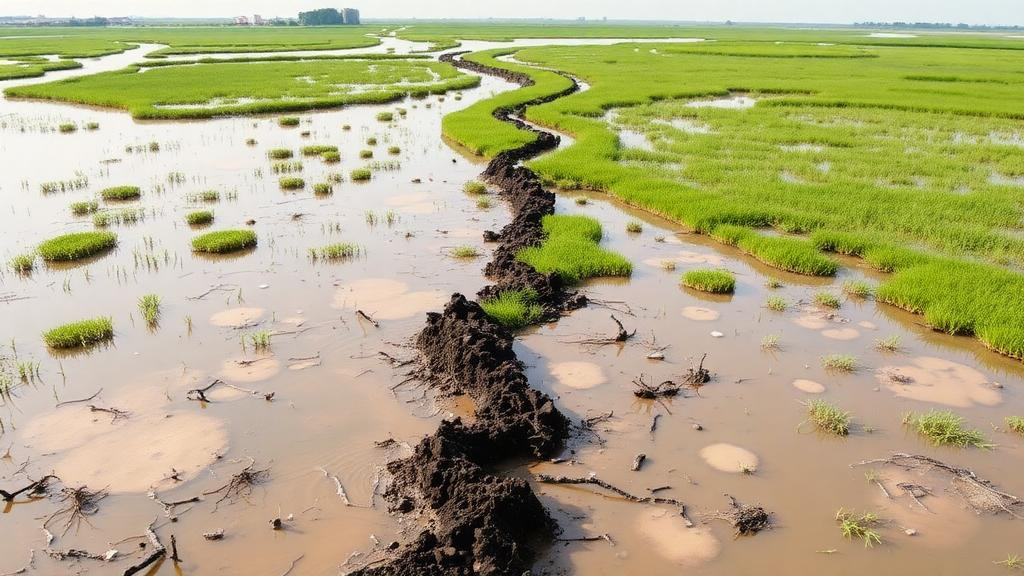
A new study of the Rasik Beel Wetland Complex in West Bengal’s Cooch Behar district has delivered one of the most detailed snapshots yet of water quality in the Teesta-Jaldhaka-Raidak basin, and the results paint a picture of an ecosystem under strain. Researchers Nihar Ranjan Barman and Laitpharlang Cajee of North Eastern Hill University collected water samples from five sites across the interconnected wetland network on March 20, 2025, during the pre-monsoon period, and analysed them for fourteen physico-chemical parameters ranging from pH and dissolved oxygen to heavy metals such as lead, iron and cadmium. By feeding those measurements into a Water Quality Index (WQI) and interrogating the data with principal component analysis, the team uncovered dramatic spatial contrasts: some beels in the complex boast water of excellent quality, while others are so polluted that the water is classified as unsuitable for use.
The headline finding is sobering. The average WQI for the entire wetland complex came out at 73.34, a value that falls squarely in the ‘poor’ category, meaning the water is unsuitable for human consumption without treatment. But the average conceals extraordinary variability. At one sampling site in Chengtimari Beel, the WQI soared to 215.03, the worst reading in the study and firmly in the ‘unsuitable’ class. At the opposite extreme, Atiamochar and Noldoba Beel recorded values of just 3.39 and 5.79, indicating excellent water quality. Bochamari and Raichangmari Beel registered a very poor score of 94.63, while the main Rasik Beel itself scored 47.85, placing it in the good category. Such a wide spread within a single wetland complex of roughly 175 hectares is unusual and points to sharply differing local conditions.
The researchers attribute the degradation of Chengtimari Beel to a combination of hydrological isolation and biological choking. Unlike the better-flushed basins in the complex, this waterbody lacks meaningful inflow and outflow, and floating plants blanket its surface for most of the year. Stagnant, shaded water cannot dilute or process incoming pollutants, so organic loads accumulate. By contrast, Atiamochar and Noldoba Beel sit at higher elevations and closer to the sources of their feeder streams, meaning their catchments deliver cleaner water and their basins experience more effective renewal. The study suggests that this combination of elevation, proximity to relatively unpolluted headwaters and regular flushing explains why those two beels remain in near-pristine condition despite the pressures bearing down on the wider complex.
The laboratory results reveal which specific parameters are driving the poor scores. Chemical oxygen demand, a measure of the total oxidisable material in water, ranged from 10.8 to 435.6 milligrams per litre with a mean of 276.88, an extraordinarily high figure that signals substantial organic pollution. Biochemical oxygen demand showed similarly wide swings, from 0.3 to 11.5 milligrams per litre, with a mean of 5.94. Together, these oxygen-demand metrics indicate that decomposing organic matter, likely from domestic wastewater and agricultural runoff, is consuming oxygen in parts of the wetland. Iron concentrations also exceeded the permissible limit of 1 milligram per litre set by the Bureau of Indian Standards, ranging from 0.77 to 3.4 milligrams per litre, which the authors attribute to lithogenic inputs or leaching from iron-rich soils in the catchment.
Not every parameter told a worrying story. Dissolved oxygen averaged a healthy 10.68 milligrams per litre, suggesting good aeration and photosynthetic activity across much of the complex. The pH ranged from 5.9 to 7.4 with a mean of 6.94, slightly acidic to near neutral and within the permissible range for aquatic life. Total dissolved solids averaged 440 milligrams per litre, chloride stayed well below desirable limits, and total hardness of 48.8 milligrams per litre indicated moderately soft water. Trace metals were largely reassuring: zinc, copper and lead concentrations remained within acceptable bounds, and cadmium was below detectable levels in every sample. The wetland, in other words, is not uniformly contaminated; rather, it is a mosaic of clean and stressed zones, and the study’s spatial approach is what makes that mosaic visible.
To untangle the relationships among the fourteen parameters, the team turned to statistical tools. Pearson correlation analysis revealed striking interconnections: alkalinity and hardness correlated at r = 0.972, pointing to a shared origin in the dissolution of carbonate and bicarbonate minerals in the catchment geology. Chloride correlated strongly with iron (r = 0.992) and zinc (r = 0.912), suggesting that chloride-bearing compounds may facilitate metal mobility, possibly through agricultural runoff or domestic effluents. Most tellingly for the index itself, the WQI correlated perfectly with lead (r = 1.000) and strongly with hardness, alkalinity, zinc, copper and chloride, indicating that heavy metals and carbonate chemistry are the key contributors to the overall deterioration of water quality in the complex.
Principal component analysis reinforced this interpretation. Four components with eigenvalues greater than one were extracted, together explaining 100 percent of the variance in the dataset. The first component, accounting for 36.1 percent of variance, loaded heavily on hardness, alkalinity, lead, zinc, chloride and iron, a signature of mineral enrichment from lithological weathering combined with anthropogenic discharges. The second component captured pH, temperature and electrical conductivity, reflecting physicochemical interactions and ionic strength. The third, at 22.6 percent of variance, paired high total dissolved solids with negative loadings on dissolved oxygen and biochemical oxygen demand, an unmistakable organic pollution gradient marking eutrophication and oxygen depletion. The fourth component loaded on chemical oxygen demand and copper, implicating household effluents, fishing activity and agricultural chemicals. Together, the components show that both natural geogenic processes and human activity govern the hydrochemistry of Rasik Beel.
Regression analysis added further nuance. A model using dissolved oxygen, biochemical oxygen demand and chemical oxygen demand as predictors explained 81.9 percent of the variance in the WQI, confirming that biological oxygen dynamics are the dominant controls on overall water quality. Another model using zinc, copper and lead achieved a perfect fit, with lead emerging as the most influential predictor of the index. Physical parameters alone, by contrast, explained only about 36 percent of WQI variation, underscoring that chemical and biological factors, not simple measures of dissolved content, are what determine whether water in the complex is fit for use. The authors caution, however, that with only five sampling sites, the statistical power of these models is limited, and the results should be treated as indicative rather than definitive.
The findings place Rasik Beel in a familiar regional context. Comparable WQI-based assessments at Deepor Beel in Assam, a Ramsar-listed wetland, the East Kolkata Wetlands and Loktak Lake in Manipur have all reported moderate to poor water quality driven by anthropogenic pressures, suggesting that the pattern observed in Cooch Behar is part of a broader story of wetland degradation across northern and eastern India. Wetlands cover more than 4.6 percent of India’s landmass and provide critical services, from flood control and groundwater recharge to fisheries habitat and refuge for migratory birds, yet they face mounting threats from urbanisation, industrial effluents and agricultural intensification. Rasik Beel, a recognised bird sanctuary and part of the Government of India’s Wetland Development Project, exemplifies both the ecological value and the vulnerability of these systems.
The study has clear limitations that the authors acknowledge. Sampling was confined to a single pre-monsoon date, so seasonal and monsoon-driven fluctuations remain unmeasured, and five sites cannot fully capture the heterogeneity of a multi-beel complex. Biological indicators such as plankton diversity and microbial contamination were not assessed, and land-use change in the surrounding catchment was not incorporated. Nevertheless, the work provides a valuable baseline for a wetland that had previously lacked integrated water quality assessment, and it demonstrates how a single numerical index, combined with multivariate statistics, can translate a complex chemical dataset into actionable information. The authors recommend continuous monitoring, seasonal sampling, control of organic and metal inputs, and policy interventions to preserve the ecological integrity of the complex. For a wetland that supports endemic fish, migratory birds and local livelihoods, the message is unambiguous: parts of Rasik Beel are still thriving, but without sustained management, the poor-quality zones will continue to spread.
Subject of Research: Physico-chemical water quality assessment and Water Quality Index evaluation of the Rasik Beel Wetland Complex, West Bengal, India
Article Title: Evaluating physio-chemical characteristics and water quality in the Rasik Beel Wetland complex in Cooch Behar district, West Bengal, India
Article References: Barman, N. R., & Cajee, L. (2026). Evaluating physio-chemical characteristics and water quality in the Rasik Beel Wetland complex in Cooch Behar district, West Bengal, India. Discover Geoscience, 4(1), Article 329. https://doi.org/10.1007/s44288-026-00697-x
Image Credits: AI Generated
DOI: 10.1007/s44288-026-00697-x
Keywords: water quality index, Rasik Beel, wetland, West Bengal, physico-chemical parameters, heavy metals, principal component analysis, dissolved oxygen, BOD, COD, water pollution, Cooch Behar
Cite Scienmag News
Violet Maxwell. (October 6, 2026). Water Quality Index Reveals Stark Pollution Divide Across Indian Wetland Complex. Scienmag. https://scienmag.com/water-quality-index-reveals-stark-pollution-divide-across-indian-wetland-complex/
Violet Maxwell. "Water Quality Index Reveals Stark Pollution Divide Across Indian Wetland Complex." Scienmag, 6 October 2026, https://scienmag.com/water-quality-index-reveals-stark-pollution-divide-across-indian-wetland-complex/. Accessed 6 October 2026.
Violet Maxwell. "Water Quality Index Reveals Stark Pollution Divide Across Indian Wetland Complex." Scienmag. October 6, 2026. https://scienmag.com/water-quality-index-reveals-stark-pollution-divide-across-indian-wetland-complex/


