


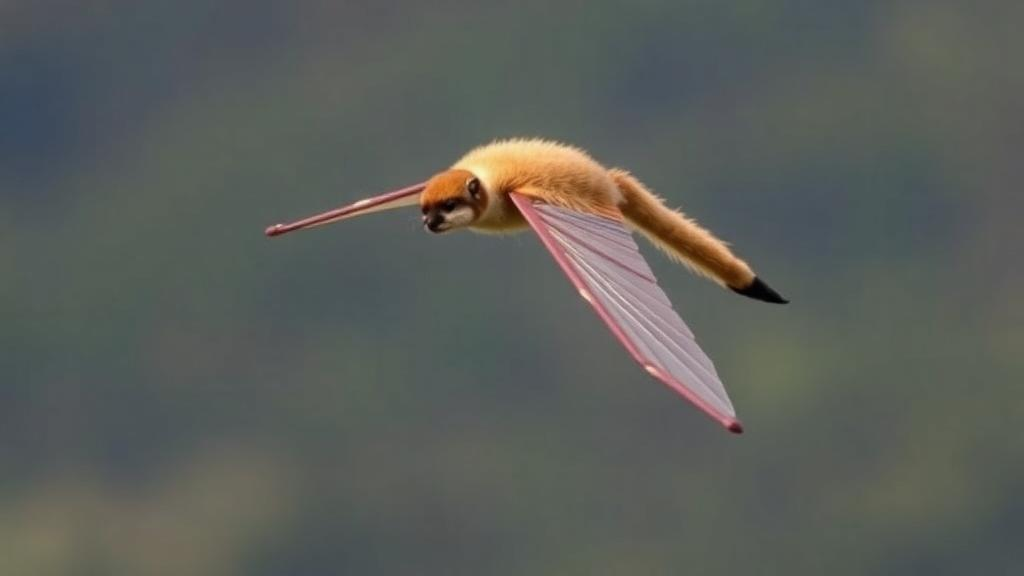
Gliding has captured the imagination of biologists for well over a century, and for good reason. Among living mammals, the ability to launch from a high branch and control a long, membrane-assisted descent has arisen independently six separate times. Flying squirrels across Asia and North America, the sugar glider of Australia and New Guinea, the colugos of Southeast Asia, and several other lineages all converged on the same remarkable solution to life in the forest canopy, despite being separated by tens of millions of years of evolution. Each of these animals sports a patagium, the stretch of skin stretching between forelimbs and hindlimbs that turns a leap into a glide. Convergent evolution on this scale poses one of the deepest questions in evolutionary genetics: when nature rebuilds the same complex trait over and over, does it reuse the same genetic blueprint, or can entirely different genetic changes produce the same functional result?
A new study led by Academician Fuwen Wei at the Institute of Zoology, Chinese Academy of Sciences, and published in Science China Life Sciences, tackles that question head-on with a genome-scale comparison of independently evolved gliding mammals. The team generated chromosome-level reference genomes for two iconic gliders, the red-and-white giant flying squirrel (Petaurista alborufus) and the sugar glider (Petaurus breviceps), and then compared these with genomes from 17 mammalian species in total, spanning three lineages in which gliding evolved independently. The central finding is striking: the different gliding lineages almost never share the same rapidly evolving regulatory regions of DNA. Yet the genes and developmental pathways connected to those distinct regions converge on strikingly similar functions, from limb and membrane development to muscle formation and Wnt signaling. In other words, evolution reached the same destination by different roads.
The technical heart of the study lies in a class of genomic features known as conserved non-coding elements, or CNEs. These are stretches of DNA that do not encode proteins but have remained remarkably unchanged over deep evolutionary time, a pattern that usually signals an essential role in regulating gene expression. Because regulatory changes are widely believed to underpin many morphological innovations, CNEs are a natural place to look for the genetic basis of a new body plan. The researchers scanned these elements across their species panel and flagged those that showed accelerated evolution specifically in gliding lineages, defining them as gliding-specific accelerated conserved non-coding elements, or GACNEs. Acceleration in an otherwise conserved element is a classic signature of recent adaptive change, suggesting that the region may have acquired a modified regulatory function in the lineage where it evolved fastest.
When the team mapped the GACNEs onto the genomes of the three gliding lineages, the results were unambiguous. The accelerated elements were widely scattered, and the overlap between lineages was minimal. The same regulatory regions were generally not altered again and again across the independent origins of gliding. This runs counter to a simple model of convergent evolution in which the same molecular targets are hit repeatedly. Instead, it points to a more flexible architecture of adaptation, in which many different regulatory elements, distributed across the genome, can be recruited into the service of building a similar trait. For a complex structure like the patagium, which involves coordinated changes to skin, limbs, muscles, and possibly even sensory and circadian systems, there may simply be many genetic routes to the same functional endpoint.
If the specific regulatory regions differ, do the genes they influence differ too? The answer, according to the study, is subtle. The particular genes associated with GACNEs were not identical across the gliding lineages, but when the researchers performed functional enrichment analysis, a statistical test of what biological processes a set of genes participates in, the associated functions converged. Genes near the accelerated elements in each lineage were enriched for roles in appendage development, brain development, and the Wnt signaling pathway, a fundamental developmental cascade that patterns embryonic tissues and is central to limb formation. This is the crux of what the authors call regulatory convergence: different pieces of DNA, altered in different lineages, feed into overlapping gene networks and developmental programs, producing similar biological outcomes despite sequence-level divergence.
The study also revealed that GACNEs are not sprinkled randomly across the genome. Instead, they cluster into distinct evolutionary hotspots, genomic neighborhoods where accelerated regulatory elements accumulate. These hotspots occupied different locations in each of the three gliding lineages, but the genes linked to the hotspots once again showed similar functional profiles. Critically, closely related non-gliding species did not display comparable patterns of clustered acceleration, which strengthens the case that these regulatory changes are connected to gliding itself rather than to shared ancestry or general rodent- or marsupial-specific evolution. The hotspot structure suggests that gliding adaptation may involve coordinated regulatory rewiring within particular genomic regions, even when the identity of those regions varies from lineage to lineage.
To move from correlation toward mechanism, the researchers combined three lines of evidence: the genes associated with GACNEs, the genes linked to the evolutionary hotspots, and the transcription factors whose binding motifs are enriched in the accelerated elements. Transcription factors are proteins that bind regulatory DNA and switch genes on or off, so identifying which ones can interact with the accelerated regions offers a window into how those regions might act. This integrative analysis surfaced several candidate regulators of gliding adaptation, including EMX2, ZFHX3, TCF7L2, TLE1, and CTBP2. Some of these names carry real developmental weight. EMX2, for example, has previously been shown to play an important role in wing membrane formation, lending immediate biological plausibility to the candidate list.
Among the newly highlighted candidates, ZFHX3 stands out as a particularly intriguing target for future work. The study suggests it may be involved in several processes relevant to the gliding body plan, including wing membrane development, muscle formation, cartilage development, and circadian regulation. That combination is notable because a functioning glider needs more than just a sheet of skin; it requires strengthened limb bones, remodeled musculature to hold the patagium taut during flight, and, some researchers argue, appropriate timing of activity to match the demands of a nocturnal, aerodynamic lifestyle. A single regulatory hub touching multiple aspects of the phenotype could help explain how a complex adaptive trait is assembled in a coordinated fashion, and ZFHX3 now becomes a priority for experimental validation.
The team did not stop at comparative genomics. They also compared their candidate regulatory regions against previously reported enhancers, the short DNA segments that boost gene transcription in specific tissues. Several of the candidate enhancers associated with gliding overlapped with regulatory regions already known to be active in embryonic forelimb and lateral body tissue, precisely the anatomical territories from which the patagium develops. This overlap provides independent, functional support for the idea that the accelerated elements identified in gliding lineages are not genomic noise but genuine participants in the developmental program that builds the gliding apparatus. It is exactly the kind of cross-validation, linking sequence acceleration to known embryonic expression domains, that gives comparative genomics its explanatory power.
Taken together, the findings reframe how scientists think about repeated evolution. Complex adaptive traits such as gliding do not require evolution to replay the same genetic changes in every lineage. Different regulatory regions, altered independently, can converge on similar genes, networks, and developmental pathways, generating functional similarity from divergent DNA. The regulatory regions and transcription factors identified here remain candidates, and the authors are careful to note that further work combining genomic, epigenomic, and gene expression data with experimental approaches will be needed to establish exactly how these elements influence development. Even so, the study offers a framework that extends well beyond gliding mammals. For any trait that has evolved independently in multiple species, from echolocation to venom, comparing genetic changes across lineages can now reveal when evolution repeatedly tinker with the same molecular machinery, and when it takes entirely different routes to the same biological destination. In the case of gliding, at least, nature has proven itself a resourceful engineer, solving the same problem many times with many different tools.
Subject of Research: Convergent evolution of gliding in mammals through distinct regulatory genomic changes
Article Title: Different DNA, similar functions: Regulatory convergence in gliding mammals
Article References: Different DNA, similar functions: Regulatory convergence in gliding mammals. (n.d.). Original publication
Image Credits: AI Generated
DOI: Not provided
Keywords: convergent evolution, gliding mammals, conserved non-coding elements, regulatory evolution, patagium, genomics, flying squirrels, sugar glider, Wnt signaling, transcription factors, developmental biology, evolutionary genetics
Cite Scienmag News
Juliet Wilcox. (October 5, 2026). Gliding Mammals Evolved the Same Skill Through Different Genetic Routes. Scienmag. https://scienmag.com/gliding-mammals-evolved-the-same-skill-through-different-genetic-routes/
Juliet Wilcox. "Gliding Mammals Evolved the Same Skill Through Different Genetic Routes." Scienmag, 5 October 2026, https://scienmag.com/gliding-mammals-evolved-the-same-skill-through-different-genetic-routes/. Accessed 5 October 2026.
Juliet Wilcox. "Gliding Mammals Evolved the Same Skill Through Different Genetic Routes." Scienmag. October 5, 2026. https://scienmag.com/gliding-mammals-evolved-the-same-skill-through-different-genetic-routes/


