


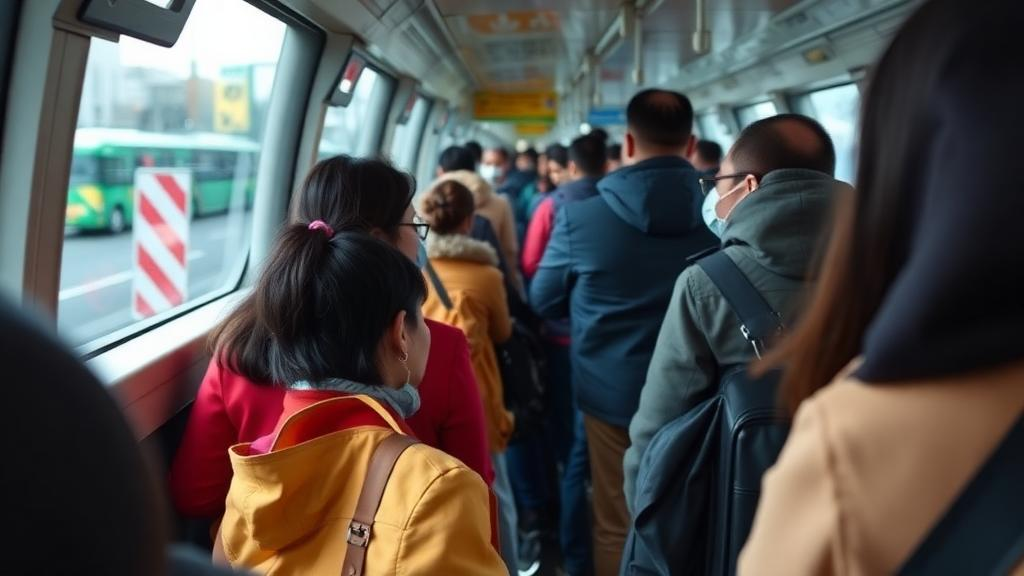
Every weekday morning, hundreds of millions of workers around the world surrender a slice of their lives to the journey between home and workplace. In China, where breakneck urbanization has pushed housing ever further from jobs, that slice has been growing. A new analysis of one of the country’s largest social surveys suggests that this daily sacrifice may carry a measurable psychological cost: employed adults who spend longer getting to work report more depressive symptoms than their shorter-commute counterparts. But the study, published in BMC Public Health, also offers an unusually candid lesson in what large observational datasets can and cannot prove about cause and effect.
Researchers Ying Zhang of Henan University of Urban Construction and Chuhan Wang and Chanyu Guo of South China Normal University drew on the China Family Panel Studies, a nationally representative biennial survey coordinated by Peking University. They assembled 33,322 person-year observations from 18,389 employed respondents aged 16 to 65, spanning four survey waves conducted in 2016, 2018, 2020 and 2022. To measure mental health, they used the six-item negative-affect component of the Center for Epidemiologic Studies Depression Scale, a widely validated screening instrument in which respondents rate how often they experienced feelings such as sadness, loneliness and restlessness during the past week. Commuting time was recorded as the one-way duration of the trip to work, self-reported by each participant.
The headline finding comes from the pooled statistical models, which compare all individuals against one another at the same point in time while adjusting for a battery of potential confounders. In the fully adjusted model, each additional minute of one-way commuting was associated with an increase of 0.00387 points on the CES-D-6 scale, with a 95 percent confidence interval running from 0.00225 to 0.00548 and a p-value below 0.001. Expressed more intuitively, every extra ten minutes spent traveling to work corresponded to roughly 0.039 points more depressive symptoms. The association was robust across a series of sensitivity checks, including analyses that applied survey weights, used inverse-probability weighting to correct for sample selection, and varied the level at which standard errors were clustered.
The research team then deployed a more demanding statistical strategy: two-way fixed-effects modeling. By comparing each person only to themselves across survey waves, and simultaneously absorbing year-specific shocks that affect everyone, this approach strips away all stable individual characteristics, whether measured or not. Personality, genetic predisposition, childhood circumstances and stable housing preferences all vanish from the equation. What remains is the question of whether a person’s depressive symptoms change when their commute changes. Here the estimate pointed in the same direction, with a coefficient of 0.00154 per minute, but the confidence interval stretched from negative 0.00078 to positive 0.00386, and the p-value of 0.192 meant the result could not be distinguished from chance.
Why did the within-person analysis falter? The authors point to a structural weakness in the data rather than an absence of any real effect. Only 9,674 of the 18,389 individuals, or 52.6 percent, appeared in at least two of the four waves, and just 7,650, or 41.6 percent, showed any variation at all in their commuting time between surveys. Because most people’s commutes stay roughly stable over two-year intervals, the fixed-effects estimator had very little identifying variation to work with. The study was, in the authors’ assessment, underpowered for associations of the magnitude implied by the pooled models. In plain terms, the signal may be real but too faint for this design to detect reliably.
The sensitivity analyses reinforce this interpretation. When the researchers removed weekly working hours from both the sample restriction and the adjustment set, the analytic sample expanded to 39,821 person-years, and the estimates barely moved: the pooled coefficient settled at 0.00347 with a p-value below 0.001, while the fixed-effects coefficient was 0.00143 with a p-value of 0.155. Weighted and inverse-probability-weighted versions of the pooled analysis remained consistent with the main result. The convergence of these estimates across specifications suggests that the between-person association is not an artifact of one particular modeling choice, even though its causal interpretation remains open.
Several mechanisms could plausibly link long commutes to poorer mental health, and the study’s framing situates itself within the broader literature on social determinants of health. Time spent commuting is time not spent sleeping, exercising, socializing or recovering from work, and chronic time scarcity is a well-documented stressor. Crowded public transport and traffic congestion add daily hassles that can accumulate into sustained strain. Commuting may also erode job satisfaction, and the researchers treated satisfaction as an exploratory secondary outcome alongside dose-response form and effect modification, though these analyses are explicitly preliminary and do not overturn the core findings.
The study’s limitations deserve as much attention as its findings. Because commuting time is self-reported, measurement error is possible, and any unmeasured time-varying factor that simultaneously lengthens commutes and worsens mood could bias the estimates. The CES-D-6 captures depressive symptoms as a screening measure rather than clinical diagnoses of major depression. The panel’s biennial rhythm means that short-term fluctuations in both commuting and mood are invisible, and the authors are explicit that the present design does not establish a causal effect. Their conclusion carefully distinguishes the robust between-person association from the statistically inconclusive within-person estimate, a level of nuance that is often lost when such findings travel into public discussion.
For urban planners and public health officials, the research lands amid intensifying debate about the hidden costs of sprawl and super-commutes. Chinese cities have expanded metro networks and experimented with remote and hybrid work arrangements, particularly since 2020, and the survey waves analyzed here capture a period of profound disruption in commuting patterns. If the association between commute length and depressive symptoms reflects even a partially causal process, the mental health dividend of shorter commutes could be substantial given the sheer number of affected workers. Conversely, if longer commutes are largely a marker of other disadvantages, such as unaffordable housing near employment centers, then interventions would need to target those upstream constraints.
What the study ultimately delivers is a rigorously quantified association, an honest appraisal of its own statistical limits, and a roadmap for future work. Panel surveys with annual waves, objective travel data from smartphones or transit records, and larger within-person variation in commuting would give fixed-effects designs the power they lacked here. Until then, the evidence stands as a suggestive but unproven case: the daily journey to work, long treated as dead time, may be quietly shaping the emotional lives of the people who make it. For the millions of workers staring at a forty-five-minute train ride, the science is not yet ready to promise that a shorter commute would lift their mood, but it has made the question impossible to ignore.
Subject of Research: The association between commuting time and depressive symptoms among employed adults in China
Article Title: Commuting time and depressive symptoms among employed adults in China: pooled and fixed-effects estimates from the China Family Panel Studies
Article References: Zhang, Y., Wang, C., & Guo, C. (2026). Commuting time and depressive symptoms among employed adults in China: pooled and fixed-effects estimates from the China Family Panel Studies. BMC Public Health. https://doi.org/10.1186/s12889-026-29768-x
Image Credits: AI Generated
DOI: 10.1186/s12889-026-29768-x
Keywords: commuting time, depressive symptoms, mental health, China Family Panel Studies, fixed-effects model, public health, employed adults, social determinants of health, CES-D scale, urbanization, panel data, BMC Public Health
Cite Scienmag News
Glenn Wilkins. (October 5, 2026). Long Commutes Linked to More Depressive Symptoms in Massive Chinese Panel Study. Scienmag. https://scienmag.com/long-commutes-linked-to-more-depressive-symptoms-in-massive-chinese-panel-study/
Glenn Wilkins. "Long Commutes Linked to More Depressive Symptoms in Massive Chinese Panel Study." Scienmag, 5 October 2026, https://scienmag.com/long-commutes-linked-to-more-depressive-symptoms-in-massive-chinese-panel-study/. Accessed 5 October 2026.
Glenn Wilkins. "Long Commutes Linked to More Depressive Symptoms in Massive Chinese Panel Study." Scienmag. October 5, 2026. https://scienmag.com/long-commutes-linked-to-more-depressive-symptoms-in-massive-chinese-panel-study/


