


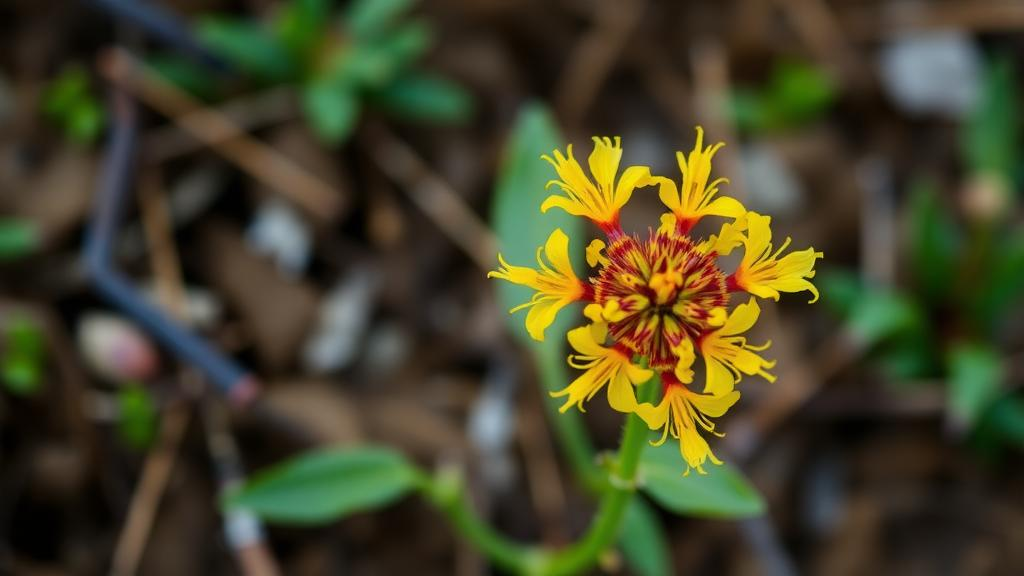
Along the windswept coasts of Oregon and California, a small yellow wildflower is quietly solving one of plant biology’s most stubborn problems. The yellow monkeyflower, Mimulus guttatus, flourishes in a zone where ocean wind hurls salt spray inland with enough force to burn, brown and ultimately kill most other vegetation. Researchers at Michigan State University have now begun to dissect exactly how these coastal populations manage this feat, and their findings, published in the American Journal of Botany, point toward strategies that could one day protect crops from salt exposure of many kinds, whether from winter road salt, worsening storm surges or the creeping salinization of farmland.
The study, led by plant biology PhD student Madison Plunkert with senior author David Lowry, a biologist at Michigan State University, took advantage of a natural experiment that monkeyflowers have been running for themselves across western North America. The species occupies an enormous range, stretching from the Pacific Coast as far inland as the Great Plains, and it is famous among botanists for colonizing places that would poison or scorch most plants. Wild monkeyflowers grow on the margins of abandoned copper mines, in hot springs, and in serpentine soils loaded with minerals toxic to the majority of the plant kingdom. That tolerance for extreme environments made them ideal subjects for asking a deceptively simple question: what, physiologically, separates a coastal monkeyflower from an inland one when both are hit with salt?
Lowry first noticed the difference nearly twenty years ago in the greenhouse. When he sprayed salty water on monkeyflowers collected from inland sites and from the coast, the results were dramatic and repeatable. The inland plants wilted, turned brown, and many of them died. The coastal plants, gathered from populations that face the ocean every day, survived. That visible contrast hinted at a deep, evolved divergence between the two groups, but for years the underlying mechanism remained a puzzle. Salt is not merely unpleasant for plants; it is actively lethal. It causes roots and leaves to dry out, disrupts water balance, and stunts growth, which is why anyone who has seen rust spots and peeling paint on beachfront homes can appreciate what the same chemistry does to living tissue over time.
To understand the coastal advantage, the team had to recreate the seaside in Michigan. The result was a piece of improvised laboratory equipment the researchers affectionately call the Saltmobile. As Plunkert described it, the device is a cart fitted with airbrushes and bottles of seawater, surrounded by a trash bag so that the lab hallway does not fill with a haze of salt spray. With the Saltmobile, the team could subject plants to a controlled, reproducible simulation of oceanfront conditions, something that would otherwise require hauling equipment to blustery coastal field sites where, as Lowry noted, the wind blows at thirty or forty miles an hour and a salty film coats car windshields. Anyone who licks the leaves of these coastal plants, he added, can even taste the salt.
The core experiment compared monkeyflowers collected from five coastal and five inland areas across Oregon and California. The researchers sprayed the plants with salty water, allowed the spray to dry on the foliage, and then measured how much sodium had actually made it inside the leaves. The numbers were striking. For every square centimeter of leaf tissue, coastal plants contained roughly thirty percent less sodium than their inland relatives. In other words, the coastal populations had not simply learned to endure more salt inside their tissues; they were demonstrably better at keeping salt out of their leaves in the first place. Lowry summarized the finding plainly: coastal plants are better at preventing salt from entering their leaves.
The next question was how. The team examined a suite of leaf traits that might explain the exclusion effect. Perhaps coastal plants had modified their stomata, the microscopic pores through which gases and water vapor pass, offering fewer entry points for seawater droplets. Or maybe the surface chemistry of coastal leaves caused saltwater to bead up and roll off rather than linger on the surface, where dissolved sodium could gradually sneak in. The answer turned out to be more subtle than any single visible trait. None of the leaf characteristics the researchers measured explained the difference, suggesting that salt exclusion in these plants is governed by mechanisms that do not show up in conventional leaf morphology, and leaving the precise physiological route as an open question for future work.
Exclusion, it turns out, is only half of the coastal defense strategy. In follow-up experiments, the researchers tested what happens when salt does manage to get inside the leaves. They used a hole punch to cut small discs from leaves and floated those discs in petri dishes, some containing sodium chloride solution and some without. Across plants from multiple sites, and repeated again and again, the same pattern emerged. Leaf discs from coastal plants held out longer in the salty conditions, showing signs of damage more slowly than discs from inland plants. Plunkert noted that the coastal plants did not show damage as quickly as the inland plants did. This capacity, known as tissue tolerance, means coastal monkeyflowers carry a second line of defense: even when salt breaches the outer barrier, their cells can withstand the internal assault for a longer period before harm becomes visible.
The defenses do not stop at the leaf. In a separate companion study, Lowry and Katherine Toll of the University of South Carolina found that coastal monkeyflowers also protect themselves through timing. Coastal plants bolt and flower later in the season than inland plants, waiting until the winds have calmed. By shifting their reproductive schedule away from the windiest, saltiest weeks, they avoid exposing their most vulnerable life stages to the worst impacts of salt spray, effectively staying out of harm’s way through behavior rather than biochemistry. Taken together, the two studies sketch a portrait of local adaptation built from multiple, layered solutions: excluding salt at the leaf surface, tolerating whatever salt gets through, and timing growth and reproduction to dodge the harshest conditions altogether.
The implications reach well beyond a single wildflower on a windy bluff. Rising sea levels and choppier waves under climate change are expected to increase salt exposure for coastal plants around the world, while far from the shore, road salt and storm surges already damage vegetation and threaten agricultural productivity. The research team’s next step is to identify the specific genetic changes that allowed coastal monkeyflowers to keep salt from entering their tissues and to limit the damage once it does. As Lowry observed, there are hundreds of thousands of miles of coastline in the world, and plants live along most of that stretch, all of them contending with the same stress. Understanding how one unassuming yellow flower solved the problem, through both exclusion and tolerance, could eventually inform efforts to breed salt-resilient crops, turning the lessons of a coastal survivor into protection for the plants humanity depends on. The work was supported by grants from the U.S. National Science Foundation.
Subject of Research: Salt spray adaptation mechanisms in coastal yellow monkeyflowers
Article Title: These coastal wildflowers thrive in salt-laden air that kills other plants
Article References: These coastal wildflowers thrive in salt-laden air that kills other plants. (n.d.). Original publication
Image Credits: AI Generated
DOI: Not provided
Keywords: yellow monkeyflower, Mimulus guttatus, salt spray, salt tolerance, coastal plants, plant adaptation, Michigan State University, American Journal of Botany, sodium exclusion, tissue tolerance, climate change, crop resilience
Cite Scienmag News
Alan Morgan. (October 5, 2026). Coastal Monkeyflowers Reveal How Wild Plants Survive Lethal Salt Spray. Scienmag. https://scienmag.com/coastal-monkeyflowers-reveal-how-wild-plants-survive-lethal-salt-spray/
Alan Morgan. "Coastal Monkeyflowers Reveal How Wild Plants Survive Lethal Salt Spray." Scienmag, 5 October 2026, https://scienmag.com/coastal-monkeyflowers-reveal-how-wild-plants-survive-lethal-salt-spray/. Accessed 5 October 2026.
Alan Morgan. "Coastal Monkeyflowers Reveal How Wild Plants Survive Lethal Salt Spray." Scienmag. October 5, 2026. https://scienmag.com/coastal-monkeyflowers-reveal-how-wild-plants-survive-lethal-salt-spray/


