


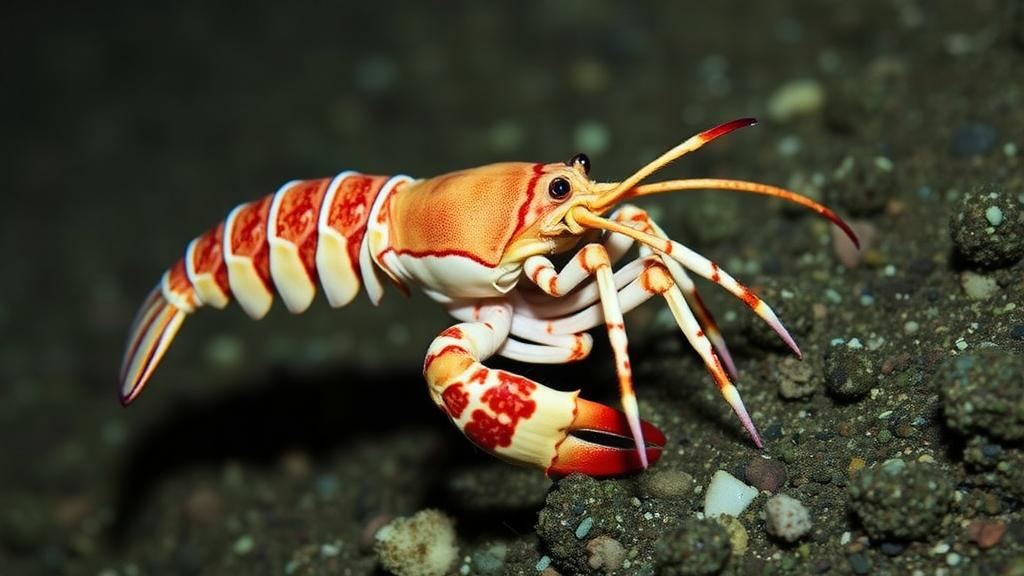
At 360 meters beneath the surface of the southeastern Arabian Sea, clinging to the flanks of an undersea mountain off Minicoy in India’s Lakshadweep Sea, lives a small orange crustacean that no one had ever formally recognized. Researchers at the Centre for Marine Living Resources and Ecology (CMLRE) in Kochi have now described it as a new species of deep-water squat lobster, named Leiogalathea samudragiri, in an open-access study published in Discover Oceans. The discovery, made during a seamount survey under India’s Deep Ocean Mission, adds a nineteenth species to a genus that had previously counted only eighteen members worldwide, and it underscores how little is still known about the fauna of the Indian Ocean’s underwater mountains.
Squat lobsters are not lobsters in the culinary sense. They are decapod crustaceans of the infraorder Anomura, the same group that includes hermit crabs and king crabs, and most species are small, laterally compressed animals that shelter in crevices or perch on hard substrates, waving their elongated claws in the current to feed. The family Munidopsidae, to which the new species belongs, is dominated by deep-water lineages, many of which are associated with seamounts, canyons, and other hard-bottom habitats far below the reach of sunlight-driven photosynthesis. Because these environments are geographically isolated from continental shelves and exhibit complex topographic and oceanographic patterns, they often harbor distinctive benthic communities, including endemic species found nowhere else.
The specimens that led to the new species were collected in late March 2024, during FORV Sagar Sampada cruise 404, using a chain bag dredge deployed at a station located at 8.54 degrees North, 73.26 degrees East, on what the team designated seamount 4 off Minicoy. Four individuals were recovered: an ovigerous female designated as the holotype, one male and two females designated as paratypes. All four came from the same dredge haul at 360 meters depth, collected by R. Ravinesh and his shipboard colleagues. The animals are small even by squat lobster standards, with postorbital carapace lengths ranging from about 4.5 to 5.2 millimeters and carapace widths between 3.7 and 4.4 millimeters.
Back in the laboratory, the team cleaned, photographed, and examined the specimens under a Leica M80 stereo-zoom microscope fitted with a high-definition camera, taking measurements with calibrated imaging software. The morphological analysis followed the descriptive terminology established in a 2019 revision of the genus by Rodríguez-Flores, Macpherson, and Machordom, which had itself described fifteen new species and remains the taxonomic backbone for Leiogalathea. Every appendage was scrutinized: the spination of the third maxillipeds, the proportions of the first pereopods, the armature of the walking legs, the shape of the rostrum, and the pattern of ridges sculpting the carapace, the armored plate that covers the head and thorax.
That ridge pattern proved decisive. Leiogalathea samudragiri shares with three of its closest relatives, L. achates, L. evander, and L. laevirostris, an unarmed hepatic margin on the carapace, a feature that initially groups them together. But the new species stands apart in two consistent characters: its mesogastric and mid-transverse ridges on the carapace are uninterrupted, running continuously across the midline, and the posterior half of the carapace bears six transverse ridges. In the three related species, the mid-transverse ridge is interrupted medially or submedially, and only four or five ridges follow it. Additional differences reinforce the split. Unlike L. achates, the new species lacks a spine on the posterior branchial margin and has subequal rather than unequal distal spines on the second antennal article. Unlike L. evander, it carries three well-developed rostral teeth rather than four to six rudimentary ones, and its abdominal tergite 3 bears a single elevated ridge rather than two. Unlike L. laevirostris, the basal antennular article is unarmed at its distomesial corner, and the mesial margin of the first pereopod’s carpus carries one spine rather than three.
The detailed anatomy is a study in miniature engineering. The rostrum, the pointed projection between the eyes, is slightly downturned and flattened dorsally, about 1.5 times as long as broad, with serrated lateral margins bearing three small teeth and three progressively smaller rudimentary teeth. The first pereopods, the elongated claws that give squat lobsters their characteristic silhouette, extend to nearly three times the carapace length and are clothed in uniramous stiff setae, with the merus segment alone slightly exceeding the carapace length and bristling with strong spines arranged along its mesial, dorsal, lateral, and ventral surfaces. The walking legs are moderately slender and laterally compressed, with propodi more than five times as long as broad and dactyli armed with rows of small, proximally diminishing teeth, each tipped with a slender movable spinule. The third maxilliped’s ischium terminates in a strong spine on its flexor margin and carries a crista dentata of twenty-two corneous denticles.
Even the coloration, recorded from freshly collected material, is distinctive and unexpectedly vivid for an animal living in near darkness. The rostrum and the anterior two-thirds of the carapace are bright orange, with light yellow patches on the posterior gastric region; the posterior carapace and anterior abdominal segments are pale orange, and the pereopods are bright orange marked with white patches. The species name itself is a nod to its habitat, combining the Sanskrit words samudra, meaning ocean, and giri, meaning mountain, a direct reference to the seamount where the animals were found. The holotype female was ovigerous, carrying eggs, which suggests the population was reproductively active at the time of collection.
The broader context makes the find more significant than a single addition to a checklist. The genus Leiogathea, established by Keiji Baba in 1969, is dominated by the Pacific Ocean, which hosts fourteen of its species, while the Atlantic and Indian Oceans had only two each before this description. The munidopsid fauna of the Northern Indian Ocean, the authors note, remains relatively unexplored compared with neighboring regions. A previous expedition had already yielded an unresolved Leiogalathea specimen from the Andaman Sea, reported as Leiogalathea sp. because it was damaged, hinting that the region harbors more diversity than the formal record reflects. The authors also point out that overlapping morphological characters among congeners probably indicate the existence of pseudocryptic species within the genus, externally near-identical lineages that only careful comparison of fine structural details, or genetic analysis, can separate.
The expedition itself is part of a larger national effort. The samples were gathered under India’s Deep Ocean Mission, specifically the Samudrayaan program, coordinated through the Ministry of Earth Sciences, with CMLRE in Kochi leading the faunal exploration aboard the research vessel Sagar Sampada. Seamounts have been recognized as ecological hotspots since faunal explorations began in the 1940s, yet only a handful of Indian Ocean seamounts have ever been surveyed, leaving vast tracts of undersea topography biologically uncharted. Voucher specimens of the new species, registered under the catalog numbers IO/SS/ANO/00195 through 00197, are deposited in the Bhavasagara Referral Centre at CMLRE, which serves as the regional node of the Ocean Biodiversity Information System for the Indian Ocean, and the associated occurrence data will be made publicly available through the OBIS portal.
For now, Leiogalathea samudragiri is known only from its type locality in the Lakshadweep Sea off Kerala, at 360 meters depth, a single seamount station in an ocean basin where deep-water sampling effort remains sparse. Whether the species is a narrow endemic restricted to one undersea mountain, as many seamount-associated invertebrates appear to be, or simply under-collected across a wider range, will only be resolved by further expeditions. What the discovery does demonstrate is that even a single dredge haul, examined with the right taxonomic expertise, can reveal a lineage new to science in one of the most heavily trafficked yet least explored marine regions on Earth, and that the census of life on the Indian Ocean’s seamounts has barely begun.
Subject of Research: Taxonomic description of a new deep-sea squat lobster species from an Arabian Sea seamount
Article Title: A new deep-sea munidopsid squat lobster of the genus Leiogalathea Baba, 1969 (Decapoda: Anomura) from the southeastern Arabian Sea, India
Article References: Tiwari, S., Padate, V. P., & Cubelio, S. S. (2026). A new deep-sea munidopsid squat lobster of the genus Leiogalathea Baba, 1969 (Decapoda: Anomura) from the southeastern Arabian Sea, India. Discover Oceans, 3(1), Article 6. https://doi.org/10.1007/s44289-026-00117-5
Image Credits: AI Generated
DOI: 10.1007/s44289-026-00117-5
Keywords: squat lobster, Leiogalathea samudragiri, seamount, Arabian Sea, deep sea, taxonomy, new species, Munidopsidae, Decapoda, Anomura, Deep Ocean Mission, marine biodiversity
Cite Scienmag News
Violet Maxwell. (October 5, 2026). New Deep-Sea Squat Lobster Species Discovered on Arabian Sea Seamount. Scienmag. https://scienmag.com/new-deep-sea-squat-lobster-species-discovered-on-arabian-sea-seamount/
Violet Maxwell. "New Deep-Sea Squat Lobster Species Discovered on Arabian Sea Seamount." Scienmag, 5 October 2026, https://scienmag.com/new-deep-sea-squat-lobster-species-discovered-on-arabian-sea-seamount/. Accessed 5 October 2026.
Violet Maxwell. "New Deep-Sea Squat Lobster Species Discovered on Arabian Sea Seamount." Scienmag. October 5, 2026. https://scienmag.com/new-deep-sea-squat-lobster-species-discovered-on-arabian-sea-seamount/


