


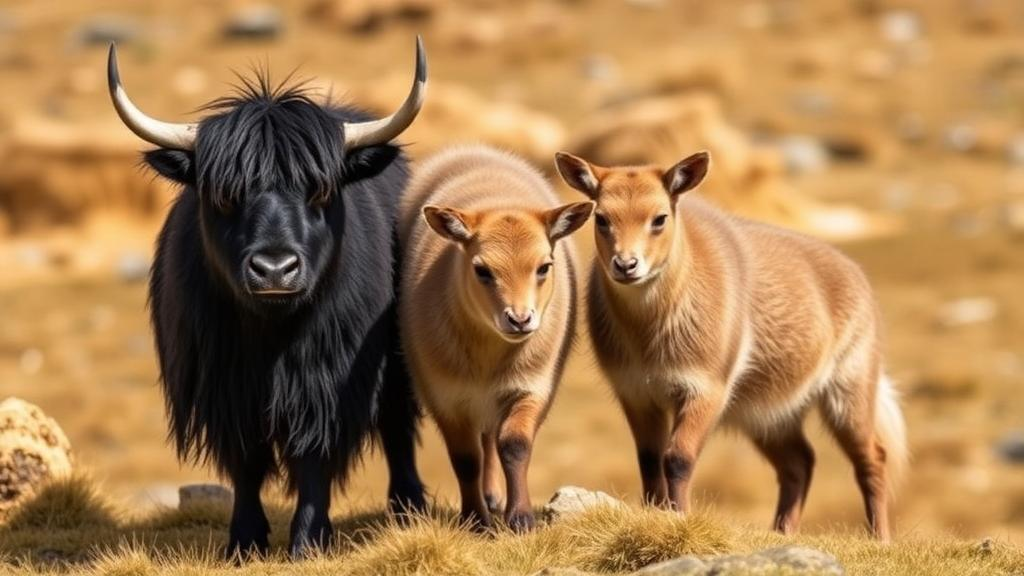
For decades, the plateau pika has been cast as one of the rangelands’ most persistent villains. The small, rabbit-relative mammal burrows across the vast alpine meadows of the Qinghai–Tibetan Plateau, and whenever its populations surge, herders and land managers have often reached for the same conclusion: the animals are competing with livestock for scarce forage and must be controlled. A new study published in eLife, previously released as a Reviewed Preprint and now appearing as the final Version of Record, turns that assumption on its head. Researchers report that at moderate densities, pikas do not undermine yak production at all — they actively improve it, by reshaping the plant community in ways that make grazing land more nutritious and easier to exploit.
The research team, led by scientists at the Northeast Institute of Geography and Agroecology of the Chinese Academy of Sciences in Changchun, together with senior author Zhibin Zhang of the School of Ecology at Hainan University, set out to answer a question that has long lingered in rangeland ecology. Small herbivores such as pikas, voles, prairie dogs, and pocket gophers are both consumers and ecosystem engineers in grasslands worldwide. Through feeding, clipping vegetation, and digging burrows, they profoundly alter plant communities and soil properties. But while population outbreaks clearly harm livestock interests, almost nothing was known about what happens when their numbers sit at lower, non-outbreak levels. Co-first author Zhiwei Zhong, Professor of Ecology at the Northeast Institute of Geography and Agroecology, framed the stakes in stark terms: livestock grazing currently occupies around 77 percent of global agricultural land and sustains billions of people, making a critical assessment of small mammals’ impacts on livestock production urgently needed for both production and biodiversity conservation.
The study focused on a specific ecological mechanism. The team hypothesised that at moderate densities — defined in the study as approximately 200 active burrows per hectare — pikas would benefit yaks by suppressing tall poisonous plants known as Stellera, a genus of forbs that thrives in degraded alpine grasslands and is toxic to livestock. If pikas cut back Stellera, the reasoning went, palatable grasses and sedges would gain space, light, and nutrients, raising both the abundance and the protein content of the forage available to yaks during the growing season from June to August.
To test this idea, the researchers combined observational and experimental approaches. First, they conducted two field surveys to establish how the diets of pikas and yaks differ, and to examine the associations among pika density, Stellera abundance, and yak grazing activity across the landscape. Then they moved to a manipulative field experiment, using fenced enclosures measuring 150 by 150 metres on the Qinghai–Tibetan Plateau, to isolate the interactive effects of pikas and Stellera on yak body growth and to uncover the mechanisms driving those effects. This two-pronged design allowed the team to move beyond correlation and demonstrate causation in a realistic grazing context.
The surveys revealed a striking dietary asymmetry. Pikas and yaks, despite sharing the same meadows, barely overlap in what they actually eat. Pikas very frequently clipped Stellera plants but did not eat them, feeding mostly on other forbs instead. Yaks, as expected, consumed far greater proportions of grasses and sedges. In other words, the supposed competition between the two herbivores was largely an illusion: the pikas were not eating the yak’s lunch, they were weeding the yak’s garden. By selectively clipping the tall poisonous forbs, pikas reduced Stellera cover by two-thirds, which in turn increased the availability and protein content of the grasses and sedges that yaks depend on.
The consequences for the yaks themselves were measurable and substantial. Co-first author Bingbo Ni, an environmental researcher at the Northeast Institute of Geography and Agroecology, explained that by improving the composition of the vegetation, the moderate presence of pikas facilitated weight gains in yaks. In livestock production, where body condition directly determines meat, milk, and economic returns, a natural mechanism that boosts weight gain without any human intervention carries obvious significance for herding communities across the plateau and beyond.
Perhaps even more compelling were the findings on foraging efficiency. The researchers tracked two behavioural metrics: bite rate, the number of bites taken on plants per hour, and the bites–step ratio, the number of bites per step taken while moving through the sward. During the manipulative experiment, when pikas were absent, the yaks’ sedge bite rate and sedge bites per step fell by 32 percent and 46 percent respectively, compared with conditions when pikas were present. Grass bite rate and grass bites per step similarly declined by 29 percent and 43 percent. The team attributed these drops directly to the resurgence of poisonous Stellera in the pikas’ absence, which forced yaks to spend more time and movement searching for acceptable forage among the toxic plants.
Zhong noted that the study is the first to show that maintaining a moderate density of pikas can substantially enhance livestock growth by suppressing Stellera, reconciling long-running debates about the effects of pikas on yak production through changes in vegetation properties. He added that the observations shed light on how small and large mammalian herbivores co-exist in complex ways. The findings carry a broader ecological message: interactions between animals of very different body sizes in shared ecosystems are rarely one-dimensional, and management policies built on the assumption of simple competition may destroy beneficial relationships that were never measured in the first place.
The authors are careful to delineate the limits of their conclusions, and those limits chart a research agenda. Their work examined pika–yak interactions only during the summer, when food resources are most abundant; whether the facilitation weakens or even flips into competition under more stressful conditions, such as autumn or winter when forage becomes limited, remains untested. The study site also sat at approximately 3,200 metres elevation, relatively low by Qinghai–Tibetan Plateau standards, so it is unknown whether similar facilitation occurs at higher elevations where other unpalatable species replace Stellera as the problematic plant. Finally, whether the same relationship holds between pikas and other livestock in the region, such as domestic sheep and goats, has yet to be determined.
Even with those caveats, the implications for rangeland management are far-reaching. Senior author Zhibin Zhang emphasised that because the conclusions rest on both experimental and observational evidence across realistic contexts, they are applicable beyond the Qinghai–Tibetan Plateau to rangeland management elsewhere, and the team hopes the insights will inform conversations and future studies concerning biodiversity and ecosystem functioning worldwide. For a species long targeted as a pest, the pika’s rehabilitation carries a cautionary lesson for land managers everywhere: culling programs aimed at small mammals may quietly remove an ecological service — natural weed suppression that fattens livestock — and the true costs of such interventions are only now coming into focus. In the alpine meadows of the world’s highest rangelands, the smallest grazers may be among the livestock industry’s most valuable, and least appreciated, partners.
Subject of Research: Facilitative interactions between plateau pikas and grazing yaks in alpine grassland ecosystems
Article Title: Plateau pikas, long considered pests, can help livestock eat well
Article References: Plateau pikas, long considered pests, can help livestock eat well. (n.d.). Original publication
Image Credits: AI Generated
DOI: Not provided
Keywords: plateau pika, yak, Qinghai–Tibetan Plateau, rangeland management, Stellera, livestock grazing, ecosystem engineers, foraging efficiency, grassland ecology, small mammals, vegetation composition, eLife
Cite Scienmag News
Alan Morgan. (October 5, 2026). Plateau Pikas Turn Out to Be Secret Allies of Grazing Yaks on the Tibetan Plateau. Scienmag. https://scienmag.com/plateau-pikas-turn-out-to-be-secret-allies-of-grazing-yaks-on-the-tibetan-plateau/
Alan Morgan. "Plateau Pikas Turn Out to Be Secret Allies of Grazing Yaks on the Tibetan Plateau." Scienmag, 5 October 2026, https://scienmag.com/plateau-pikas-turn-out-to-be-secret-allies-of-grazing-yaks-on-the-tibetan-plateau/. Accessed 5 October 2026.
Alan Morgan. "Plateau Pikas Turn Out to Be Secret Allies of Grazing Yaks on the Tibetan Plateau." Scienmag. October 5, 2026. https://scienmag.com/plateau-pikas-turn-out-to-be-secret-allies-of-grazing-yaks-on-the-tibetan-plateau/


