


Deep underground, miners working the downward drift-and-fill method place their trust in an unusual ceiling: a slab of cemented tailings backfill left behind by the previous mining slice. As extraction descends, this artificial roof spans the newly opened drift and shields workers and equipment from the overlying fill mass. A new study published in Results in Engineering has now built a field-calibrated mechanical model that quantifies, for the first time at this level of detail, exactly how much steel reinforcement at the bottom of such a roof contributes to its strength, and how much subsidence miners can expect before trouble begins.
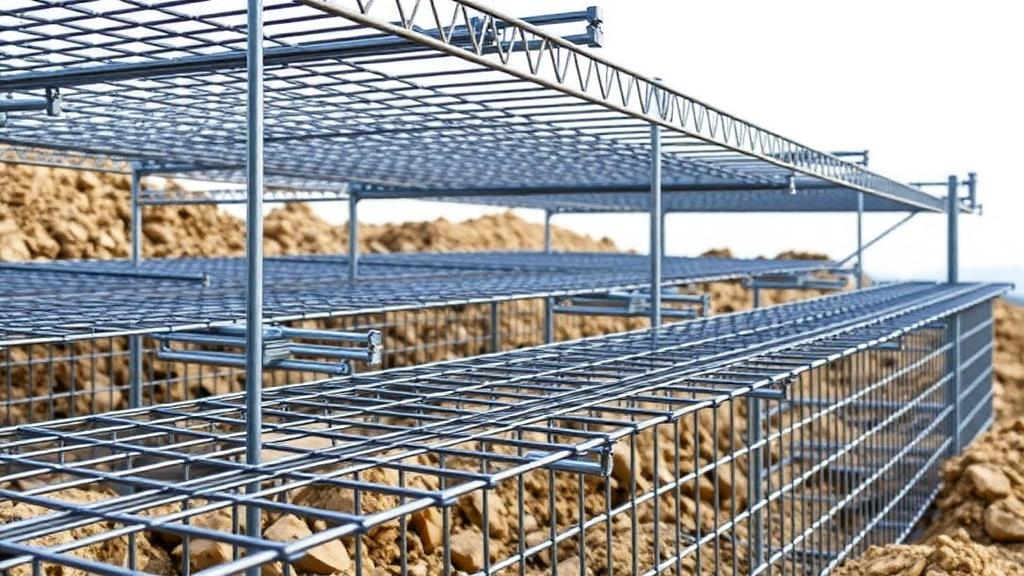
The research team, led by Yongjing Ye and Keqing Li, carried out their investigation at Longshou Mine, where the drift cross-section is hexagonal, with a sidewall width of 6 meters, a floor width of 4 meters, and a height of 5 meters. The load-bearing layer of backfill above the drift is 3 meters thick. Before filling, crews place triangular steel trusses on the drift floor and lay steel mesh above them, lapping the mesh continuously along the floor and up both sidewalls. The longitudinal bars of the mesh, spaced at 300 millimeters, and the main bars of the trusses act together as the tensile reinforcement of the resulting composite slab.
To model this structure, the researchers turned to a classic tool of reinforced concrete theory: the transformed section method. Because steel is far stiffer than cemented backfill, with an elastic modulus ratio of roughly 122 in this case, each bar’s cross-sectional area can be converted into an equivalent area of backfill. This allows the neutral axis position, the moment of inertia, and the stress distribution of the whole section to be calculated with standard beam mechanics. Before cracking, the model treats the backfill as a homogeneous, linear-elastic material obeying the plane-section assumption; after cracking, it assumes the fractured tension zone carries no tensile force at all, leaving the steel to act alone. That second assumption is deliberately conservative, meaning the real capacity of a cracked roof is likely higher than the model predicts.
The roof itself is idealized as a simply supported beam spanning the drift width, loaded by a uniformly distributed overburden pressure. The authors are candid about the limits of this idealization: real drift ends receive some rotational restraint from surrounding rock and adjacent fill, so the simply supported model may slightly underestimate stiffness and overestimate deflection. Self-weight is likewise excluded from the capacity calculations because it is identical for every reinforcement scheme considered, making the results valid comparative indices rather than absolute design loads.
Validation came from an ambitious field monitoring program. Because embedding and fixing sensors in soft backfill is notoriously difficult, the team designed a dedicated fixing device and installed pressure cells at elevations of 1, 2, and 3 meters above the drift floor, concrete strain gauges at four elevations, and rebar stress gauges welded directly into the steel mesh and trusses. All instruments sat at midspan, and convergence monitoring sections were arranged along several drifts to track roof subsidence as mining advanced. The results showed the overburden load on the roof’s load-bearing layer holding steady between 0.11 and 0.16 megapascals, with strain flipping from compression near the top of the section to progressively larger tension near the bottom, exactly the pattern a bending beam should produce.
The comparison between theory and measurement was instructive. The model predicted an initial cracking capacity of 0.30 megapascals, comfortably above the measured 0.14 megapascals, confirming the roof stayed uncracked throughout monitoring, which matched field observation. Predicted strains at 0.5, 1.0, and 1.5 meters above the floor matched measured trends with errors of only 18, 38, and 2 microstrain. At 2.0 meters, however, the measured compressive strain of 632 microstrain vastly exceeded the predicted 58, a discrepancy the authors attribute to local stress concentrations, pressure arching, material heterogeneity, and the fact that a single gauge records a local response while the model describes an average. Rebar gauge readings told a similar story: theoretical forces of 6.3 and 6.7 kilonewtons fell within the measured range but below the maximum of 10 kilonewtons, prompting the team to introduce a calibrated adjustment coefficient of 1.7 on the elastic modulus ratio to cover unfavorable stress states with a safety margin.
With the calibrated model in hand, the reinforcement’s contribution became quantifiable. Installing the mesh and truss shifts the neutral axis downward, shrinking the tension zone and cutting the peak tensile stress at the bottom edge, where cracks begin. The result is a 7.6 percent increase in initial cracking capacity, from 0.288 to 0.310 megapascals. More striking is the post-cracking behavior: at the moment the backfill first cracks, the steel carries only about 114 megapascals against a tensile strength of 375 megapascals, leaving substantial reserve. The model predicts the reinforced roof can still sustain 0.102 megapascals of overlying load after cracking, roughly 33 percent of its cracking capacity, with tensile rupture of the reinforcement, rather than crushing of the backfill, governing eventual failure.
Subidence calculations revealed a subtler picture. The classical elastic deflection formula for a simply supported beam predicted a mere 0.28 millimeters of sag, wildly short of the 16 millimeters measured in the field, exposing the inadequacy of ideal elastic theory for absolute prediction. A geometric alternative fared far better: by computing the elongation of the roof’s lower boundary under bending and approximating the sagging profile as a circular arc, the team obtained a theoretical subsidence of 31.5 millimeters, which a field-calibrated adjustment coefficient of 0.49 refined to 15.4 millimeters, closely matching observation. Before cracking, reinforcement barely changes subsidence at all. Its real value emerges afterward: by continuing to carry tensile force, it extends the allowable subsidence from 23.05 to 41.09 millimeters, an increase of about 78 percent, delaying crack propagation and instability rather than preventing initial deflection.
Finally, the team used the corrected model to optimize the reinforcement layout itself, holding truss geometry fixed and varying only bar diameters and spacings within a 200-to-500-millimeter window for the mesh. Evaluating total steel mass, cracking capacity, post-cracking capacity, and limiting subsidence across seven schemes, they identified a preferred configuration using 6-millimeter mesh bars at 200-millimeter spacing with trusses at 1000-millimeter spacing. Compared with the original design, this scheme raises the theoretical post-cracking load-bearing capacity by 22.5 percent while actually trimming material cost by 3.1 percent, with cracking capacity and deformation limits essentially unchanged. A cost-focused alternative cuts steel mass by 17 percent at unchanged performance. Because the schemes alter only spacing and diameter, they require no change to existing fabrication practice. The authors stress that both calibration coefficients are empirical values tied to Longshou Mine’s monitoring data and must be recalibrated elsewhere, and that hangers and other vertical components, whose load-transfer roles differ from horizontal tensile reinforcement, remain outside the model’s scope for future work. Even so, the study delivers something underground engineers have long lacked: a fast, transparent, field-tested formula connecting steel layout to roof survival.
Subject of Research: Mechanical modeling and field monitoring of steel-reinforced cemented backfill roofs in downward drift mining
Article Title: A mechanical model for bottom reinforcement strengthened backfill roofs in downward drifts revised by field monitoring
Article References: Ye, Y., Li, K., Hu, Y., Zhang, B., Guo, R., & Han, B. (2026). A mechanical model for bottom reinforcement strengthened backfill roofs in downward drifts revised by field monitoring. Results in Engineering, 32, Article 113264. https://doi.org/10.1016/j.rineng.2026.113264
Image Credits: AI Generated
DOI: 10.1016/j.rineng.2026.113264
Keywords: backfill roof, downward drift mining, cemented backfill, steel reinforcement, transformed section method, simply supported beam, field monitoring, roof subsidence, cracking capacity, post-cracking behavior, Longshou Mine, mining geotechnics
Cite Scienmag News
Denise Maddox. (October 5, 2026). Steel-Mesh Reinforcement Keeps Mine Backfill Roofs Standing, Field Data Confirm. Scienmag. https://scienmag.com/steel-mesh-reinforcement-keeps-mine-backfill-roofs-standing-field-data-confirm/
Denise Maddox. "Steel-Mesh Reinforcement Keeps Mine Backfill Roofs Standing, Field Data Confirm." Scienmag, 5 October 2026, https://scienmag.com/steel-mesh-reinforcement-keeps-mine-backfill-roofs-standing-field-data-confirm/. Accessed 5 October 2026.
Denise Maddox. "Steel-Mesh Reinforcement Keeps Mine Backfill Roofs Standing, Field Data Confirm." Scienmag. October 5, 2026. https://scienmag.com/steel-mesh-reinforcement-keeps-mine-backfill-roofs-standing-field-data-confirm/


