


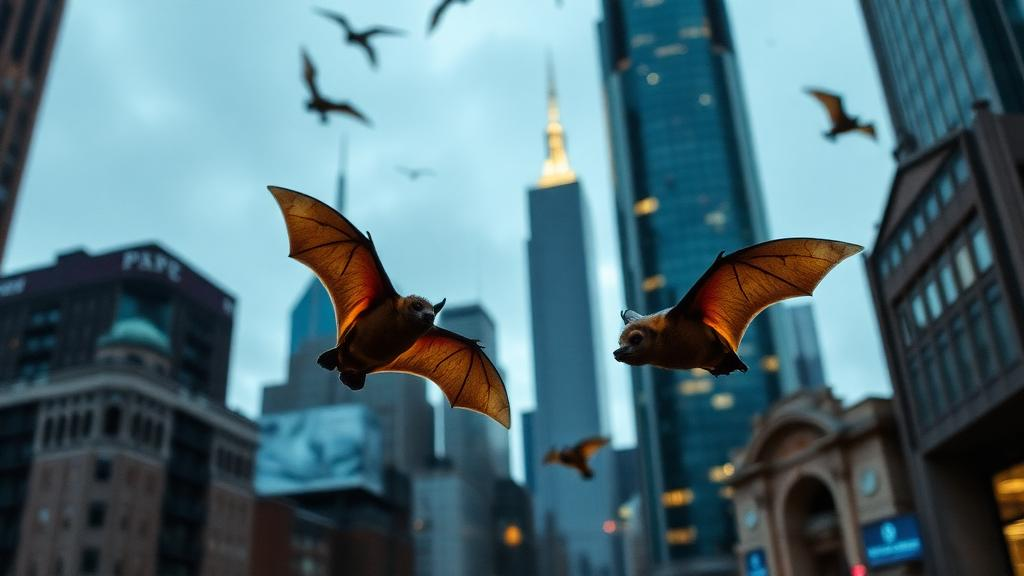
City-dwelling bats may be getting an unexpected helping hand from the very environments often blamed for driving wildlife away. A large-scale acoustic monitoring study conducted across Israel has found that insectivorous bats active in urban habitats are far less constrained by weather conditions than their rural counterparts, suggesting that cities act as environmental buffers that smooth out the climatic variability shaping the nightly lives of these flying mammals. The research, published in the journal iScience, offers one of the most comprehensive pictures to date of how urbanization reshapes the behavior of echolocating bats, drawing on tens of thousands of recorded encounters across a steep aridity gradient.
The study, led by Jianan Ding, Arjan Boonman, Ofri Eitan, Yuval Werber, David Troupin, Nir Sapir, and Yossi Yovel, deployed passive acoustic recorders at 27 sites, 12 urban and 15 rural, spread across nearly 300 kilometers of Israel. The sites ranged from temperate forests receiving roughly 800 millimeters of annual rainfall in the north to semi-arid desert zones receiving about 200 millimeters in the south. Each AudioMoth full-spectrum recorder was placed within 20 meters of a meteorological station, allowing the researchers to tie every recorded bat call to precise, locally measured weather conditions. From August 1 to October 13, the team logged 1,151 nights of recordings, capturing 95,473 bat occurrences in total.
The technical setup was demanding. Recorders operated on a 50 percent duty cycle, capturing 30-second audio sessions every minute for 12 hours each night from sunset to sunrise, generating nearly 720 audio files per site per night. A custom-written MATLAB program then detected echolocation calls and automatically classified them to species based on signal frequency, duration, and harmonic content. To validate the automated pipeline, the researchers manually reviewed complete recordings from 30 nights at each site. Automatic classification was used only where accuracy exceeded 90 percent; at sites with intermediate accuracy, every identification was manually verified, and at two sites with accuracy below 70 percent, all files were classified by hand. Three sites yielded no bat detections at all.
Of the 23 bat species detectable in the region with the equipment’s sampling constraints, the team recorded 11 species from 7 genera and 4 families across 24 sites. Rural sites proved richer, hosting all 11 species, while urban sites supported 8, all of which also occurred in rural areas. For seven of the species found in both habitat types, activity was significantly higher at rural sites, measured as encounters per hour. The sole exception was Tadarida teniotis, the European free-tailed bat, which was significantly more active in urban areas, where it typically roosts. Species richness also correlated positively with latitude, reflecting the region’s rainfall gradient, with the five most species-rich sites all clustered in the wetter north.
The study’s central insight emerged when the researchers examined how environmental variables influenced bat activity. They divided species into two functional groups: generalists, detected at both urban and rural sites, and rural specialists, found exclusively outside cities. Using zero-inflated negative binomial models, they tested 511 predictor combinations per species and selected the best-supported models by Akaike Information Criterion. The predictors included temperature, humidity, wind speed, ambient illumination, the proportion of built-up area, average building height, environmental noise, hours from sunset, and latitude. The pattern was strikingly consistent: rural specialists were the most sensitive to weather, generalists at rural sites showed intermediate sensitivity, and generalists at urban sites were the least affected of all.
On average, bat activity rose with temperature and humidity and fell with wind speed and illumination, but the strength of these effects varied dramatically by habitat. Rural bats strongly preferred low wind speeds, a preference the authors attribute to thermoregulatory costs, acoustic interference with echolocation, and the behavior of insect prey, whose own flight activity drops in windy conditions. Urban bats, by contrast, showed little to no wind aversion. When the analysis isolated moonlight as the sole illumination variable, activity at rural sites generally declined as moonlight intensified, consistent with heightened perceived predation risk, whereas most urban species showed no significant lunar response, likely because city lights wash out the moon’s signal entirely.
Comparing the environmental conditions under which bats actually flew revealed the buffering effect in vivid detail. Rural specialists were the most restricted animals in the dataset, active only at higher temperatures and lower humidities than generalist species foraging at the very same sites. Generalists, meanwhile, operated across a much wider range of conditions, but remarkably, the same species extended their activity to lower temperatures, higher humidities, and stronger winds when hunting in cities than when hunting in the countryside. A Kullback-Leibler divergence analysis, which quantifies how different the weather during bat activity was from the weather across the entire night, confirmed that this mismatch was greatest for rural specialists and smallest for urban generalists.
The physical environment itself helps explain the pattern. During the study period, urban sites averaged roughly 2 degrees Celsius warmer and about 5 percent more humid-differing in humidity by about 5 percent lower-than nearby rural sites, a signature of the urban heat island effect and the reduced weather variability that cities create. The authors suggest several mechanisms that might allow urban bats to tolerate harsher conditions: the proximity of reliable food, the availability of irrigated parks, ponds, and lakes that attract both insects and bats in a water-scarce region, and the microclimatic shelter provided by buildings. Seasonal trends reinforced the story, as species richness and activity declined markedly toward winter at rural sites but remained comparatively stable in cities, hinting that urban environments may extend the active season for city-dwelling bats.
The researchers are careful to note the study’s limitations. Acoustic monitoring counts call encounters rather than individual bats, so differences in activity could partly reflect differences in the number of animals present. The monitoring window covered only 2.5 months from midsummer to autumn, leaving other seasons unexamined. And because the work was entirely remote, it cannot definitively establish that urban buffering causes bats to broaden their activity windows; unmeasured factors such as prey availability and fine-scale habitat structure may also contribute. The microphone setup, sampling at 96 kilohertz, could reliably detect only relatively loud calls below 50 kilohertz, excluding nine local species including all horseshoe bats, though previous work consistently identifies those species as rural specialists unlikely to alter the conclusions.
Beyond its findings on bats, the study showcases the power of passive acoustic monitoring combined with automated species classification for biodiversity research at scales that would be impossible with traditional surveys. As urbanization accelerates worldwide, the results add nuance to a usually grim picture: while rural specialists avoid cities and overall diversity is lower in urban areas, the generalist bats that do persist there appear to gain a measure of climatic freedom, operating under conditions that would ground their rural relatives. In an era of rapid environmental change, the city, for some species at least, may be less a threat than a shelter.
Subject of Research: The effects of urbanization and weather conditions on the activity of insectivorous bats
Article Title: Urban habitats offer buffered environmental conditions for city-dwelling bats
Article References: Ding, J., Boonman, A., Eitan, O., Werber, Y., Troupin, D., Sapir, N., & Yovel, Y. (2026). Urban habitats offer buffered environmental conditions for city-dwelling bats. iScience, 29(10), Article 117767. https://doi.org/10.1016/j.isci.2026.117767
Image Credits: AI Generated
DOI: 10.1016/j.isci.2026.117767
Keywords: bats, urbanization, passive acoustic monitoring, echolocation, urban heat island, weather, moonlight, wildlife behavior, Israel, iScience, biodiversity, urban ecology
Cite Scienmag News
Gavin Prescott. (October 5, 2026). City Life Shields Bats From Weather Swings, Landmark Acoustic Survey Reveals. Scienmag. https://scienmag.com/city-life-shields-bats-from-weather-swings-landmark-acoustic-survey-reveals/
Gavin Prescott. "City Life Shields Bats From Weather Swings, Landmark Acoustic Survey Reveals." Scienmag, 5 October 2026, https://scienmag.com/city-life-shields-bats-from-weather-swings-landmark-acoustic-survey-reveals/. Accessed 5 October 2026.
Gavin Prescott. "City Life Shields Bats From Weather Swings, Landmark Acoustic Survey Reveals." Scienmag. October 5, 2026. https://scienmag.com/city-life-shields-bats-from-weather-swings-landmark-acoustic-survey-reveals/


