


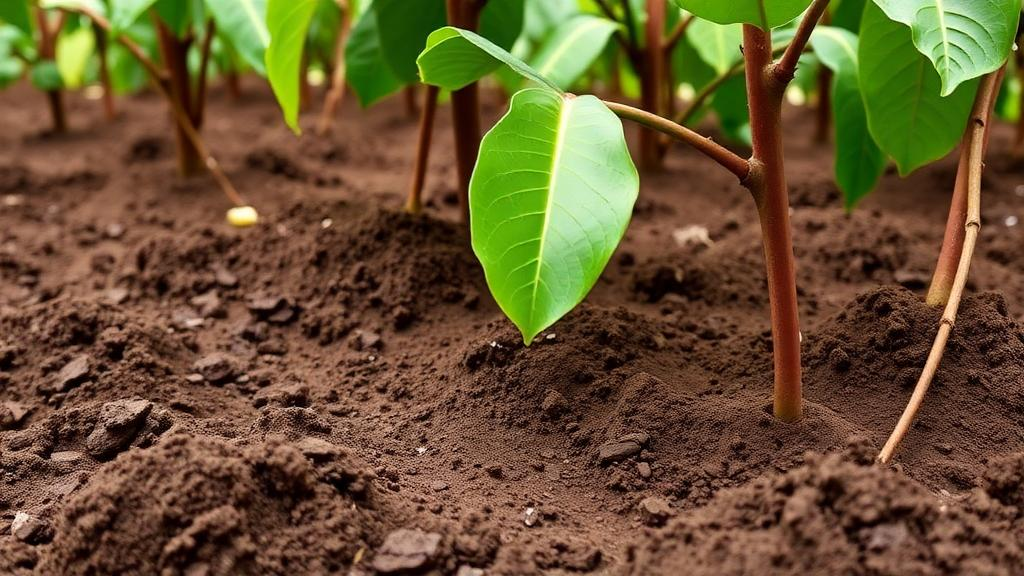
In the acidic soils of the Peruvian Amazon, an invisible threat lurks beneath the roots of one of the world’s most beloved crops. When soil pH drops below about 5.5, aluminium that is normally locked away in mineral structures begins to dissolve into the soil solution, where it can stunt root growth, interfere with nutrient uptake and quietly erode cacao yields. The problem is widespread across the tropics, yet it is also unevenly monitored, because the laboratory test that directly measures aluminium saturation, the exchangeable-acidity determination, is expensive, technically demanding and often unavailable in the very regions where acidic soils are most common. A new study published in Environmental Monitoring and Assessment suggests that the humble routine soil test, the kind many regional laboratories already perform every day, may be enough to identify which cacao fields are most likely to harbour dangerously high levels of this toxic metal.
The research, conducted by Peter Coaguila-Rodriguez and Alberto Franco Cerna-Cueva of the Universidad Nacional Agraria de la Selva in Tingo María, Huánuco, set out to answer a deceptively simple question: can ordinary soil chemistry measurements predict which samples will show aluminium saturation at or above 20 percent, a threshold commonly associated with high or very high toxicity risk? To do so, the team turned to an anonymized institutional soil-monitoring database containing 1,842 records from cacao-growing areas of the central Peruvian Amazon. After filtering for acidity, 1,539 samples with pH below 5.5 formed the analytical cohort, a substantial dataset for a region where such comprehensive soil records are rare.
Aluminium saturation is defined as the proportion of the soil’s exchangeable cation exchange capacity occupied by aluminium rather than by base cations such as calcium, magnesium and potassium. As soils acidify, base cations are leached away and aluminium increasingly dominates the exchange complex, which is why the metric serves as a direct chemical indicator of the intensity of acid-soil stress a plant will experience. Cacao, a crop native to the upper Amazon and economically vital to Peru, is known from prior ecophysiological work to be sensitive to soil acidity, with juvenile plants showing impaired growth and altered nutrition under acidic conditions. Yet the full exchangeable-acidity analysis needed to compute saturation requires titration procedures that many regional laboratories do not routinely offer, whereas pH, organic matter and exchangeable bases are standard fare.
The researchers built six logistic-regression models, comparing predictors drawn from routine soil tests against covariates derived from two publicly available gridded data products: PISCOp, Peru’s high-resolution interpolated rainfall dataset, and SoilGrids, a global digital soil mapping product. The outcome variable in every case was the laboratory-reported aluminium saturation value, dichotomized at the 20 percent threshold. Logistic regression, a workhorse of applied statistics, estimates the probability of a binary outcome as a function of predictor variables, making it well suited to a screening task where the goal is to flag samples for follow-up rather than to measure toxicity directly.
What distinguishes the study methodologically is the rigor of its validation design. All preprocessing steps and the selection of the decision threshold were nested inside a fivefold grouped cross-validation scheme, meaning that the data transformations and cutoff choices were re-learned within each training fold rather than tuned on the full dataset. The grouping was based on surrogate environmental signatures, a strategy designed to prevent information leakage between samples drawn from similar environments, a well-known pitfall in spatially structured ecological and soil data. This kind of careful cross-validation is essential when records may cluster by farm, soil type or microregion, because otherwise a model can appear far more accurate than it truly is when deployed on genuinely new locations.
The performance of the simplest model, built entirely from routine soil test variables, was striking. Across pooled cross-validation folds it achieved a balanced accuracy of 0.876, with a fold-level standard deviation of 0.022 and a group-bootstrap 95 percent confidence interval of 0.856 to 0.896. Balanced accuracy, the average of sensitivity and specificity, is a robust metric when the two outcome classes are unevenly represented. The model’s sensitivity, its ability to correctly flag samples that truly exceed the 20 percent threshold, was 0.868, while its specificity, the ability to correctly clear samples below the threshold, was 0.885. Perhaps most importantly for a screening application, the positive predictive value reached 0.952, meaning that when the model flags a sample as high-risk, that flag is very likely to be confirmed by the full laboratory determination.
Additional metrics reinforced the picture of a well-calibrated classifier. The area under the receiver-operating-characteristic curve, which summarizes discrimination across all possible thresholds, was 0.936, and the area under the precision-recall curve, often more informative when positive cases are the minority, was 0.968. The Brier score, a measure combining discrimination and calibration that penalizes both wrong predictions and misplaced confidence, came in at 0.082, with lower values indicating better overall probabilistic accuracy. Together these figures indicate that routine soil chemistry carries a strong, quantifiable signal about aluminium saturation, enough to triage samples with a high degree of confidence before committing resources to confirmatory analysis.
Just as revealing is what the study found when it added the gridded environmental covariates. Relative to the routine model, the difference in balanced accuracy was 0.000, with a 95 percent confidence interval of −0.010 to 0.010, when PISCOp rainfall covariates were included, and −0.007, with an interval of −0.020 to 0.005, when PISCOp and SoilGrids were combined. In other words, the authors found no evidence of a stable improvement from the remotely sensed and interpolated data layers within the spatial support available. This is a noteworthy result in a field where digital soil mapping and machine learning covariates are frequently promoted as enhancements to local prediction, and it suggests that for this specific screening task, at this spatial resolution, the chemistry already measured in routine tests contains most of the relevant information.
The authors are careful to delineate what the model can and cannot do, and these caveats matter for anyone hoping to apply it. The tool is intended to prioritize confirmatory aluminium-saturation analysis in comparable acidic cacao soils, not to measure plant toxicity directly, not to replace laboratory diagnosis and not to support continuous zoning or mapping of unsampled areas. Aluminium saturation in a soil sample is a chemical property, not a biological endpoint, and actual toxicity to a given cacao genotype depends on root architecture, cultivar-specific tolerance mechanisms and management history. The model’s value lies in triage: laboratories and extension services with limited budgets can use routine test results to decide which samples genuinely need the more elaborate exchangeable-acidity workup, concentrating scarce analytical capacity where it is most likely to change management decisions.
The practical implications extend across the tropical cacao belt, where acid soils cover vast areas and liming decisions hinge on knowing where aluminium stress is severe. Acid soils are estimated to occupy a large share of the world’s potentially arable land, and aluminium toxicity is among the principal chemical constraints on crop production in these regions. A screening approach that leverages data already flowing through regional monitoring programs could accelerate the identification of high-risk fields without new instrumentation or new sampling campaigns. The study’s data and code are available from the corresponding authors upon reasonable request, subject to the confidentiality restrictions of the institutional monitoring database, and the work received no external funding. For the farmers of the central Peruvian Amazon, and potentially for cacao producers far beyond it, the message is quietly transformative: the answers to one of tropical agriculture’s most stubborn soil problems may already be sitting in the routine test reports that laboratories produce every day.
Subject of Research: Predictive screening of high aluminium saturation in acidic cacao soils of the Peruvian Amazon using routine soil test data and logistic regression
Article Title: Routine soil tests support screening of high aluminium saturation in acidic cacao soils
Article References: Coaguila-Rodriguez, P., & Cerna-Cueva, A. F. (2026). Routine soil tests support screening of high aluminium saturation in acidic cacao soils. Environmental Monitoring and Assessment, 198(10), Article 1105. https://doi.org/10.1007/s10661-026-15945-3
Image Credits: AI Generated
DOI: 10.1007/s10661-026-15945-3
Keywords: soil acidity, aluminium saturation, Theobroma cacao, Peruvian Amazon, logistic regression, soil screening, cross-validation, digital soil mapping, SoilGrids, PISCOp, environmental monitoring, soil chemistry
Cite Scienmag News
Alan Morgan. (October 5, 2026). Cheap Soil Tests Could Flag Toxic Aluminium in Cacao Farms, Study Finds. Scienmag. https://scienmag.com/cheap-soil-tests-could-flag-toxic-aluminium-in-cacao-farms-study-finds/
Alan Morgan. "Cheap Soil Tests Could Flag Toxic Aluminium in Cacao Farms, Study Finds." Scienmag, 5 October 2026, https://scienmag.com/cheap-soil-tests-could-flag-toxic-aluminium-in-cacao-farms-study-finds/. Accessed 5 October 2026.
Alan Morgan. "Cheap Soil Tests Could Flag Toxic Aluminium in Cacao Farms, Study Finds." Scienmag. October 5, 2026. https://scienmag.com/cheap-soil-tests-could-flag-toxic-aluminium-in-cacao-farms-study-finds/


