


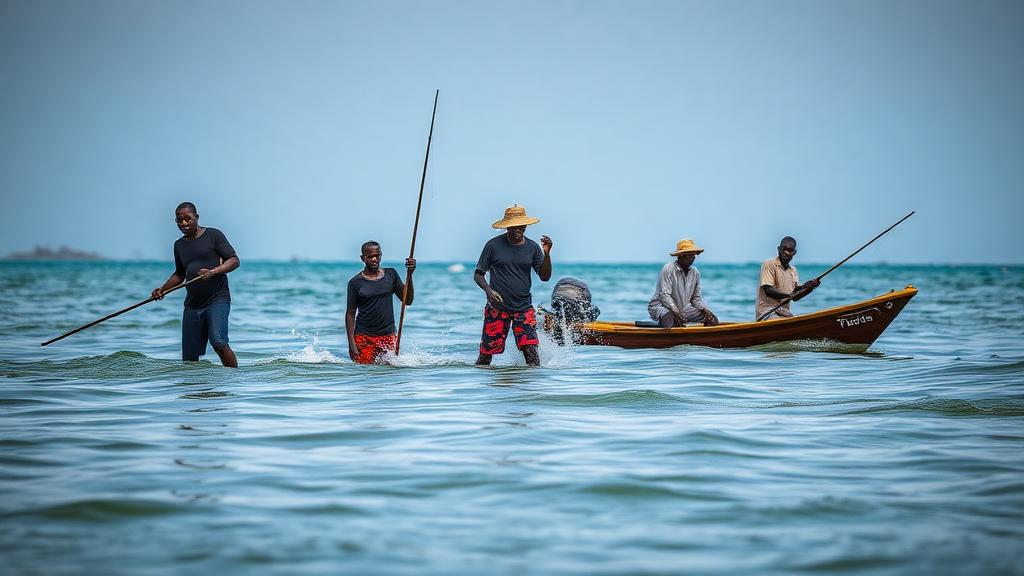
On the shores of Pemba Bay in northern Mozambique, fishermen are reading the ocean with remarkable accuracy. They report hotter sun, weaker rains, rising seas and more violent cyclones, and their observations track closely with what climate models project for the western Indian Ocean. Yet when asked why the climate is changing, most of them do not point to smokestacks or deforestation. They point to ancestral spirits and divine will. A new study of artisanal fishers in Pemba district reveals a striking paradox: communities with deep empirical knowledge of environmental change but almost no connection to the scientific explanation for it, a gap that researchers say could undermine adaptation in one of Africa’s most climate-vulnerable coastlines.
The research, published in the journal Discover Oceans, surveyed 113 randomly selected artisanal fishermen at three landing centers, Ruela, Chibuabuare and Chuiba, between September and November 2024. The team, led by Heráclito Comia of Lúrio University, used semi-structured questionnaires administered face to face in Portuguese and the local language Emakua, a necessity in a population where more than half of respondents had no formal schooling. The sample was drawn from 146 registered fishermen using systematic sampling with a random starting point, and the data were analyzed with descriptive statistics and chi-square tests. The survey deliberately anchored questions to the previous five years, a window that cognitive psychology research suggests minimizes recall bias while capturing meaningful trends, and one that includes the traumatic memory of Cyclones Idai and Kenneth in 2019.
The numbers tell a story of partial awareness. Just under 62 percent of respondents said they had heard of climate change, a figure well below the near-universal awareness reported among fishers in Ghana and Nigeria. But awareness of the label tells only part of the story. When asked about specific environmental changes, the fishermen’s empirical observations were strikingly sharp: 91 percent perceived rising temperatures, 82 percent noted declining rainfall, 86 percent perceived rising sea levels, and a remarkable 98 percent reported more frequent cyclones. One 52-year-old fisherman from Ruela described the shift in visceral terms, saying the sun is much hotter now than when he started fishing, and that by ten in the morning the heat burns their skin where once they could stay out until midday.
Attribution is where the scientific and traditional worlds diverge most sharply. Nearly three quarters of respondents, 72.6 percent, attributed the changes to supernatural or divine forces rather than human activity, and only 27.4 percent acknowledged potential human contributions. One 65-year-old fisherman from Chuiba explained that the changes in the sea and the winds are controlled by the spirits of the ancestors, and that when ceremonies are not performed correctly or the sea is angered, the weather turns against the community. The researchers argue this attribution pattern matters enormously for policy, because belief in human agency is often a precondition for proactive adaptation. If the weather is a moral response to human behavior, the logic of emissions reduction or coastal planning simply does not compute.
The statistical analysis added nuance to the picture. Education level was strongly associated with climate change awareness, with those holding primary education or higher significantly more likely to recognize the term than those with no formal schooling, a moderate effect size confirmed by chi-square testing. Years of fishing experience, meanwhile, predicted the adoption of adaptation strategies: fishers with more than two decades on the water were far more likely to deploy multiple responses, suggesting that accumulated local ecological knowledge is itself a form of adaptive capacity. Intriguingly, perception of warming did not vary by age group, indicating that the experience of a hotter coast is shared across generations, and awareness did not differ significantly between landing centers.
What the fishermen are actually doing in response to change is arguably the most encouraging part of the study. The most common strategy, adopted by 36 percent, was abandoning mosquito nets, a cheap but destructive fishing method, in favor of proper drift nets, a shift the fishers describe as both a reaction to declining catches and a conscious conservation choice. One 38-year-old from Chibuabuare explained that mosquito nets were cheap but the fish were disappearing, and that drift nets cost more but catch bigger fish while the small ones can grow. A quarter of respondents reported avoiding juvenile fish, and a fifth said they deliberately avoided expanding their fishing zones. One elder put the logic plainly: if you catch the babies today, there will be no food for the children tomorrow.
But the study also exposes the hard ceiling that poverty places on adaptation. Poverty was named as the primary barrier by 41.6 percent of respondents, followed by lack of access to financial resources at 20.4 percent. The dilemma is captured by a 29-year-old fisherman from Chuiba who said he knows he should buy a motor to reach deeper, cooler water, but struggles just to buy food for his family and cannot imagine saving for an engine. Other constraints included restricted access to fishing grounds during conservation closures, lack of appropriate gear, limited access to government services, and competition from foreign fishing vessels. In the IPCC’s vulnerability framework of exposure, sensitivity and adaptive capacity, the fishers of Pemba score high on the first two and dismally on the third.
The information landscape shaping these perceptions is equally revealing. Radio was the dominant source of climate information, cited by 41.6 percent of respondents, followed by fisher-to-fisher communication at 28.3 percent. Formal channels, NGOs, researchers and extension services, barely registered, each mentioned by fewer than one percent of respondents. That near-total absence of institutional contact represents a critical failure of the science-society interface, the authors argue, and simultaneously points to a solution: radio broadcasts in Emakua and Portuguese, paired with peer-to-peer education networks, could carry scientific climate information into communities through channels they already trust. The researchers also propose engaging fishers as citizen scientists to record environmental changes, co-producing knowledge that is both scientifically valid and locally credible.
The wider stakes are considerable. Mozambique’s coastal and marine environment supports roughly two million people who depend directly on fisheries, and the artisanal sub-sector accounts for about 80 percent of total marine catches. Climate projections suggest temperatures in the country could rise by 1.5 to 2.5 degrees Celsius by 2100, and the 2019 cyclone season, which killed more than 600 people and displaced millions, offered a brutal preview of what intensifying extremes mean for coastal communities. The Pemba study’s recommendations therefore extend beyond climate communication to structural change: alternative livelihood programs such as sustainable aquaculture and ecotourism, subsidies for sustainable fishing gear, microfinance access, SMS and radio early-warning systems, community climate information centers at landing sites, and social protection measures such as cash transfers during closed seasons or weather-indexed insurance.
What emerges from Pemba is a lesson that resonates far beyond northern Mozambique. Local communities living on the front lines of climate change often perceive its fingerprints with precision, sometimes more vividly than distant institutions, but perception alone does not produce effective adaptation when explanations are supernatural, information is informal and money is scarce. The researchers call for longitudinal studies tracking how perceptions evolve, comparative work across Mozambique’s coastlines, and gender-disaggregated analyses, since women dominate fish processing and marketing yet were largely absent from this survey of registered fishers. Until the structural constraints of poverty and the cultural framing of climate causation are addressed together, the fishermen of Pemba will keep reading the sea accurately, and keep waiting for the spirits to calm it.
Subject of Research: Climate change perceptions and adaptation among artisanal fishing communities in northern Mozambique
Article Title: Artisan fishers’ perception of climate change: a case study of Pemba district, Northern Mozambique
Article References: Comia, H., Achia, S., & Machaieie, S. (2026). Artisan fishers’ perception of climate change: a case study of Pemba district, Northern Mozambique. Discover Oceans, 3(1), Article 9. https://doi.org/10.1007/s44289-026-00123-7
Image Credits: AI Generated
DOI: 10.1007/s44289-026-00123-7
Keywords: climate change perception, artisanal fisheries, Mozambique, Pemba, adaptation strategies, coastal communities, local ecological knowledge, climate communication, vulnerability, Indian Ocean cyclones, fisheries conservation, adaptive capacity
Cite Scienmag News
Violet Maxwell. (October 5, 2026). Fishers in Mozambique Feel the Climate Changing but Blame the Spirits. Scienmag. https://scienmag.com/fishers-in-mozambique-feel-the-climate-changing-but-blame-the-spirits/
Violet Maxwell. "Fishers in Mozambique Feel the Climate Changing but Blame the Spirits." Scienmag, 5 October 2026, https://scienmag.com/fishers-in-mozambique-feel-the-climate-changing-but-blame-the-spirits/. Accessed 5 October 2026.
Violet Maxwell. "Fishers in Mozambique Feel the Climate Changing but Blame the Spirits." Scienmag. October 5, 2026. https://scienmag.com/fishers-in-mozambique-feel-the-climate-changing-but-blame-the-spirits/


