


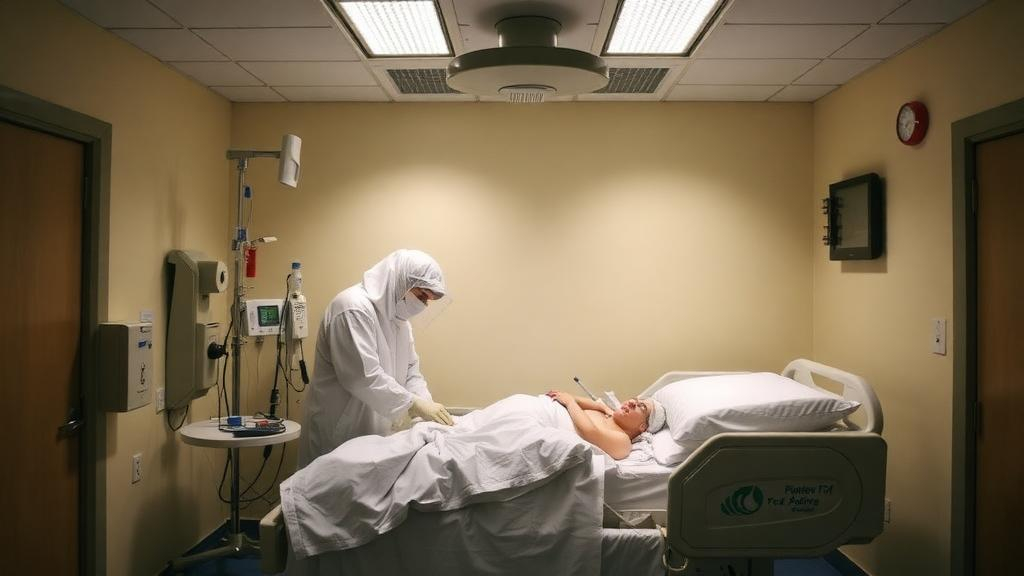
Sepsis, the body’s catastrophic immune response to infection, continues to claim at least 350,000 American lives every year, and a sweeping new set of clinical guidelines developed under the leadership of a University of Virginia Health System physician now aims to close the persistent gaps in how hospitals across the country recognize, treat and prevent the condition. The guidelines, assembled by Taison Bell, MD, MBA, interim chair of UVA Health’s Department of Medicine, and a coalition of leading national experts, were created on behalf of the Infectious Diseases Society of America together with seven other professional societies. Their central ambition is deceptively simple but clinically profound: to make high-quality sepsis care consistent, reliable and reproducible in every hospital, rather than dependent on where a patient happens to be admitted.
The clinical problem the guidelines confront is one of the most formidable in modern medicine. Sepsis arises when the immune system’s response to an infection spirals out of control, triggering a cascade of inflammation, blood-clotting abnormalities and impaired circulation that can culminate in organ failure and death. Despite decades of campaigns to improve early recognition and treatment, sepsis remains a leading cause of serious illness and mortality worldwide, and outcomes still vary dramatically between institutions. Part of the difficulty lies in the syndrome’s heterogeneity: sepsis can be triggered by bacterial, viral or fungal infections, can present with wildly different symptoms depending on the patient and the pathogen, and can progress from seemingly mild illness to life-threatening shock within hours.
Bell, who is part of the Divisions of Pulmonary and Critical Care Medicine and Infectious Diseases and International Health at the UVA School of Medicine, emphasized that the guidelines are designed to strengthen the underlying systems of care rather than to focus narrowly on any single drug or device. What excites him most about the work, he said, is its focus on making high-quality sepsis care more consistent and reliable. By strengthening the systems behind diagnosis, treatment, prevention and quality improvement, he noted, the medical community has an opportunity to make a real difference for patients while continuing to evaluate the technologies that could shape the future of sepsis care.
The scope of the new recommendations is unusually broad. Rather than addressing only the acute resuscitation of a patient in septic shock, the document spans the entire arc of sepsis-related care: diagnostic testing and pathogen detection, antimicrobial management, infection prevention and surveillance, performance measurement, and the hospital infrastructure and organizational support needed to sustain all of these activities. This systems-level perspective reflects a growing recognition in critical care medicine that sepsis outcomes are determined less by any individual clinical decision than by the reliability of the workflows that surround those decisions, from the moment a blood culture is drawn to the moment an antibiotic is infused.
Among the most concrete recommendations is the implementation of rapid molecular testing of positive blood cultures. Traditional culture-based identification of bloodstream pathogens can take a day or more of additional laboratory work after a culture flags positive, during which clinicians may be forced to prescribe broad-spectrum antimicrobials that are often unnecessary, expensive and conducive to resistance. Rapid molecular diagnostics can shorten that interval dramatically, allowing microbiology laboratories to identify the offending organism and its key resistance markers within hours. Earlier organism identification enables earlier de-escalation to targeted therapy, which improves individual patient outcomes and helps steward scarce antimicrobial resources at the institutional level.
Equally urgent is the guideline’s call to ensure immediate antibiotic therapy for patients suffering septic shock, the most life-threatening form of the syndrome, in which infection-driven circulatory failure causes dangerously low blood pressure and inadequate perfusion of vital organs. The biological rationale is straightforward: every hour of delayed effective antimicrobial therapy in septic shock is associated with measurably worse survival, because the proliferating pathogen continues to drive the inflammatory cascade while the host’s defenses are compromised. The recommendation reinforces a principle that sepsis bundles have long promoted but that hospitals have not always reliably executed, particularly during nights, weekends and periods of diagnostic uncertainty when the signs of shock can be mistaken for other conditions.
The guidelines also embrace electronic sepsis surveillance as a standard hospital capability. Sepsis often announces itself through subtle patterns in a patient’s vital signs, laboratory values and nursing observations long before a clinician formally suspects the diagnosis. Electronic surveillance systems continuously mine the electronic health record for these composite signals, flagging deteriorating patients to rapid-response teams and bedside clinicians. Deploying such systems at scale is not trivial, since poorly tuned algorithms can generate alert fatigue, but the guideline authors position surveillance as an essential organizational safeguard against the missed early cases that contribute most heavily to sepsis mortality.
In a notably practical and low-technology recommendation, the document calls for standardizing daily toothbrushing for hospitalized patients to reduce hospital-acquired pneumonia. The connection between oral hygiene and lower respiratory infection is well established in the hospital epidemiology literature: the mouths of critically ill patients can become reservoirs of pathogenic bacteria that are microaspirated into the lungs, particularly in patients on ventilators. A consistent toothbrushing protocol is among the simplest, cheapest and most broadly applicable interventions available, and its inclusion in national sepsis guidelines underscores the document’s philosophy that preventing infection is as much a part of sepsis care as treating it.
Looking forward, the guidelines highlight emerging technologies with the potential to reshape sepsis care, including next-generation diagnostics and artificial intelligence-enhanced clinical decision support. Machine-learning models trained on electronic health record data promise to identify septic patients earlier and to predict which patients are most likely to deteriorate, while advanced diagnostic platforms may eventually characterize infections with a speed and precision that current methods cannot match. The authors are careful, however, to temper enthusiasm with caution: these technologies will need further validation before they are widely deployed in hospitals. The history of clinical prediction tools is littered with algorithms that performed impressively in retrospective studies but failed to improve outcomes, or introduced bias, when implemented in real-world settings, and the guideline authors make clear that rigorous prospective evaluation must precede broad adoption.
The collaborative breadth of the effort is itself a signal of its intent. The guidelines were developed by representatives from the Infectious Diseases Society of America, the American College of Emergency Physicians, the American Society for Microbiology, the American Thoracic Society, the Pediatric Infectious Diseases Society, the Society of Critical Care Medicine, the Society for Healthcare Epidemiology of America, the Society of Hospital Medicine, the Society of Infectious Diseases Pharmacists and Sepsis Alliance. That roster spans emergency medicine, microbiology, critical care, pediatrics, hospital medicine, pharmacy, infection prevention and patient advocacy, reflecting the reality that sepsis care is a relay involving every part of the hospital, from the emergency department triage nurse to the antimicrobial stewardship pharmacist to the survivors and families who advocate for greater awareness.
The guidelines have been published as a position paper in the journal Clinical Infectious Diseases, giving hospitals a single authoritative reference point for aligning their sepsis protocols. For institutions, the practical challenge now is implementation: translating recommendations on rapid diagnostics, immediate antibiotics, electronic surveillance and standardized prevention practices into workflows that function reliably at three in the morning on a holiday weekend. For patients, the stakes could hardly be higher. If the systems-level approach championed by Bell and his colleagues succeeds in making excellent sepsis care the default rather than the exception, the annual toll of a condition that kills more Americans than many better-known diseases could begin, at last, to decline. The effort also aligns with broader institutional ambitions at the University of Virginia, where the newly launched Paul and Diane Manning Institute of Biotechnology has been created to accelerate the development of new drugs and treatments for the most complex and challenging diseases, a mission that places improved sepsis care squarely among its priorities.
Subject of Research: New clinical guidelines for the diagnosis, treatment and prevention of sepsis
Article Title: New sepsis guidelines seek to reduce infection’s deadly toll
Article References: New sepsis guidelines seek to reduce infection’s deadly toll. (n.d.). Original publication
Image Credits: AI Generated
DOI: Not provided
Keywords: sepsis, clinical guidelines, Infectious Diseases Society of America, septic shock, rapid molecular diagnostics, antimicrobial stewardship, electronic surveillance, hospital-acquired pneumonia, artificial intelligence, critical care, UVA Health, infection prevention
Cite Scienmag News
Kristina Jarvis. (October 5, 2026). New national sepsis guidelines aim to standardize hospital care and curb a killer of 350,000 Americans each year. Scienmag. https://scienmag.com/new-national-sepsis-guidelines-aim-to-standardize-hospital-care-and-curb-a-killer-of-350000-americans-each-year/
Kristina Jarvis. "New national sepsis guidelines aim to standardize hospital care and curb a killer of 350,000 Americans each year." Scienmag, 5 October 2026, https://scienmag.com/new-national-sepsis-guidelines-aim-to-standardize-hospital-care-and-curb-a-killer-of-350000-americans-each-year/. Accessed 5 October 2026.
Kristina Jarvis. "New national sepsis guidelines aim to standardize hospital care and curb a killer of 350,000 Americans each year." Scienmag. October 5, 2026. https://scienmag.com/new-national-sepsis-guidelines-aim-to-standardize-hospital-care-and-curb-a-killer-of-350000-americans-each-year/


