


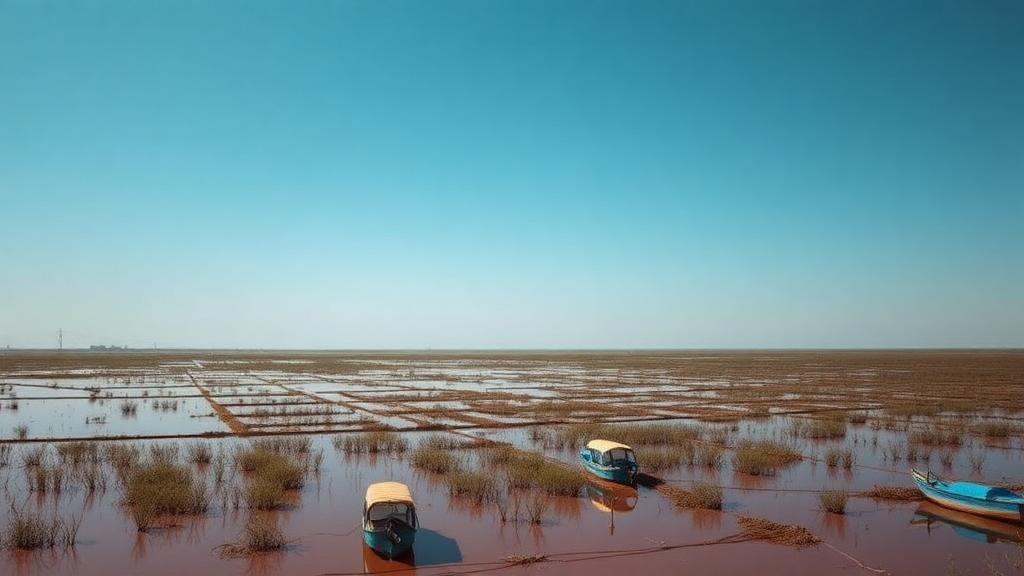
On the southern shore of the Caspian Sea lies one of the region’s most ecologically precious assets: the Anzali Wetland, a sprawling mosaic of reed beds, lagoons, and shallow open water that shelters migratory birds, filters sediments, and sustains fishing communities in Iran’s Gilan province. For decades, scientists have watched this wetland expand and contract, and most explanations have focused on local pressures such as land-use change, upstream water diversion, and pollution. A new study published in Theoretical and Applied Climatology argues that a crucial piece of the puzzle lies thousands of kilometers away, in the great oscillating engines of the global climate system.
The research, led by Ali Haji Elyasi together with Mohsen Nasseri and Peyman Badiei of the School of Civil Engineering at the University of Tehran, set out to quantify how two large-scale teleconnections, the El Niño–Southern Oscillation (ENSO) and the North Sea–Caspian Pattern (NCP), shape the hydrological behavior of the Anzali Wetland over the period 2000 to 2024. Teleconnections are recurring patterns of atmospheric pressure and circulation that link weather in one part of the world to conditions in another. While their influence on regional temperature and rainfall is well documented, their connection to the dynamics of individual wetland ecosystems has remained largely unquantified, a gap the authors describe as a missing link.
To close that gap, the team assembled a suite of hydroclimatic variables, including precipitation, drought indices, minimum and maximum temperature, Caspian Sea level, and the surface area of the wetland itself, which they derived from satellite observations. All variables were standardized on a bi-monthly time scale, allowing the researchers to compare signals that are normally expressed in very different units. Before any correlation was computed, the series underwent rigorous quality control and pre-whitening using ARIMA and seasonal ARIMA models, a statistical step that strips out autocorrelation and seasonal structure so that apparent relationships between climate indices and wetland behavior cannot arise as artifacts of shared trends or persistence.
With the cleaned series in hand, the researchers deployed three complementary analytical tools. Cross-correlation functions measured the strength of the relationship between each teleconnection index and each hydroclimatic variable at different time lags. Wavelet coherence analysis, a technique borrowed from signal processing, revealed how strongly two time series are synchronized across different frequencies and how that synchronization evolves through time. Finally, structural equation modeling (SEM) allowed the team to test whether the teleconnections act on the wetland directly or through intermediate climatic pathways, effectively disentangling cause-like chains of influence that simpler correlation analysis cannot resolve.
The results reveal two strikingly different styles of influence. The ENSO index showed lagged relationships of roughly six months with precipitation, drought, and wetland extent, meaning that a shift in the tropical Pacific today echoes in the Caspian lowlands half a year later. This delay is physically plausible: ENSO anomalies propagate through the atmosphere and ocean over months, and their downstream effects on Middle Eastern circulation build gradually. The North Sea–Caspian Pattern, by contrast, acted almost immediately, with relationships appearing at lags of zero to two months and often in synchrony with the hydroclimatic variables themselves. NCP phases also aligned strongly with wetland area on sub-annual to annual scales, whereas ENSO’s fingerprint was episodic and event-driven, surfacing mainly during major El Niño and La Niña episodes.
Perhaps the most consequential finding came from the structural equation models. Both teleconnections were linked to the wetland primarily through indirect climatic mediation, with indirect pathways accounting for more than 72 percent of the NCP effect and more than 61 percent of the ENSO effect. In other words, these oscillations do not act on the wetland like a tap; instead, they reshape the regional climate, altering rainfall, drought severity, and temperature, and the wetland responds to those reshaped conditions. The models also found no significant synergistic interaction between the two patterns, indicating that ENSO and NCP operate as distinct yet complementary components of the atmospheric machinery governing the region.
The historical record makes the stakes vivid. Positive NCP phases coincided with wetland expansion during the decade from 2000 to 2009, while a 30 percent reduction in wetland area between 2020 and 2024 unfolded in step with persistently negative NCP conditions. That temporal alignment does not prove the atmosphere alone caused the shrinkage, and the authors are careful to frame teleconnections as contributing factors rather than sole drivers. Still, the correspondence suggests that a substantial portion of the wetland’s recent decline may reflect a climatic backdrop that local management cannot control, even as local stressors such as land conversion and sediment loading continue to erode the ecosystem’s resilience.
Methodologically, the study is notable for the care taken to avoid the classic pitfalls of lag-based climate analysis. Spurious cross-correlations are a well-known hazard when two autocorrelated series share a trend, and the pre-whitening procedure directly addresses this. The wavelet approach adds a second layer of protection by showing where in the time-frequency domain coherence genuinely exists, distinguishing persistent phase-aligned coupling from coincidental overlap. The SEM framework, increasingly popular in ecology and hydrology, then converts these pairwise associations into a network of direct and indirect pathways, quantified with standard goodness-of-fit measures. Together, the three methods triangulate a conclusion that any single technique alone could not support with confidence.
The study also claims a first: the earliest quantitative evidence of a linkage between the North Sea–Caspian Pattern and wetland dynamics. The NCP, identified in the early 2000s as an upper-level atmospheric pattern affecting the eastern Mediterranean and the Caspian region, has been linked to winter temperatures in Iran and to drought and vegetation responses across western Eurasia, but its role in wetland hydrology had not previously been pinned down. By demonstrating that NCP exerts a fast, phase-aligned influence on the Anzali system, the researchers effectively add a new, regionally tuned predictor to the toolkit available for wetland monitoring in the Caspian basin.
The practical implications extend well beyond one Iranian wetland. If NCP conditions can foreshadow wetland expansion or contraction within weeks to months, and ENSO can foreshadow them half a year ahead, then managers gain something they have historically lacked: a leading indicator. Anticipating a drying phase could inform decisions about water allocation, dredging, and habitat protection before crisis points are reached, while a forecast of favorable phases could guide restoration timing. More broadly, the work signals a shift in how wetland science accounts for climate variability, treating these ecosystems not as isolated victims of local exploitation but as sensitive recorders of planetary-scale atmospheric rhythms. As climate change alters both the background hydrology and potentially the behavior of the teleconnections themselves, understanding these distant controls will become essential for anyone hoping to keep the world’s wetlands, and the communities that depend on them, above water.
Subject of Research: Teleconnection influences on the spatiotemporal hydrological dynamics of the Anzali Wetland
Article Title: Unraveling a missing link: What role do teleconnections play as contributing factors in spatiotemporal wetland dynamics?
Article References: Unraveling a missing link: What role do teleconnections play as contributing factors in spatiotemporal wetland dynamics?. (n.d.). https://doi.org/10.1007/s00704-026-06565-5
Image Credits: AI Generated
DOI: 10.1007/s00704-026-06565-5
Keywords: teleconnections, ENSO, North Sea–Caspian Pattern, Anzali Wetland, wetland dynamics, wavelet coherence, structural equation modeling, drought, Caspian Sea, hydroclimatology, remote sensing, Iran
Cite Scienmag News
Violet Maxwell. (October 5, 2026). Distant Climate Rhythms Found to Steer the Fate of Iran’s Anzali Wetland. Scienmag. https://scienmag.com/distant-climate-rhythms-found-to-steer-the-fate-of-irans-anzali-wetland/
Violet Maxwell. "Distant Climate Rhythms Found to Steer the Fate of Iran’s Anzali Wetland." Scienmag, 5 October 2026, https://scienmag.com/distant-climate-rhythms-found-to-steer-the-fate-of-irans-anzali-wetland/. Accessed 5 October 2026.
Violet Maxwell. "Distant Climate Rhythms Found to Steer the Fate of Iran’s Anzali Wetland." Scienmag. October 5, 2026. https://scienmag.com/distant-climate-rhythms-found-to-steer-the-fate-of-irans-anzali-wetland/


