


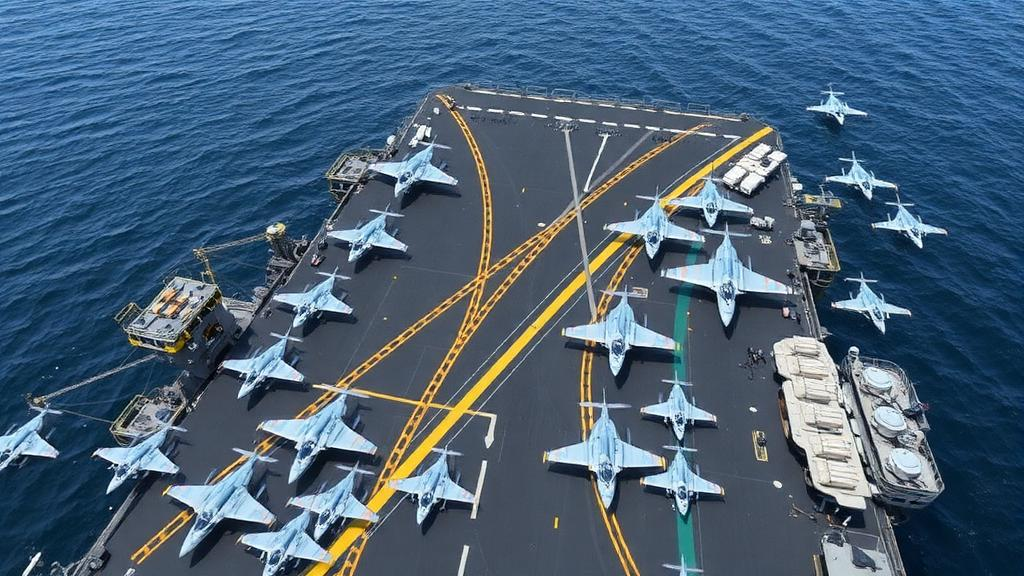
The flight deck of an aircraft carrier is one of the most unforgiving workspaces in engineering: a cramped, heaving slab of steel packed with multi-tonne aircraft, fuel lines, ordnance crews and jet blasts, where a single miscalculation during taxi operations can cascade into disaster. Moving several aircraft across such a deck simultaneously is a planning problem of extraordinary difficulty, and it has long resisted clean mathematical solutions. Now, researchers Wei Fu and Qidan Zhu of Harbin Engineering University in China have unveiled a new trajectory-planning algorithm, described in the International Journal of Aeronautical and Space Sciences, that blends two traditionally separate ways of thinking about motion into a single, more reliable framework. Their method, called Hybrid A*-Safe Interval Path Planning, or HA-SIPP, promises safer and more feasible coordinated taxiing for entire fleets of aircraft on congested carrier decks.
The core challenge the researchers set out to solve is twofold. First, aircraft are not free-floating points; they are large, elongated vehicles with real geometry, and they cannot slide sideways or pivot on the spot. Their motion is governed by what roboticists call nonholonomic kinematic constraints, meaning the direction a plane can travel at any instant is tied to the orientation of its nose. Second, when multiple aircraft move at once, their paths and schedules must not intersect in ways that produce collisions, either at the same moment or in sequence as one plane follows another through shared deck space. A planner that ignores either requirement produces trajectories that look elegant on paper but are physically impossible or outright dangerous.
Existing approaches tend to sacrifice one requirement for the other. Classical multi-agent path planning methods, which treat aircraft as abstract tokens moving on a grid or graph, can schedule many agents efficiently but produce paths a real aircraft could never follow, with sharp turns and instantaneous changes of direction. Conversely, kinodynamic planners that respect vehicle dynamics often struggle to coordinate many vehicles at once, because the search space explodes combinatorially as agents are added. The theoretical difficulty is well documented: optimal multi-robot path planning on graphs is computationally intractable in the general case, which has pushed the field toward clever approximations rather than exhaustive search.
HA-SIPP attacks the problem by fusing two established techniques, each compensating for the other’s blind spots. The first ingredient is Hybrid A*, a search algorithm beloved in autonomous driving because it searches over discretized states while propagating motion primitives that obey the vehicle’s actual turning behavior. This ensures every candidate trajectory is something a nosewheel-steering aircraft could genuinely execute. The second ingredient is Safe Interval Path Planning, or SIPP, a framework designed for planning through environments where obstacles appear and disappear over time. SIPP compresses time into safe intervals, windows during which a given region of space is guaranteed to be free of other agents, allowing a single planner to route one vehicle after another through a shared, dynamic map without re-planning everything from scratch.
Embedding Hybrid A* motion primitives inside the SIPP framework is the paper’s central move. The planner searches over a hybrid state space that captures both where an aircraft is and when it will be there, while the safe-interval structure keeps track of which portions of the deck are occupied by already-planned trajectories. When a potential conflict arises between a new trajectory and an existing one, the algorithm does not simply abandon the plan. Instead, it invokes a hybrid validation mechanism that operates on two levels: a fast, conservative screening step followed by a precise geometric certification.
That two-stage safety check is where the discrete-continuous philosophy becomes concrete. In the screening stage, the planner derives conservative collision time windows using the circumradii of the aircraft’s footprint envelopes, essentially circumscribing each aircraft within a circle whose radius guarantees containment of the vehicle’s full outline. If two such circumscribed circles cannot possibly overlap during a given time window, the planner can dismiss the conflict instantly and keep searching. Only when the cheap test flags a possible danger does the algorithm escalate to the second stage: an exact intersection check between the actual polygonal outlines of the two aircraft at the relevant moments. This layered design means the planner pays the computational cost of precise geometry only when it matters, while never certifying a trajectory as safe unless the true shapes have been verified against each other.
The collision model itself is also carefully engineered. Rather than inflating aircraft into oversized bounding circles, which wastes precious deck space and renders tight maneuvers infeasible, the researchers construct a polygon-based collision model that expands the aircraft’s actual geometric contour. The polygon preserves the elongated shape of a carrier aircraft, with its narrow nose and wider wingspan, so that clearance is assessed where the airframe really extends rather than where a crude envelope says it might. The authors note that this preserves shape characteristics while reducing unnecessary conservativeness, a seemingly modest refinement that translates directly into more feasible trajectories in the narrow corridors between deck edge, elevators, catapults and parked aircraft.
To evaluate the approach, the team ran experiments on representative flight-deck layouts with varying fleet sizes, all under fixed computational time budgets, a realistic constraint given that deck operations cannot wait indefinitely for a planner to finish thinking. The results showed that HA-SIPP improved both planning success rates and trajectory feasibility compared with traditional SIPP-based algorithms, and delivered more reliable multi-aircraft conflict avoidance. In practical terms, the hybrid planner was more often able to find complete, executable taxi plans for all aircraft within the allotted time, and the plans it produced were more likely to respect both the kinematic limits of the vehicles and the safety separations demanded by a crowded deck.
The significance of this work extends beyond the carrier deck. The same mathematical structure, kinematically constrained vehicles sharing a confined, time-varying space, describes automated airport ground movement, warehouse fleets of autonomous tugs, and any setting where large vehicles must be marshaled efficiently through tight quarters. The paper situates itself within a rich literature spanning multi-agent path finding with continuous time, prioritized planning for differential-drive robots, and cooperative dispatch frameworks for carrier aircraft, and its contribution is a pragmatic synthesis: keep the scheduling power of safe-interval reasoning, keep the physical realism of hybrid motion primitives, and bind them together with a collision-checking pipeline that is conservative where cheap and exact where necessary.
Challenges remain before such algorithms guide real steel on a real deck. The study is computational, demonstrated on representative layouts rather than at sea, and the authors state that the code is available from the corresponding author on reasonable request, inviting replication and refinement. Real deck operations involve human directors, traction vehicles, weather, and uncertainty in taxi times, factors that the deterministic planner does not fully capture. Yet the direction of travel is clear. As navies pursue autonomous dispatch and as ports and airports automate ground handling, planners like HA-SIPP, which refuse to trade physical feasibility for scheduling convenience, will define the safety envelope within which machines and aircraft share the world’s most congested pavements. The work was partially supported by the National Natural Science Foundation of China under Grant 52171299, and the authors report no conflict of interest.
Subject of Research: Multi-aircraft taxi trajectory planning on aircraft carrier flight decks using hybrid discrete-continuous path planning
Article Title: A Hybrid Discrete-Continuous Strategy for Multi-aircraft Trajectory Planning on Flight Deck
Article References: Fu, W., & Zhu, Q. (2026). A Hybrid Discrete-Continuous Strategy for Multi-aircraft Trajectory Planning on Flight Deck. International Journal of Aeronautical and Space Sciences. https://doi.org/10.1007/s42405-026-01243-2
Image Credits: AI Generated
DOI: 10.1007/s42405-026-01243-2
Keywords: aircraft carrier deck, multi-aircraft taxi planning, trajectory planning, Hybrid A*, Safe Interval Path Planning, collision avoidance, kinematic constraints, nonholonomic motion, multi-agent path finding, autonomous dispatch, motion planning, aerospace engineering
Cite Scienmag News
Grant Pearson. (October 5, 2026). Hybrid Algorithm Charts Collision-Free Paths for Crowded Aircraft Carrier Decks. Scienmag. https://scienmag.com/hybrid-algorithm-charts-collision-free-paths-for-crowded-aircraft-carrier-decks/
Grant Pearson. "Hybrid Algorithm Charts Collision-Free Paths for Crowded Aircraft Carrier Decks." Scienmag, 5 October 2026, https://scienmag.com/hybrid-algorithm-charts-collision-free-paths-for-crowded-aircraft-carrier-decks/. Accessed 5 October 2026.
Grant Pearson. "Hybrid Algorithm Charts Collision-Free Paths for Crowded Aircraft Carrier Decks." Scienmag. October 5, 2026. https://scienmag.com/hybrid-algorithm-charts-collision-free-paths-for-crowded-aircraft-carrier-decks/


