


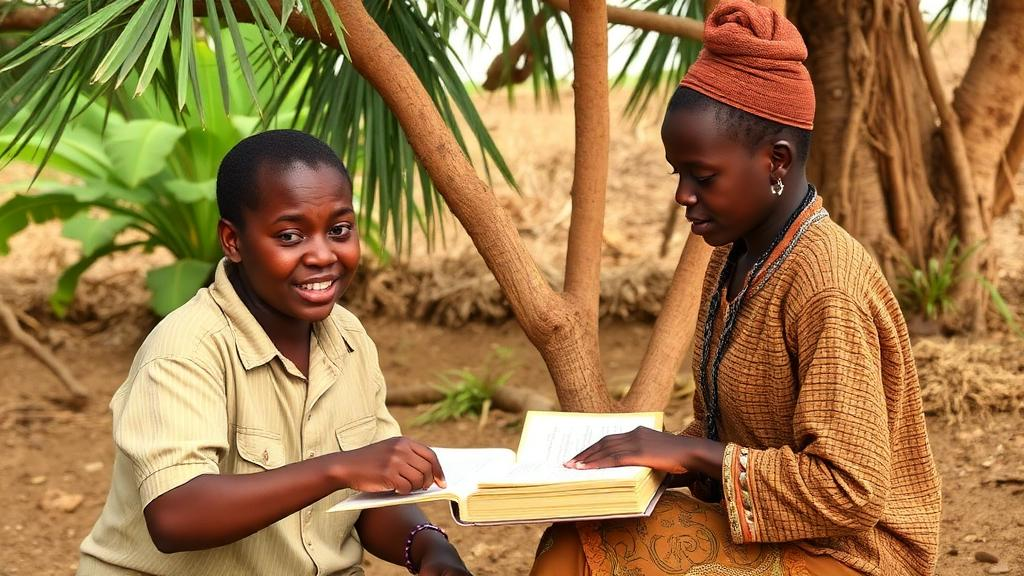
Across much of Africa, the classroom remains one of the last unexamined artifacts of empire. Curricula written in colonial languages, organized around European epistemologies and validated by external standards continue to shape what millions of students learn and, just as importantly, what they are taught to disregard. A new systematic review published in Discover Sustainability argues that this inheritance is not merely a cultural inconvenience but an active barrier to sustainability itself. The study, led by Naseer Shah of the University of Southampton together with Huma Akram and Abbas Hussein Abdelrady, examines how Indigenous Knowledge Systems, often abbreviated as IKS, could be woven into the fabric of formal education in Ghana, South Africa, Kenya, Tanzania, and a comparative North African sub-case spanning Morocco and Algeria. Its central claim is provocative: education systems that marginalize local knowledge traditions cannot reliably deliver the socially grounded learning that sustainable development demands.
The authors ground their analysis in three theoretical traditions that have gained considerable traction in decolonial scholarship. Decolonial thought interrogates the coloniality of knowledge, the idea that political independence did not dismantle the underlying hierarchies of what counts as legitimate expertise. Postcolonial theory examines how those hierarchies persist in institutions, languages, and credentialing systems long after formal rule ends. Ubuntu philosophy, rooted in southern African thought and often summarized as the principle that a person is a person through other persons, offers a relational ethic in which knowledge is communal, contextual, and bound to collective wellbeing rather than individual accumulation. Together, these frameworks provide the analytical lens through which the researchers read decades of literature on African education, asking not only what is taught but whose knowledge is authorized to appear in the curriculum at all.
Methodologically, the study is a systematic analysis of literature rather than a new empirical survey, a design choice that carries both strengths and constraints. By aggregating peer-reviewed findings across five national contexts, the authors can identify patterns that no single-country study could reveal, such as the recurring gap between policy rhetoric and classroom practice. The trade-off is that the review inherits the limitations of its source material: uneven documentation, variable definitions of what constitutes indigenous knowledge, and the persistent underreporting of oral traditions that resist easy codification. The authors are candid about this gap, noting that existing literature frequently celebrates the value of IKS in the abstract while failing to investigate its practical integration within the varied contexts across the continent. Their review is explicitly an attempt to move the conversation from principle to implementation.
What the analysis found is a consistent architecture of obstruction. Five barriers recur across the case countries with striking regularity. The first is the persistence of Eurocentric curricula, in which African history, science, and ecology appear, if at all, as footnotes to a European narrative. The second is language: instruction delivered in English, French, or Arabic often severs children from the languages in which their communities encode agricultural, medicinal, and ecological knowledge. The third is institutional resistance, as universities and ministries built on colonial templates treat indigenous epistemologies as folklore rather than scholarship. The fourth is inadequate policy support, with governments issuing symbolic endorsements of local knowledge without budget lines, teacher training, or assessment reform to back them. The fifth is the challenge of meeting global academic standards, a structural bind in which internationally benchmarked examinations and accreditation regimes penalize curricula that deviate from metropolitan norms.
Against this bleak backdrop, the case findings offer concrete evidence that integration can work. Ghana’s mother-tongue education initiatives, which deliver early literacy instruction in local languages rather than English, have yielded measurable improvements in reading outcomes while strengthening children’s connection to community knowledge. The mechanism is well understood in literacy research: phonological awareness and comprehension develop fastest in a language a child already speaks, so mother-tongue instruction is not a sentimental concession but a cognitive advantage. South Africa’s formal IKS policy frameworks, among the most developed on the continent, have created institutional channels through which indigenous knowledge can be documented, protected, and incorporated into research and teaching, with reported gains in cultural identity alongside academic outcomes. These are not peripheral experiments; they are national-scale demonstrations that decolonized curricula can be both culturally grounded and pedagogically effective.
The Kenyan and Tanzanian cases illustrate a different dynamic, one in which policy ambition collides with implementation reality. Both countries have experimented with incorporating local content and languages into schooling, yet the review documents how examination pressure, teacher shortages, and centralized curriculum control repeatedly pull practice back toward the colonial-era default. In the North African comparative sub-case of Morocco and Algeria, the picture is complicated by the region’s layered linguistic history, where Amazigh indigenous knowledge and language have had to negotiate space within education systems dominated by Arabic and French legacies. The comparison underscores a key analytical point of the study: there is no single African template for decolonizing education. The colonial encounter differed profoundly across the continent, and so must the pathways out of it.
From these findings the authors derive a three-part prescription. First, localized curriculum reform: national curricula should be redesigned so that indigenous ecological knowledge, oral histories, and local problem-solving traditions are treated as core content rather than enrichment material. Second, community-driven teacher training: because most teachers were themselves educated within colonial epistemologies, professional development must be co-designed with elders, knowledge holders, and local communities rather than imposed from ministry headquarters. Third, national legislation to institutionalize IKS, giving indigenous knowledge the same legal and structural protection that formal disciplines enjoy. The argument here is essentially institutional: without statutory anchoring, IKS integration remains hostage to political cycles and administrative discretion, vulnerable to reversal with each change of government.
The implications extend well beyond the five countries studied. Education for sustainable development has become a global policy orthodoxy, enshrined in United Nations frameworks and national strategies alike, yet the review suggests that sustainability education imported wholesale from external models risks reproducing the very epistemic dependencies it claims to overcome. Indigenous knowledge systems, by contrast, often encode precisely the relational, place-based understanding of ecosystems that sustainability science now champions, from rotational farming practices to community water governance. The study’s contribution is to show that recognizing this is not enough; the mechanisms of schooling, including language policy, teacher certification, assessment design, and legislative frameworks, must be restructured to carry that knowledge. Sustainability, in this reading, is as much an epistemological project as an environmental one.
For policymakers and development practitioners, the review functions as both a diagnosis and a roadmap. Its evidence base, drawn from published literature rather than new fieldwork, means that the reported outcomes, such as improved literacy in Ghana and strengthened cultural identity in South Africa, should be read as promising signals warranting rigorous longitudinal evaluation rather than settled proof. The authors themselves frame the findings as significant implications for those seeking to build culturally grounded and socially relevant education systems across post-colonial Africa, a formulation that invites further empirical testing. What the study establishes firmly is the shape of the problem: five interlocking barriers, documented across multiple national contexts, that will not dissolve through goodwill or symbolic policy alone.
The deeper stakes of the research are captured in its attention to post-colonial identity. Education does not merely transmit skills; it tells young people who they are and whose knowledge matters. When a Kenyan student learns ecology only through European case studies, or a Ghanaian child is punished for speaking her mother tongue at school, the curriculum performs a quiet erasure that no amount of technical training can offset. The review’s most consequential argument may be that sustainable education and epistemic justice are inseparable: a system that devalues the knowledge of the communities it serves will struggle to secure their trust, participation, or long-term engagement. Reimagining African education through decolonial pathways, the authors suggest, is therefore not a retreat from global standards but a demand that those standards make room for the intellectual traditions of the continent’s own people, and a demonstration, through cases from Accra to Cape Town, that when they do, learning improves.
Subject of Research: Integration of Indigenous Knowledge Systems into sustainable education reform in post-colonial Africa
Article Title: Reimagining sustainable education in Africa through decolonial pathways and indigenous knowledge systems
Article References: Shah, N., Akram, H., & Abdelrady, A. H. (2026). Reimagining sustainable education in Africa through decolonial pathways and indigenous knowledge systems. Discover Sustainability. https://doi.org/10.1007/s43621-026-04596-6
Image Credits: AI Generated
DOI: 10.1007/s43621-026-04596-6
Keywords: Indigenous Knowledge Systems, decolonisation, African education, sustainable education, education for sustainable development, postcolonial theory, Ubuntu philosophy, curriculum reform, mother-tongue education, Ghana, South Africa, language policy
Cite Scienmag News
Courtney Benton. (October 5, 2026). Indigenous Knowledge Could Rebuild Africa’s Sustainable Education Systems. Scienmag. https://scienmag.com/indigenous-knowledge-could-rebuild-africas-sustainable-education-systems/
Courtney Benton. "Indigenous Knowledge Could Rebuild Africa’s Sustainable Education Systems." Scienmag, 5 October 2026, https://scienmag.com/indigenous-knowledge-could-rebuild-africas-sustainable-education-systems/. Accessed 5 October 2026.
Courtney Benton. "Indigenous Knowledge Could Rebuild Africa’s Sustainable Education Systems." Scienmag. October 5, 2026. https://scienmag.com/indigenous-knowledge-could-rebuild-africas-sustainable-education-systems/


