


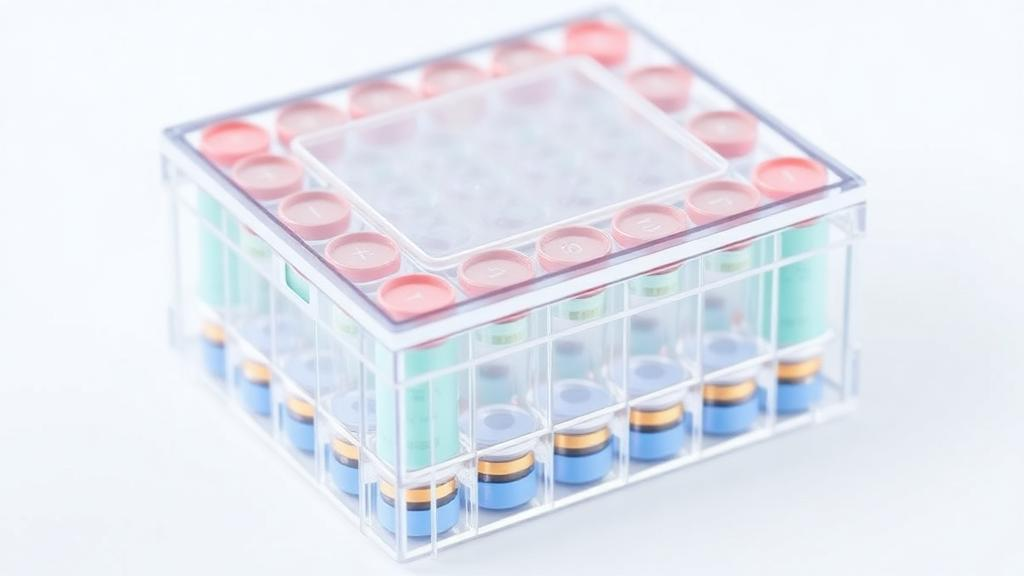
The medicines that dominate modern biopharma—monoclonal antibodies—begin their lives not in gleaming stainless-steel bioreactors but in plates no larger than a smartphone. Before any industrial process is designed, developers must sift through hundreds of candidate cell clones to find the rare few that will grow vigorously, stay healthy, and pump out therapeutic protein for weeks on end. The trouble is that this earliest, most consequential selection step has long been run under conditions that bear little resemblance to how the winning clones will actually be manufactured. A new study published in Current Research in Biotechnology tackles that mismatch head-on, and its findings could change how the industry chooses the cells behind its blockbuster drugs.
Researchers at University College London, working with scientists at AstraZeneca, report the successful miniaturisation of a semi-perfusion cell screening method from a 24-well microwell plate format down to a 96-well deepwell plate, and then combined it with a multi-parameter ranking tool known as the manufacturability index. The work, led by Marie Dorn with colleagues Christine Ferng, Kerensa Klottrup-Rees, Kenneth Lee and Martina Micheletti, addresses a growing tension in bioprocessing: while manufacturing has been steadily shifting from traditional fed-batch culture toward continuous perfusion, clone screening has remained stubbornly fed-batch, conducted at microlitre or millilitre scale long before perfusion conditions are ever introduced at the bench.
The rationale for closing this gap is grounded in physiology. In fed-batch culture, cells are fed once or a few times and accumulate waste products as nutrients are depleted, so the environment changes dramatically over the run. Perfusion culture, by contrast, continuously exchanges medium while retaining cells, keeping conditions far more stable and allowing much higher cell densities. Because the culture environment shapes cell growth and productivity, clones that look mediocre in fed-batch screening might excel under perfusion—and vice versa. Previous studies have shown that screening under production-representative conditions can alter clone rankings, meaning that conventional fed-batch screens risk discarding clones that would have been the best performers in the actual manufacturing process.
The team had previously validated a semi-perfusion screening method at the 24-well microwell plate scale, demonstrating that operation mode and perfusion rate significantly influence clone performance. But industrial screening pipelines overwhelmingly rely on the smaller 96-well deepwell plate format, which is supported by mature automation hardware, software and user expertise. Adapting semi-perfusion to that format was therefore the logical next step to make production-representative screening compatible with the high-throughput automated workflows that pharmaceutical companies already run. The challenge was that miniaturisation introduces new physical constraints: the team’s shaker platform was limited to a maximum agitation speed of 300 rpm with a 19-millimetre orbital diameter, below the 320 to 350 rpm and larger diameters typically reported for deepwell plate work.
To find workable conditions, the researchers first ran preliminary experiments with a CHO Cobra cell line, testing working volumes between 200 and 400 microlitres. Growth proved feasible at 200 and 300 microlitres, while higher volumes impaired culture performance—likely due to insufficient mixing and oxygen transfer at the limited agitation speed. Encouragingly, cell performance at the validated volumes was comparable to previously published 24-well plate data, giving the team confidence the smaller system could deliver trustworthy results. The final screening protocol used squared 96-well deepwell plates sealed with Duetz sandwich lids to minimise evaporation while preserving gas exchange, with a daily partial medium exchange of 0.75 reactor volumes per day mimicking perfusion with cell retention over a ten-day culture period.
With the platform established, the team screened eight clonally derived Chinese hamster ovary cell lines, all producing the same proprietary monoclonal antibody, at both 200 and 300 microlitre working volumes. Growth dynamics were highly comparable between the two volumes, though a trend toward better sustained growth emerged at 200 microlitres, with cultures at 300 microlitres showing earlier declines in viable cell concentration and viability—consistent with possible inhibitory effects or oxygen limitation at the higher volume. Maximum viable cell concentrations ranged widely, from roughly 5 to 35 million cells per millilitre, revealing substantial natural variation among clones. Space-time yield, a measure of how much product a given culture volume produces per day, peaked between 0.04 and 0.14 grams per litre per day, with a couple of clone-specific anomalies that the authors attribute to analytical variability in HPLC-based protein quantification at very low concentrations.
The heart of the study lies in how the clones were ranked. Traditional selection relies on a single metric—typically cell-specific productivity, the amount of antibody each cell produces per day. When the team ranked the eight clones by this single parameter, the results were sobering. Within the 96-well plate system, rankings were internally consistent across the two working volumes, with clone mAb1_C5 topping both lists and mAb1_C7 consistently last. But when those rankings were compared against the earlier 24-well plate data, only the very best and very worst clones held their positions. Mid-ranked clones shuffled dramatically: mAb1_C4 placed second in both 24-well runs but only fourth or fifth in the deepwell plates, while mAb1_C6 performed far better in the smaller format. In short, single-parameter rankings were robust within a platform but did not travel across scales.
Enter the manufacturability index. Originally developed by Goldrick and colleagues, this metric treats clone selection as a multi-criteria decision-making problem, folding growth, viability, productivity and other indicators into a single composite score in which each parameter is rated against the best and worst performer and weighted according to process priorities. Because the 96-well format’s tiny working volumes limited sampling, the index here used five parameters—maximum viable cell concentration, minimum viability, growth rate, space-time yield and average cell-specific productivity—compared with ten parameters, including five metabolite-related metrics, in the larger 24-well system. Even with the reduced parameter set, the multi-parameter rankings proved markedly more consistent. The same three clones occupied the top three positions at both working volumes, and cross-scale agreement with the 24-well data was stronger than for the single-parameter approach.
Statistical analysis reinforced the story. Spearman rank correlations showed that manufacturability index rankings at 200 microlitres agreed significantly with both 24-well plate runs, with correlation coefficients of 0.714 and 0.690, the latter just missing the conventional significance threshold. Single-parameter rankings, by contrast, reached significance against one 24-well run but not the other, exposing their vulnerability to run-to-run variability. The authors are appropriately cautious: with only eight clones, far fewer than the hundred-plus typical of industrial campaigns, the correlations indicate trends rather than definitive proof. Still, the internal coherence of the results, combined with the clear mechanistic advantage of evaluating clones on multiple fronts, lends weight to the conclusion that richer metrics make early screening more predictive.
The implications reach well beyond one plate format. As biopharmaceutical manufacturing continues its march toward intensified and continuous processes, the ability to screen clones under conditions that genuinely represent production—early, cheaply and at high throughput—becomes a strategic advantage, shortening development timelines and preventing costly late-stage surprises. The authors point toward integrating product quality attributes into the index and harnessing machine learning, multivariate data analysis and automation to push predictive power further. For an industry whose approvals have increased three- to four-fold since 2015, and in which monoclonal antibodies remain the leading class of new therapeutics, choosing the right cell clone on day one may prove one of the highest-leverage decisions in the entire manufacturing chain. This study suggests the industry now has a scalable, data-rich way to make that choice well.
Subject of Research: Miniaturised semi-perfusion screening and multi-parameter manufacturability ranking of CHO cell clones for perfusion biomanufacturing
Article Title: Improved clone selection by combining a manufacturability index with semi-perfusion scale-down screening systems
Article References: Dorn, M., Ferng, C., Klottrup-Rees, K., Lee, K., & Micheletti, M. (2026). Improved clone selection by combining a manufacturability index with semi-perfusion scale-down screening systems. Current Research in Biotechnology, Article 100423. https://doi.org/10.1016/j.crbiot.2026.100423
Image Credits: AI Generated
DOI: 10.1016/j.crbiot.2026.100423
Keywords: CHO cells, clone selection, semi-perfusion, perfusion bioprocessing, manufacturability index, deepwell plates, monoclonal antibodies, cell line development, scale-down models, space-time yield, bioprocess intensification, high-throughput screening
Cite Scienmag News
Drew Townsend. (October 4, 2026). Miniature Perfusion Screens and a Manufacturability Index Reshape How Biotech Picks Its Best Cell Clones. Scienmag. https://scienmag.com/miniature-perfusion-screens-and-a-manufacturability-index-reshape-how-biotech-picks-its-best-cell-clones/
Drew Townsend. "Miniature Perfusion Screens and a Manufacturability Index Reshape How Biotech Picks Its Best Cell Clones." Scienmag, 4 October 2026, https://scienmag.com/miniature-perfusion-screens-and-a-manufacturability-index-reshape-how-biotech-picks-its-best-cell-clones/. Accessed 4 October 2026.
Drew Townsend. "Miniature Perfusion Screens and a Manufacturability Index Reshape How Biotech Picks Its Best Cell Clones." Scienmag. October 4, 2026. https://scienmag.com/miniature-perfusion-screens-and-a-manufacturability-index-reshape-how-biotech-picks-its-best-cell-clones/


