


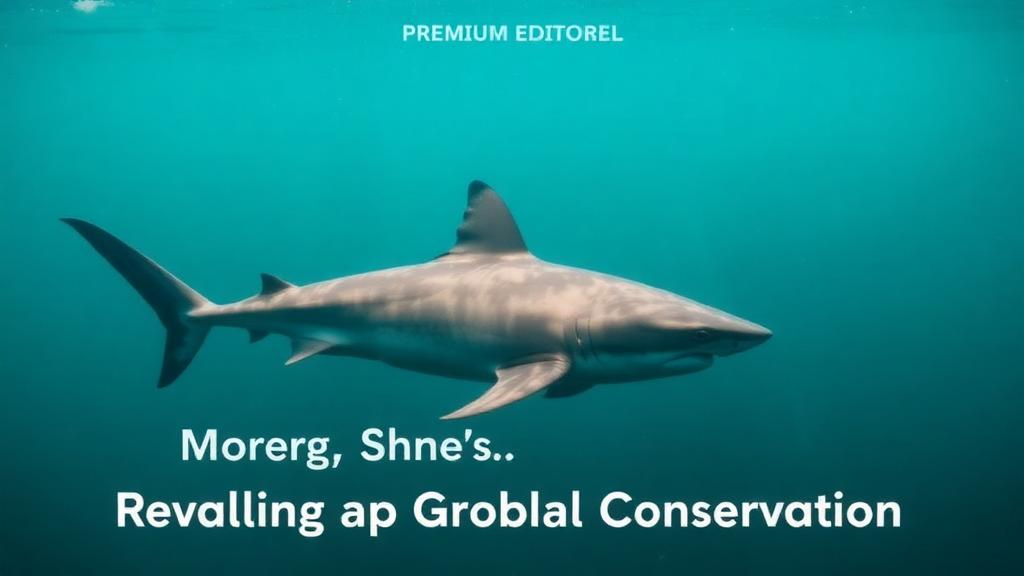
Some of the ocean’s most formidable travelers are slipping through the cracks of global conservation policy, and a new study from the University of Queensland has mapped exactly where the safety net fails. By synthesizing three decades of satellite tracking, acoustic monitoring and mark-recapture research, scientists have built the first cross-boundary migratory connectivity baseline for the sharks and rays of Australian waters. The findings, published in the journal Conservation Biology, reveal that several of these apex predators routinely traverse vast stretches of ocean, crossing into the territorial waters of neighboring nations and even venturing into the high seas, where no single country has jurisdiction over their fate.
The research team, led by PhD candidate Diego Bezerra from the university’s School of the Environment, began with a deceptively simple question: which of Australia’s migratory shark and ray species actually depend on waters beyond Australia’s control? To answer it, the researchers shortlisted 29 species that occur within Australian waters and are listed under the Convention on the Conservation of Migratory Species, an international treaty framework designed to protect animals that ignore political borders. They then developed network models, a statistical approach that treats individual movement records as connections between locations, allowing scientists to visualize how populations link distant marine regions into a single, interconnected migratory web.
The results were striking. Five species emerged as confirmed international travelers: whale sharks, blue sharks, shortfin mako sharks, school sharks and white sharks. Some individuals were recorded as far afield as South Africa, New Zealand, Indonesia and Micronesia, while others moved into offshore areas beyond national jurisdiction, the so-called high seas that cover nearly half the planet’s surface. For a white shark tagged off Australia to appear in New Zealand waters, or for a blue shark to span entire ocean basins, is not an anomaly but a routine feature of these animals’ life histories. Their survival, the study makes clear, depends on conditions in many places at once.
That dependence is precisely the problem. Bezerra notes that these long journeys expose sharks and rays to threats across multiple jurisdictions and political boundaries, each with its own laws, enforcement capacity and conservation priorities. A species may enjoy robust protection in one country’s waters only to face intense fishing pressure the moment it crosses an invisible maritime line. Sharks are threatened by overfishing and by being accidentally captured as bycatch when other species are targeted, and blue sharks and school sharks are particularly susceptible to bycatch because they overlap with commercial fisheries across enormous ranges. For a migratory animal, the weakest link in the chain of protection effectively sets the ceiling on its survival.
The study also exposed a more fundamental problem: ignorance. Of the 29 shark and ray species in Australian waters listed under the Convention on the Conservation of Migratory Species, 18 species, or 62 percent, had no published movement information at all. Only eight species had sufficient data to build network models, and just five could be confirmed as crossing international borders. In other words, for roughly two-thirds of the migratory sharks and rays that international treaties are meant to safeguard, scientists cannot say where these animals go, which routes they follow or which jurisdictions they depend on. As Associate Professor Daniel Dunn, a co-author of the study, puts it, you cannot manage migratory species by only looking at one part of their migration, and you cannot manage species or create policy when you have zero information.
Why is the data gap so severe for sharks when migratory birds, sea turtles and marine mammals are tracked in ever-greater numbers? The answer lies partly in the biology of the animals themselves. As Dunn explains, sharks do not breathe air and do not regularly come to the surface, which makes them much harder to tag and to detect. A satellite tag on a seabird transmits its position whenever the bird flies beneath orbiting receivers, and a surfacing whale or turtle offers regular opportunities for data collection. Most sharks, by contrast, spend their lives submerged, so researchers must rely on acoustic receivers placed on the seafloor, pop-up archival tags that must physically detach and float to the surface, or the labor-intensive recapture of marked individuals. Each method captures only a fraction of an animal’s true range, and coverage thins dramatically in deep water and remote ocean regions.
The consequences of this asymmetry ripple through international policy. The Convention on the Conservation of Migratory Species, often called the Bonn Convention, works by listing species across their range and encouraging member states to coordinate protection. But coordination requires evidence, and the new study shows that the evidence base for most migratory sharks and rays is simply too thin to support it. Network models of the kind built by the Queensland team offer a way forward, because they translate scattered tracking records into a quantitative picture of connectivity, identifying which populations link which countries and where conservation investment would deliver the greatest benefit. Yet with only eight of 29 species modeled, the picture remains a sketch rather than a map.
The policy implications are already visible in specific cases. Bezerra points to the whale shark, the world’s largest fish, as a cautionary example. Whale sharks are protected in Australian waters, but they migrate to Indonesia, where fishing could put them in danger. Understanding the different levels of protection between countries, he argues, is essential, because a sanctuary that ends at a maritime boundary offers little comfort to an animal that cannot read one. The same logic applies across the study’s other confirmed migrants: shortfin makos and blue sharks roam into international waters where regional fisheries management organizations, not national laws, govern fishing pressure, and school sharks move between hemispheres along routes that span multiple management regimes.
The researchers argue that wealthy nations with strong domestic protections have a responsibility that extends beyond their own exclusive economic zones. Australia, Bezerra notes, does a relatively good job of protection, but other nations do not always have the same capacity to implement strong measures. His prescription is practical: Australia should support neighboring nations through collaboration and by sharing technology and information. In practice, that could mean joint tagging programs, shared acoustic receiver networks, open data agreements and capacity building for fisheries monitoring in countries that host the same migratory populations but lack the resources to study them. Because the animals themselves are shared, the argument goes, so too should be the science and the tools.
The study lands at a moment when international ocean governance is undergoing its most significant expansion in decades. The recent agreement on biodiversity beyond national jurisdiction, negotiated under the United Nations, aims for the first time to allow the creation of protected areas on the high seas, precisely the offshore regions where the study’s confirmed migrants spend part of their lives. For such instruments to work for sharks and rays, however, they will need the kind of connectivity baseline this research begins to provide. The message from the Queensland team is ultimately one of both warning and opportunity: the ocean’s most endangered migratory predators are already telling scientists where they go, but for most species, the tracking data needed to protect them along the way has yet to be collected. Filling that gap, the researchers say, will require a much larger effort, coordinated across the many nations these remarkable animals call home.
Subject of Research: Migratory connectivity and cross-border conservation of Australian shark and ray species
Article Title: Sharks on the move expose the need for international conservation efforts
Article References: Sharks on the move expose the need for international conservation efforts. (n.d.). Original publication
Image Credits: AI Generated
DOI: Not provided
Keywords: sharks, rays, migration, conservation biology, satellite tracking, acoustic telemetry, bycatch, high seas, Convention on Migratory Species, Australia, marine policy, University of Queensland
Cite Scienmag News
Margaret Porter. (October 4, 2026). Migratory Sharks Cross Borders, Revealing Gaps in Global Conservation. Scienmag. https://scienmag.com/migratory-sharks-cross-borders-revealing-gaps-in-global-conservation/
Margaret Porter. "Migratory Sharks Cross Borders, Revealing Gaps in Global Conservation." Scienmag, 4 October 2026, https://scienmag.com/migratory-sharks-cross-borders-revealing-gaps-in-global-conservation/. Accessed 4 October 2026.
Margaret Porter. "Migratory Sharks Cross Borders, Revealing Gaps in Global Conservation." Scienmag. October 4, 2026. https://scienmag.com/migratory-sharks-cross-borders-revealing-gaps-in-global-conservation/


